VA Loan Assumption: Test the Equity Gap
Compare a VA loan assumption with new financing, including the cash or second loan needed for the equity gap, monthly payments, and five-year debt costs.

Estimated reading time: 7 minutes
A VA loan assumption comparison needs a plan for the price outside the existing mortgage. Follow the fictional equity-gap example to compare monthly payments, debt repayment and the cash committed to each option.
A low existing mortgage rate can still produce the higher monthly bill. In this fictional purchase, a 3% first loan plus a shorter 9% second loan costs about $288 more each month than one new 6.5% loan. It also pays debt down much faster. Check both results before deciding whether the rate is worth pursuing.
A VA assumption takes over the seller’s mortgage. Non-Veterans can qualify; the loan must be current and the buyer must meet VA credit and income standards. VA acknowledgement.
VA loan assumption: how much of the price still needs funding?
All prices, rates and terms here are invented, not available offers. The home costs $450,000 and the assumed loan balance is $300,000. That leaves $150,000 of the price outside the existing loan. With $30,000 of buyer cash allocated to the price, another $120,000 must come from somewhere.
VA permits junior borrowing for seller amounts and allowable closing costs, with no cash back. The holder must protect the VA loan’s first-lien position, document the secondary lender, amount and terms, and include its payment in underwriting. Circular 26-24-17.
Path A assumes assumption approval and an obtainable $120,000 junior offer. Path B assumes approval for the new loan. The junior offer is a hypothetical fully amortizing, ten-year loan. This chosen term isn’t a VA requirement. If no such financing is obtainable, the two-loan path is unavailable regardless of its calculated interest savings.
| Input | A: Assumption plus junior loan | B: New single loan |
|---|---|---|
| Buyer cash toward price | $30,000 | $30,000 |
| Starting total debt | $420,000 | $420,000 |
| First loan | $300,000 at 3%; 300 months remaining | $420,000 at 6.5%; 360 months |
| Junior loan | $120,000 at 9%; 120 months | None |
| First-loan monthly principal and interest | $1,422.63 | $2,654.69 |
| Junior monthly principal and interest | $1,520.11 | $0 |
| Combined monthly principal and interest, months 1–120 | $2,942.74 | $2,654.69 |
All rates are fixed annual nominal interest rates. Payments occur in equal monthly periods, starting one month after this comparison begins. No extra or late payments occur. Closing costs, assumption charges, any applicable funding fee, mortgage insurance, taxes, homeowners insurance, association charges and maintenance are excluded. The buyer would need separate cash for any costs due upfront. These exclusions aren’t a claim that a real transaction has no fees.
The payment falls at different dates
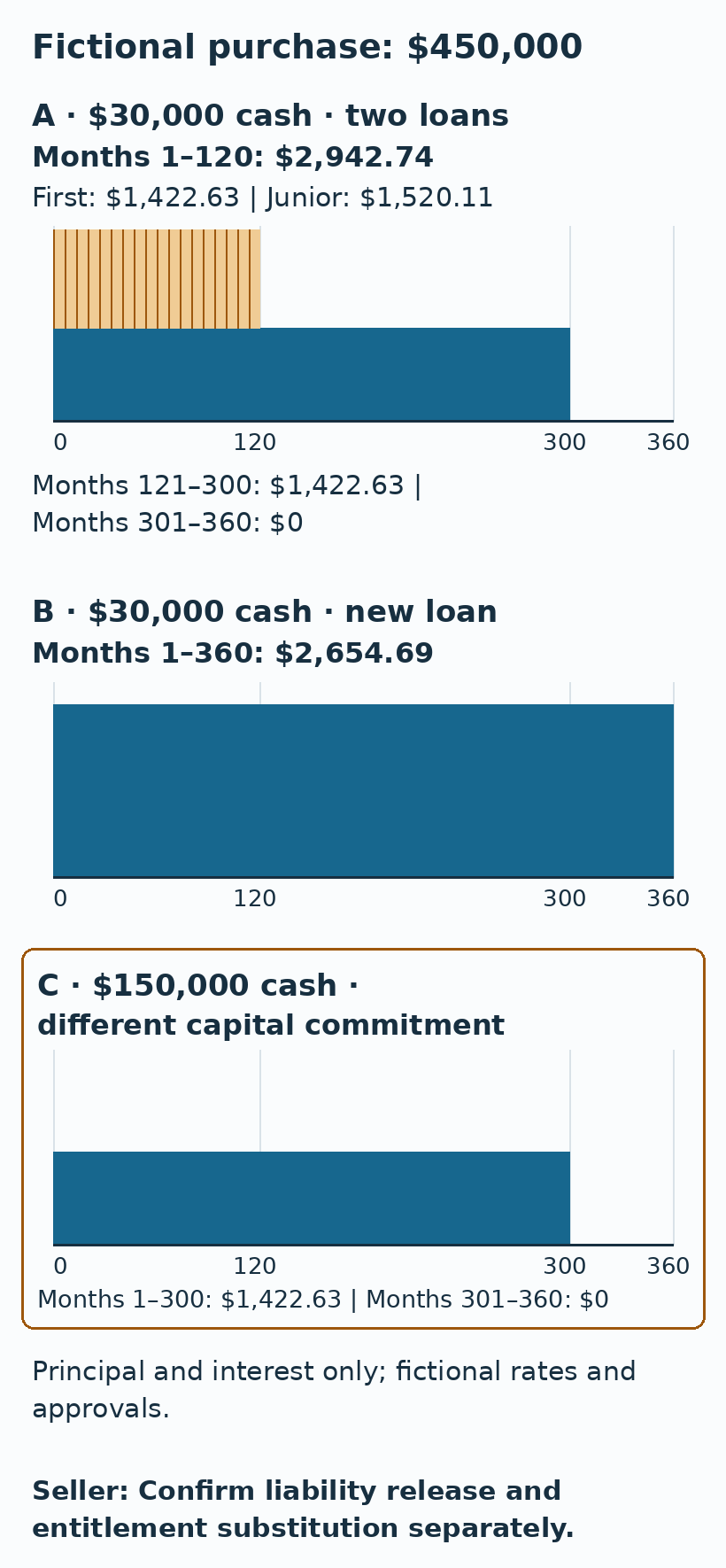
In A, both streams run through month 120. From month 121 through month 300, only the $1,422.63 first-loan installment remains. It then ends. B keeps its $2,654.69 installment through month 360. These different end dates explain why comparing just the first payment is incomplete.
The higher A payment also exposes a practical limit. A household with only $2,800 available for principal and interest could cover B with about $145 left, but would be about $143 short on A. Those hypothetical margins say nothing about qualification, and the household still needs a separate plan for the excluded ownership costs. Use the homebuying-budget guide when setting that broader limit.
VA loan assumption: distinguish five-year interest and repayment
| Result | A: Two loans | B: New loan |
|---|---|---|
| Installments paid | $176,564.59 | $159,281.14 |
| Interest included in installments | $86,309.81 | $132,447.25 |
| Remaining debt | $329,745.22 | $393,166.11 |
A requires about $17,283 more in installments during these five years, yet incurs about $46,137 less interest. Its remaining debt is about $63,421 lower. The last number combines extra cash paid with lower interest; it isn’t another saving to add on top of those two effects. Both began with the same $420,000 balance.
This compares financing cash flows, not investment returns or resale proceeds. It doesn’t put a value on retaining cash or account for tax deductions. A real offer’s fees, dates and terms may change the ranking. Use the actual first-loan installment and remaining schedule rather than treating its current balance as a new 30-year loan.
A cash-funded VA loan assumption gap is a different capital choice
Path C uses $150,000 of buyer cash to cover the entire gap and assumes only the $300,000 first loan. Its monthly principal and interest is $1,422.63; after 60 payments, remaining debt is $256,516.43 and interest paid is $41,874.46.
C requires $120,000 more upfront than A or B. It isn’t the same $30,000-cash comparison with a better monthly result. A buyer who has only $30,000 can’t select it. A buyer who has the extra money must consider how much liquidity remains for other needs; this illustration assigns no earnings or opportunity cost to that money.
VA loan assumption: test each loan component separately
Use the loan-payment calculator to reproduce the principal-and-interest components, one loan at a time. It doesn’t approve an assumption, arrange junior financing or calculate excluded closing costs. The rate input is the fixed contractual annual interest rate supplied in the example.
For A’s first loan, enter $300,000, 3% and 300 months remaining. Expected payment is $1,422.63. Use the remaining term from the example, not a new 360-month term. This component is also the only debt in the separately cash-funded Path C.
For A’s junior loan, enter $120,000, 9% and 120 months. Expected payment is $1,520.11. Adding the unrounded installments and then displaying cents gives the combined $2,942.74. The individual payment streams still have different final months.
For B, enter $420,000, 6.5% and 360 months. Expected payment is $2,654.69. Don’t retain the junior loan from the previous run in B’s comparison: B’s single mortgage already funds the modeled $420,000 borrowing.
Open the calculation table for each component and inspect payment 60. A’s first loan should have $256,516.43 principal remaining and its junior loan $73,228.79. Together they reproduce $329,745.22. B’s corresponding balance is $393,166.11.
The smaller A balance isn’t an additional cash receipt. It reflects both the larger installments and the different modeled interest. Keep cumulative payments and remaining debt beside each other rather than adding every favorable difference as an independent saving.
VA loan assumption: preserve the funding boundary when cash changes
Return to the $450,000 price and $300,000 assumed balance. The gap remains $150,000. If usable buyer cash toward the price were only $24,000 instead of $30,000, the unfunded amount would be $126,000. Keeping the original $120,000 junior loan would leave a $6,000 purchase-price gap.
This arithmetic doesn’t establish that a larger junior loan is obtainable or permissible under actual terms. A revised financing proposal needs its own amount, rate, term, payment and underwriting review. Don’t increase the modeled amount while continuing to present the original payment as if nothing changed.
Likewise, separate cash allocated to price from cash reserved for the excluded transaction and ownership costs. A household with $30,000 in the bank can’t automatically commit all of it to the price if part is already needed for other closing uses.
Keep Path C labeled as the $150,000-cash alternative. It doesn’t become available merely because its calculator result matches A’s first loan. The missing $120,000 is an upfront funding difference between the original paths, not a fee recovered through lower payments.
For a real review, attach the first loan’s actual remaining schedule and the proposed junior-loan documents to the same sources-and-uses worksheet. Confirm both cash availability and the required payment before comparing totals.
Keep the seller’s release and entitlement questions in their own record too. A calculator match can’t confirm either one, and neither should be inferred solely from the buyer’s rate or payment preference.
The seller has a separate entitlement decision
Confirm release of liability separately from substitution of entitlement (SOE). Without SOE, entitlement stays tied to the loan. SOE needs an eligible Veteran, sufficient entitlement and qualifying occupancy. Ask the holder or VA about remaining entitlement. VA acknowledgement.
Also ask about the junior loan’s later assumability and grace periods. A non-assumable second loan can constrain a later assumption sale; VA requires reasonable grace periods before late charges and foreclosure proceedings. Circular safeguards.
The useful decision is whether the whole funding plan is obtainable, affordable and acceptable to both sides. A favorable first-loan rate answers only part of that question. This U.S. educational example was checked October 19, 2026; it isn’t a loan offer, payoff quote or individualized legal or financial advice.
Review the separate VA entitlement questions and the cash checks in the VA down-payment example alongside the payment comparison.

One Mortgage Form, Two Borrowers
Match each person’s share.