How to Decide If a Small Digital Loan Solves the Problem or Delays It
Few people make financial decisions in a tranquil moment. Most people usually take out a little digital loan since something has already gone wrong unexpectedly. A car needs fixing a week before payday. A client pays a freelancer late. An emergency medical bill arrives along with an energy bill. In such cases, the chance to get rich quick may not be a choice so much as a lifeline.
Digital lenders understand this urgency. Their typical applications are straightforward, approvals can take minutes, and funding can come considerably faster than traditional borrowing. That convenience has helped millions of customers fill short-term gaps in their finances.
But never mix speed with appropriateness.
A loan that addresses today’s difficulty can be next month’s financial hardship if you don’t match it to your actual position. But, on the other hand, it’s not always the best choice to say no to every loan. Sometimes, borrowing a small amount can save you from more expensive results, such as late payment penalties or the loss of important services or the loss of work.
The hard part is not figuring out whether loans are good or bad. The fundamental question is whether this particular loan, at this particular time, really improves your fiscal well-being.
Instead of focusing on how fast you can get approved or how much you can borrow, it’s best to figure out what problem you’re really trying to solve. Sometimes it is not about the money. This could be due to uneven income, bad budgeting habits, late payments from clients, or recurring bills that keep eating up available cash.
Knowing the distinction helps stop a momentary fix from becoming a long-term cycle of borrowing.
Start by Determining the Real Gap in Finances
People often talk of their situation in terms of their “need for money,” but that phrase rarely tells the whole story.
Before looking at lenders or filling out an application, take a moment to understand what caused the shortfall in the first place.
Consider questions such as the following:
- Is this cost totally unexpected?
- Could greater planning have prevented this payment?
- Is the income delayed rather than cut for the long term
- Is this payment a recurring expense for next month?
- Can you address the problem without borrowing money?
These are simple questions, but they often reveal whether borrowing is solving the problem or just addressing the symptoms.
Suppose, for example, that two distinct individuals need $300.
The first is a freelance photographer waiting to get paid for a completed project. The invoice is due in five days, but an urgent piece of equipment needs fixing. A brief temporal mismatch can be covered with a short-term loan if payment is reliable.
Now, let’s suppose there is a person who is always broke before the next payday. This is because their monthly costs surpass their income. You borrow $300, and now you’ve solved this week’s difficulty. But when it’s time to pay it back, you’ll probably be short again.
The amount borrowed is the same, but the finances are entirely different.
Not Every Emergency Carries the Same Level of Urgency
When people feel pressured, nearly every expense seems urgent. Taking a step back often reveals that some situations require immediate funding while others can be managed differently.
The following comparison illustrates the difference.
| Situation | May Justify Immediate Borrowing? | Could Another Solution Work? |
|---|---|---|
| Emergency medical treatment | Often, yes. | Limited alternatives depending on circumstances |
| Essential car repair needed for work | Often, yes. | Compare repair financing options first |
| Overdue electricity bill facing disconnection | Sometimes | Contact the provider before borrowing |
| Holiday shopping | Usually not. | Delay purchases or reduce spending |
| Upgrading electronics | Rarely | Save gradually instead |
| Entertainment or leisure expenses | No | Adjust discretionary spending |
The purpose of this exercise isn’t to judge spending decisions. Instead, it’s about distinguishing between problems that threaten financial stability and those that simply require patience.
Borrowing becomes easier to justify when avoiding the expense would create even greater financial damage.
Look Beyond the Monthly Payment
Many borrowers evaluate loans by asking one question:
“Can I afford the repayment?”
While important, that question is incomplete.
A better question is
“What will repayment prevent me from doing next month?”
Imagine a digital loan requires a manageable monthly payment. On paper, everything looks fine. But after making that payment, you suddenly struggle to pay rent, purchase groceries, or maintain business expenses.
The loan itself didn’t become unaffordable.
Instead, it reduced the flexibility of your future budget.
Creating a simple cash-flow estimate can make the situation much clearer.
| Monthly Income | Amount |
|---|---|
| Freelance earnings | $2,300 |
| Other income | $300 |
| Total Income | $2,600 |
| Monthly Essential Expenses | Amount |
|---|---|
| Housing | $900 |
| Utilities | $210 |
| Food | $420 |
| Transportation | $240 |
| Insurance | $180 |
| Existing debt payments | $250 |
| Business expenses | $230 |
| Remaining before new loan | $170 |
If the proposed loan repayment is $160 per month, technically it fits within the budget.
However, only $10 remains afterward.
That leaves almost no room for unexpected costs, increasing the likelihood of needing another loan later.
Looking only at affordability can create false confidence. Looking at remaining financial flexibility paints a much more realistic picture.
One Helpful Question Many Borrowers Never Ask
Before accepting any digital loan, ask yourself something surprisingly simple:
“Will this loan leave me in a stronger financial position after repayment?”
If the answer is yes, borrowing may genuinely solve a problem.
For example:
- For example, borrowing may be used to pay for equipment that allows a freelancer to complete contracted work.
- Covering transportation expenses needed to start a higher-paying job.
- It can also help prevent expensive penalties that exceed the cost of borrowing.
- Managing a temporary income delay with a confirmed payment arriving soon.
In each case, the borrowed money supports an event that improves or protects future financial stability.
Now compare that with situations where the answer is less encouraging.
A loan used to cover everyday expenses without addressing why those expenses exceed available income doesn’t strengthen your financial position. It simply postpones the moment when you must face the underlying issue.
That doesn’t automatically make borrowing wrong, but it does suggest that the loan is treating the symptom rather than the cause.
Borrowing Should Match the Lifespan of the Problem
One practical way to judge any small digital loan is to compare the loan’s repayment period with the problem it is solving.
A temporary problem is generally better suited to temporary borrowing.
For instance, if a verified client payment is arriving within a week, a short-term loan may bridge that brief gap without creating long-lasting financial pressure.
However, if the issue is an ongoing mismatch between monthly income and expenses, even a small loan can become part of a repeating cycle. Once it’s repaid, the same shortage may return because nothing about the underlying financial situation has changed.
When the lifespan of the loan extends far beyond the lifespan of the original problem—or when the problem itself has no clear end—it is worth pausing to explore other solutions before borrowing.
Small Warning Signs That a Digital Loan May Only Delay the Problem
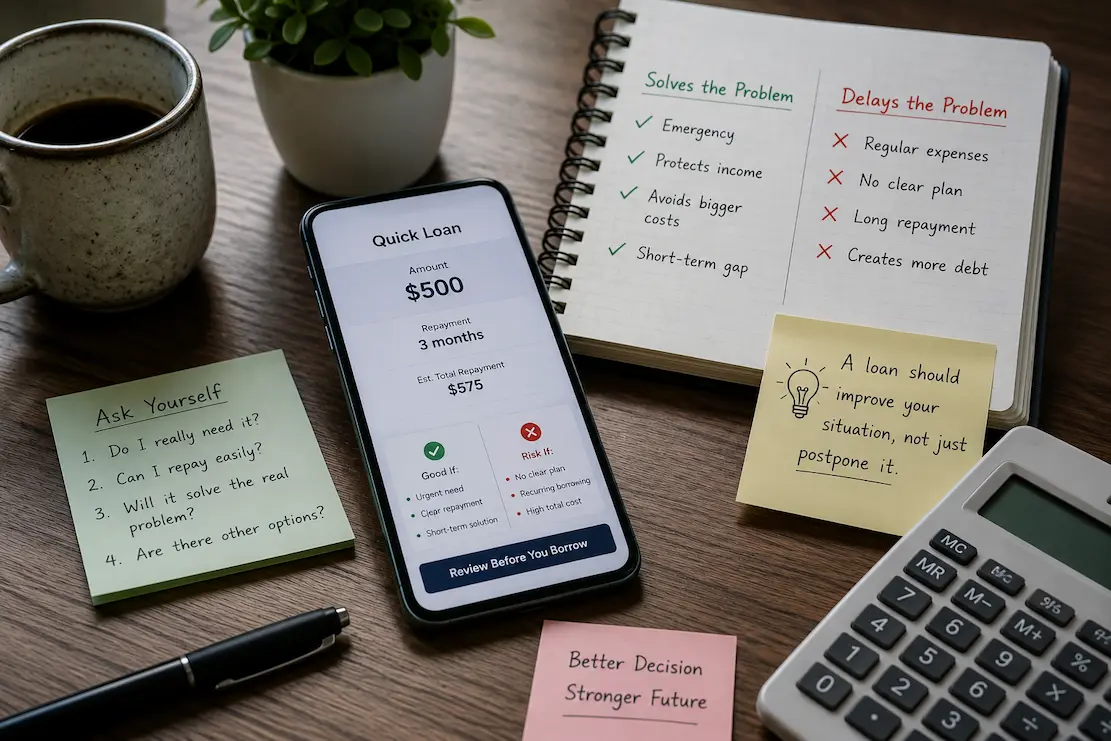
Borrowing isn’t automatically a mistake, but certain patterns deserve extra attention because they often indicate that the loan is becoming a substitute for long-term financial planning.
Pay close attention if any of these situations describe you:
- You’ve borrowed for the same type of expense more than once in the past six months.
- Repayment depends on hoping for extra income rather than income you already expect.
- You are considering one loan to repay another.
- You haven’t calculated your total monthly commitments after taking the new loan.
- You’re applying because approval is quick, not because you’ve compared alternatives.
- You don’t know the total amount you’ll repay by the end of the loan.
None of these automatically mean you shouldn’t borrow. They simply suggest it’s worth slowing down and reviewing your options before making a decision.
Compare the Cost of Borrowing With the Cost of Waiting
Many people only compare different loans with one another. A better comparison is between the cost of borrowing and the cost of doing nothing.
Sometimes waiting is inexpensive.
Sometimes waiting becomes very costly.
Consider the following examples.
| Situation | Cost of Waiting | Cost of Borrowing | Which May Be Better? |
|---|---|---|---|
| Freelance software subscription needed for active projects | Lost income from delayed work | Interest and fees | Borrowing may make sense |
| Utility bill before service interruption | Late fees and possible reconnection charges | Loan costs | Compare both carefully |
| Optional online course | Delayed learning | Interest charges | Saving first may be wiser |
| Seasonal shopping | Little financial impact | Interest and repayment | Waiting is often better |
| Emergency home repair causing additional damage | Repair costs increase over time | Loan costs | Borrowing could reduce total expenses |
Thinking this way shifts the focus from “Can I obtain approval?” to “Which option leaves me better off financially?”
Don’t Ignore the Total Cost Just Because the Loan Is Small
A common misconception is that small loans carry small financial consequences.
The amount borrowed may be modest, but fees, interest, and repayment terms determine the true cost.
Imagine borrowing a relatively small amount to solve today’s problem. If the total repayment ends up significantly higher than expected, the loan can place unnecessary pressure on future income.
Before accepting any offer, understand:
- The total repayment amount.
- Whether interest is fixed or variable.
- Any service or processing fees.
- Charges for late payments.
- Determine whether early repayment is allowed without penalties.
Reading these details takes only a few minutes but can prevent unpleasant surprises later.
Freelancers Face a Different Borrowing Decision
For freelancers and gig workers, income often arrives unevenly rather than consistently.
One month may be highly profitable while the next feels unusually quiet.
Because of these factors, borrowing decisions should be based on confirmed work rather than optimistic expectations.
For example, suppose a graphic designer has already completed a project with payment scheduled in ten days. A short-term funding gap may justify temporary borrowing if the repayment comfortably fits within that expected income.
Now compare that with borrowing because new clients “should” arrive next month.
Future opportunities are encouraging, but they shouldn’t become the foundation of repayment planning.
The safest borrowing decisions rely on income that is already earned or contractually expected—not income that simply feels likely.
Students Should Consider the Long-Term Impact
Students sometimes turn to digital loans for expenses that financial aid doesn’t fully cover.
In certain situations, such borrowing can be reasonable.
For example:
- Essential textbooks.
- Required course materials.
- Transportation is necessary to attend classes.
- Emergency living expenses.
However, borrowing for discretionary spending can make graduation more financially challenging than necessary.
Students should also remember that future repayment often begins while they’re still building their careers.
Asking one additional question can provide valuable perspective:
“Will this expense still feel worthwhile when I’m making repayments months from now?”
If the answer is uncertain, delaying the purchase may be the better financial choice.
Alternatives Worth Exploring Before Borrowing
A loan shouldn’t always be the first solution considered.
Depending on your situation, another option may solve the immediate problem with less financial pressure.
Some possibilities include:
- Negotiating a payment extension with a utility provider.
- Asking medical providers about installment plans.
- Requesting earlier payment from freelance clients if appropriate.
- Adjusting discretionary spending temporarily.
- Selling unused items.
- Using emergency savings if available.
- Exploring employer salary advances where offered.
- You should check whether educational institutions provide emergency assistance funds for students.
Even if these options don’t fully eliminate the need for borrowing, they may reduce how much you need to borrow, which lowers your future repayment obligations.
A Simple Decision Framework Before You Apply
When emotions are strong, complicated financial advice isn’t always helpful.
Instead, try working through these five questions.
- Is the expense truly necessary right now?
If delaying the expense creates little consequence, waiting may be the better option.
- Is the financial shortage temporary or ongoing?
Temporary gaps are generally easier to solve than recurring deficits.
- Do I already know how I’ll repay the loan?
The repayment plan should rely on realistic, expected income rather than hope.
- Will this loan improve my financial situation after it’s repaid?
If the answer is no, consider whether another solution exists.
- Have I compared borrowing with at least one alternative?
The fastest solution isn’t always the least expensive one.
These questions won’t yield the same answer for everyone, but they encourage thoughtful decisions rather than rushed ones.
Financial Confidence Comes From Better Decisions, Not Faster Approvals
Digital lending has made borrowing easier than ever. That convenience has helped many people manage temporary challenges that might otherwise have become larger financial problems.
At the same time, easier access to credit means it’s also easier to borrow without fully considering the long-term impact.
A small digital loan isn’t inherently beneficial or harmful. Its value depends on why you’re borrowing, how you’ll repay it, and whether it addresses the real financial issue instead of simply postponing it.
The strongest financial decisions are usually made for reasons other than immediate availability of money. They’re made because the solution fits the problem.
Before accepting any loan, give yourself enough time to understand not only what the money can accomplish today but also how the repayment will affect tomorrow. A few extra minutes of careful evaluation can prevent months of unnecessary financial pressure and help ensure that borrowing becomes a useful tool rather than an ongoing habit.
Frequently Asked Questions
1. Is taking a small digital loan always a bad financial decision?
No. A small digital loan can be beneficial when it solves a short-term financial gap and you have a realistic repayment plan. Problems usually arise when borrowing becomes a recurring solution for ongoing budget shortages.
2. How can I tell if I can realistically afford a loan?
Consider more than just the monthly payment. Calculate how much money will remain after paying all essential expenses and the loan installment. Your budget should still have room for unexpected costs.
3. Should I borrow to cover everyday living expenses?
If basic living expenses regularly exceed your income, borrowing may only postpone the issue. Reviewing your budget or exploring ways to increase income may provide a more sustainable solution.
4. Are digital loans suitable for freelancers?
They can be particularly useful when bridging a temporary gap before confirmed client payments are received. Freelancers should avoid relying on uncertain future projects to repay borrowed money.
5. What should I verify before accepting a digital loan?
Review the total repayment amount, interest rate, fees, repayment schedule, late payment charges, and whether early repayment is allowed without additional costs.
6. Can students benefit from small digital loans?
Occasionally. If the loan covers essential education-related expenses and repayment remains manageable, it may be worthwhile. Students should carefully distinguish between necessary costs and optional spending.
7. What’s the biggest mistake people make with small digital loans?
Many focus only on getting approved quickly instead of asking whether the loan actually improves their financial situation after repayment. Making that distinction often leads to better long-term decisions.