Credit Card Hardship Programs: What to Ask Before You Agree
Prepare for a hardship call, compare an issuer’s full offer, and check whether payments will fit your budget after temporary relief ends.

A credit card hardship arrangement is worth evaluating by its full payment schedule, not just the first smaller bill. Ask your issuer for help promptly, find out what you can actually afford, and get the terms in writing. The phrase “hardship program” alone does not promise approval, a particular interest rate, debt forgiveness, or a credit-score result.
The Consumer Financial Protection Bureau recommends contacting your card company right away when you cannot pay. Explain the problem, the amount you can manage, and how long you expect to need a different payment. Use the checklist below to turn that conversation into a plan you can evaluate.
Prepare a realistic number before you call
Have your current statement available. On a separate page, write down your balance, required payment, due date, and any amount already overdue. Then work through your household budget to find the amount available for this card after essential expenses and your other commitments.
Use income you can reasonably rely on. If overtime, a new job, or a return to work is uncertain, do not build the proposed payment around it as though it were confirmed. Write down both what you can pay now and what would need to change before you could pay more.
You can start with this adaptable script, written for this guide:
“My income has changed, and I may not be able to make the required payment. I can currently budget $___ a month for this card. What assistance can you evaluate me for? Please explain the full terms, including what happens when the arrangement ends, before I decide.”
Change the explanation to fit your circumstances. If you cannot estimate a recovery date, say that clearly rather than making a promise you may not be able to keep.
Nine questions to ask about an offer
These are review questions, not a list of benefits every issuer provides. Record the answers for your specific account.
- What payment starts when? Ask for the exact amount, its first due date, and the number of billing cycles it applies to. Clarify whether a payment is needed before the arrangement becomes effective.
- What happens to interest and fees? Ask which annual percentage rate applies during the arrangement, whether interest continues to accrue, and precisely which fees, if any, change.
- How is an overdue amount handled? Ask whether the quoted payment includes it or whether something additional is required. Write the amounts separately so you do not mistake one for the total.
- Can you still use the account? Ask whether it will remain usable, become restricted, or close, and when. Ask how recurring charges would be affected.
- How will the account be reported? Ask how the account status and payments will be reported to credit reporting companies. If you are already behind, ask how that affects the answer. Do not assume the arrangement erases earlier missed payments or guarantees a particular score outcome.
- What is due after relief ends? Request the next payment amount or the method used to calculate it, the applicable rate, and any catch-up amount. Ask for the first date those changes would apply.
- What if your situation does not improve? Ask when you should contact the issuer again, whether another review is possible, and what happens if you miss an agreed payment. Do not assume an extension is available.
- What happens to automatic payments? Ask whether existing autopay instructions change, who must update them, and how to confirm the amount and date of the first withdrawal.
- Where is the written agreement? Request all the terms, the effective date, and a contact route for follow-up. Read it for differences from the telephone explanation.
Test the payment now and after the end date
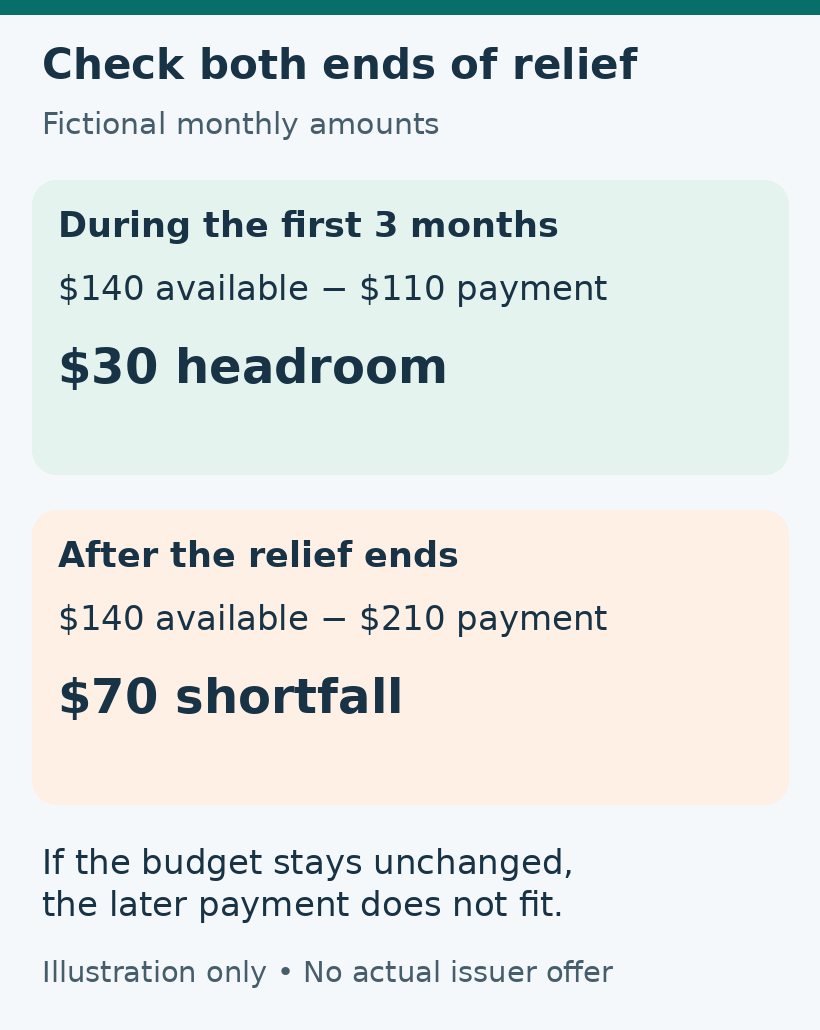
The following is a fictional budgeting example, not an actual issuer offer or an estimate of available relief.
Suppose you have $140 a month available for this card. A hypothetical arrangement calls for $110 a month for three months, then $210 a month.
- During the arrangement: $140 available minus $110 due leaves $30 of headroom.
- Afterward: $140 available minus $210 due leaves a $70 monthly shortfall if your budget has not changed.
The first three payments total $330. That is scheduled cash paid, not necessarily $330 removed from principal: this example does not specify interest or fees.
The smaller initial payment fits the example budget. The later payment does not. Before agreeing, the reader would need to discuss that gap and understand the issuer’s response. A hopeful income estimate is not a substitute for knowing what will be due.
Keep a record and check the first statement
Call using the number on your card or statement. The Federal Trade Commission advises keeping records of the conversation and obtaining a written agreement. Note the date, representative, reference number, agreed terms, and next steps.
Requesting help is not itself an approved payment change. Ask what remains due while the request is being reviewed; do not assume you can skip a payment while waiting.
Once an arrangement is confirmed, make a short follow-through list:
- Save the confirmation where you can retrieve it.
- Calendar the first payment date, the end date, and a reminder to review your budget before relief expires.
- Verify the automatic-payment instructions against the agreement.
- Compare the next statement’s payment, rate, fees, and due date with the confirmed terms.
- Contact the issuer promptly about a mismatch and keep the response.
If the offer is still unaffordable
Explain the gap plainly: “The proposed payment is $___, but my current budget allows $___.” Ask whether any other arrangement can be evaluated. Agreeing to an amount you cannot sustain does not resolve the budget problem.
If several debts are competing for the same limited money, consider a broader review with a credit counselor. The CFPB’s credit-counseling guide explains how counselors can help with budgets and debt management. Ask about their qualifications, services, and alternatives, and request a written quote for setup and ongoing fees before enrolling.
Bottom line: Leave the conversation knowing what you owe now, what changes during the arrangement, and what you will owe when it ends. If one of those answers is missing, ask for clarification before treating the offer as a workable plan.
This guide provides general education for U.S. readers, not individualized financial or legal advice. Terms depend on your issuer, account, and written agreement. Sources checked October 19, 2026.
Featured photo: Photo by Mikhail Nilov on Pexels. Used under the photo license. Illustrative stock photograph of budget preparation; not a customer or issuer offer.

Credit-Builder Loan vs. Secured Card: A Cash-Access Checklist
Work through three fictional situations and four private questions before deciding whether a new account fits your needs.
Hotel Card Hold: Compare Two Checkout Payment Paths
Compare two fictional hotel checkout choices while keeping the original card’s capacity and the actual payment in separate records.
Overdraft Fee? Look Beyond the Online Bill Label
Compare three fictional document packets behind the same $60 ONLINE BILL entry, then identify what the records still leave unexplained.