Hotel Card Hold: Compare Two Checkout Payment Paths
Compare two fictional hotel checkout choices while keeping the original card’s capacity and the actual payment in separate records.

Estimated reading time: 8 minutes
A hotel card hold and a completed payment are different records. These fictional checkout paths help you identify what has changed and what still needs checking.
This guide compares two payment choices for one hotel stay. Follow the original card’s capacity alongside the actual checkout payment, so neither record disappears from the calculation. The examples are alternatives for one stay.
Capital One explains that pending amounts reduce available credit before entering the account balance; finalized charges enter that balance.
Chase notes that balance displays and processing times vary. Confirm how your issuer labels the amounts you’re comparing.
Report suspected unauthorized activity promptly, even while pending. See Capital One’s fraud guidance.
Hotel card hold: compare the checkout records
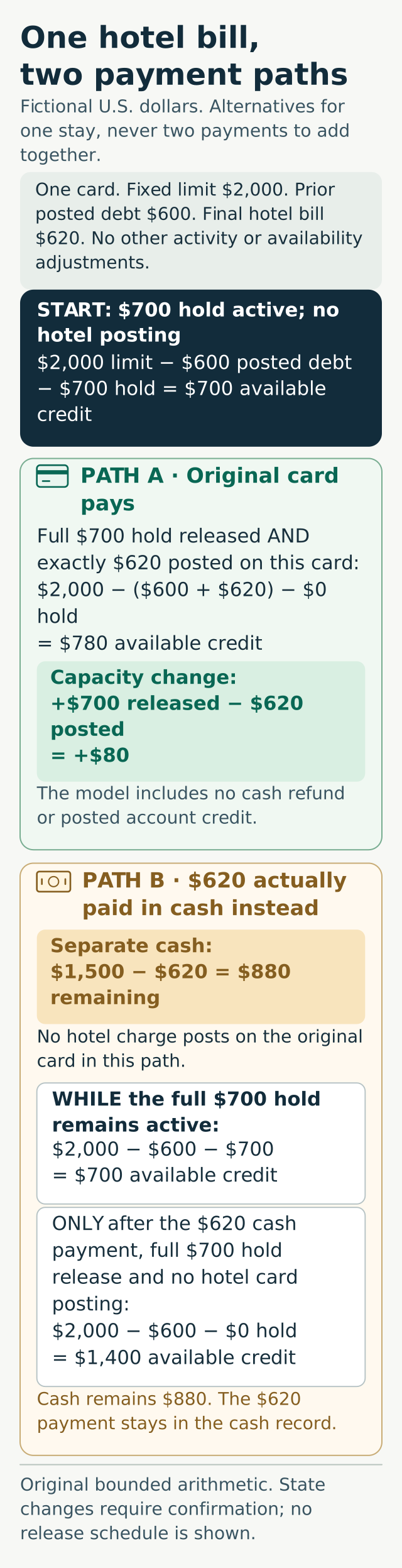
All amounts are fictional U.S. dollars. Use one conventional positive-limit credit card with a fixed $2,000 limit, $600 of prior posted debt counted once, a separate active $700 hotel authorization, and a final hotel total of $620. The $600 excludes the hotel. The authorization is outside posted debt in this model.
Assume the final total includes every hotel amount in the example. There are no other deposits, prepayments, purchases, card payments, credits, fees, interest, additional hotel charges, currency adjustments, limit changes or other availability adjustments. These assumptions let us isolate the checkout decision.
| Original card input | Amount |
|---|---|
| Fixed credit limit | $2,000 |
| Prior posted debt, excluding hotel | $600 |
| Active hotel hold, counted separately | $700 |
| Available credit in this model | $2,000 − $600 − $700 = $700 |
For this example, available credit equals the fixed limit minus posted debt minus the active hold. It measures remaining credit capacity. It isn’t cash, an issuer-held credit balance, an amount due, a credit-scoring calculation or a guarantee that another transaction will be approved.
Hotel card hold, path A: settle on the original card
The completed state requires both facts: the entire $700 hold no longer reduces capacity, and exactly $620 has posted to this card. Under those conditions, posted debt becomes $600 + $620 = $1,220, the active hold is $0, and available credit is $2,000 − $1,220 − $0 = $780.
Here’s the change from the starting snapshot:
- Removing the modeled $700 hold adds $700 of capacity.
- Adding the $620 posted hotel purchase uses $620 of capacity.
- The net improvement is $700 − $620 = $80 of capacity.
No cash refund or posted account credit appears in this example. Adding an $80 refund would invent a transaction; adding a $700 credit to the posted-debt ledger would do the same. The original authorization was never part of that ledger.
A checkout receipt, a release request or a visible $620 posted line alone doesn’t establish the completed state. Until both conditions are confirmed, leave the unexplained hold status open. Don’t subtract the original hold again after its full release has been established.
Hotel card hold, path B: pay $620 cash instead
Restart from the original snapshot. This time, assume the hotel actually receives a separate $620 cash payment and no hotel purchase posts on the original card. Don’t combine this payment with Path A. The cash example starts with $1,500 and ends with $1,500 − $620 = $880.
The original card has its own record. While the full $700 hold remains active, and with no hotel posting, its available credit remains $2,000 − $600 − $700 = $700. The cash receipt has changed the cash record; this assumed card snapshot is still unchanged.
Only after the separate $620 payment, full release of the $700 hold, and confirmation that no hotel charge has posted to the original card does this model reach $2,000 − $600 − $0 = $1,400 available credit. The separate cash balance remains $880.
| Confirmed hold state | Original-card posted debt | Original-card available credit | Separate cash remaining |
|---|---|---|---|
| Full $700 hold remains active | $600 | $700 | $880 |
| Full $700 hold released; active hold $0 | $600 | $1,400 | $880 |
Comparing only the original card would omit the cash used to pay for the stay. The larger capacity figure in the completed cash path doesn’t make the hotel cheaper or restore the spent $620. This comparison doesn’t recommend paying cash to increase the displayed credit figure.
Confirm the payment arrangement before changing methods
For checkout, confirm the total and method; then follow the FTC’s advice: ask the hold amount and removal plan, identify any different payment method, and request removal of the earlier hold.
Keep the hotel’s answer and receipt beside the original card’s dated snapshot. In your own comparison, give a release request its own field. Don’t enter it as a completed release. Keep any later issuer-confirmed change with its actual status and amount, without assigning an expected release day from this example.
The cash track here’s deliberately simple. If you choose a different card instead, the cash subtraction above is no longer the right payment record. Record the actual transaction on that other card separately rather than copying the $880 cash result.
Hotel card hold: test a confirmed partial release
Use a separate intermediate snapshot of the cash-payment path. Keep the $2,000 limit, $600 prior posted debt and $620 paid in cash. Suppose the issuer confirms that only $400 of the original $700 authorization has stopped reducing capacity. The remaining active hold is $300.
With no hotel card posting and no other activity, available credit is $2,000 minus $600 minus $300, or $1,100. The separate cash balance remains $880. The partial release increases modeled capacity by $400 from the original $700 available, but it doesn’t restore the $620 cash paid for the stay.
This snapshot doesn’t meet the original path’s full-release condition. Record the remaining $300 as active and the question still open. A request to release it or a representative’s expected processing date isn’t the same as confirmation that it no longer affects capacity.
Don’t add $400 to posted account credits. In this exercise the authorization was never posted debt, so reducing its active amount changes the capacity calculation directly. The posted-debt record remains $600.
Hotel card hold: include a later unrelated purchase only once
Return to the completed original-card payment path, which had $1,220 posted debt, no active hold and $780 available. In a new variation, add a separate $50 purchase that has fully posted and has no remaining authorization. Posted debt becomes $1,270 and available credit becomes $730.
The $50 explains the difference between the two dated snapshots. It isn’t evidence that part of the hotel hold returned, that the hotel total increased or that a promised $80 cash refund is missing. Keep the transaction reference and time with the new snapshot.
If the $50 purchase is instead still pending and separately reduces capacity, that would need a different status record. Don’t count both a pending authorization and a posted amount unless the issuer confirms they independently affect available credit at the measured point.
Before interpreting any difference, align the snapshots’ dates, posted transactions, active holds and limit. Use the same actual account definitions throughout. These teaching variations calculate capacity from stated facts; they don’t guarantee authorization of another purchase, establish an amount due or supply a release deadline for a real hotel stay.
Available credit in these snapshots is a spending-capacity measure. It doesn’t supply the balance an issuer reports to a credit bureau or calculate a credit score, so don’t reuse the hold-inclusive arithmetic as a utilization result.
If the two records still disagree
Suppose the hotel confirms that it received the cash, but the original card still displays a hotel item. The missing fact is what that item currently represents. A pending line beside a posted line doesn’t, by itself, establish two posted purchases or show whether both separately reduce capacity.
For this reconciliation, identify the actual posted hotel amount and the authorization amount that still affects available credit. Clarify labels with your issuer. Preserve the cash payment in its own record while the card question remains open. If your snapshots were taken at different times, include intervening activity before comparing them.
If you question an actual posted card charge, use the separate credit-card billing-error guide. The checkout arithmetic doesn’t establish a billing error, a refund entitlement or what to pay on a real statement.
Finish the comparison with two answers: how the hotel was actually paid, and which posted amounts and active holds explain the original card’s current capacity. Leave any missing answer visible. Keep real records private, using short account labels rather than full card numbers in general notes.
General U.S. financial education. All example amounts and account states are fictional. Primary sources checked October 21, 2026. No release deadline or account-specific payment recommendation is calculated.
Related reading
For a related question, read Temporary Debit Credit: Reconcile What Stays and What Reverses and Overdraft Fee? Look Beyond the Online Bill Label.


