Overdraft Fee? Look Beyond the Online Bill Label
Compare three fictional document packets behind the same $60 ONLINE BILL entry, then identify what the records still leave unexplained.
Your statement shows ONLINE BILL, $60, beside a fee you want explained. You remember paying on a website. That leaves the payment method and processing details uncertain. Compare the three document packets below: the same short description can conceal different facts.
The example uses a U.S. single-holder checking account opened mainly for personal use, family needs or household purposes. Cards are issued by or for the bank holding that account. Business accounts, prepaid products, independently issued third-party cards, linked-savings transfers and credit lines are outside this example.
One statement line, three possible histories
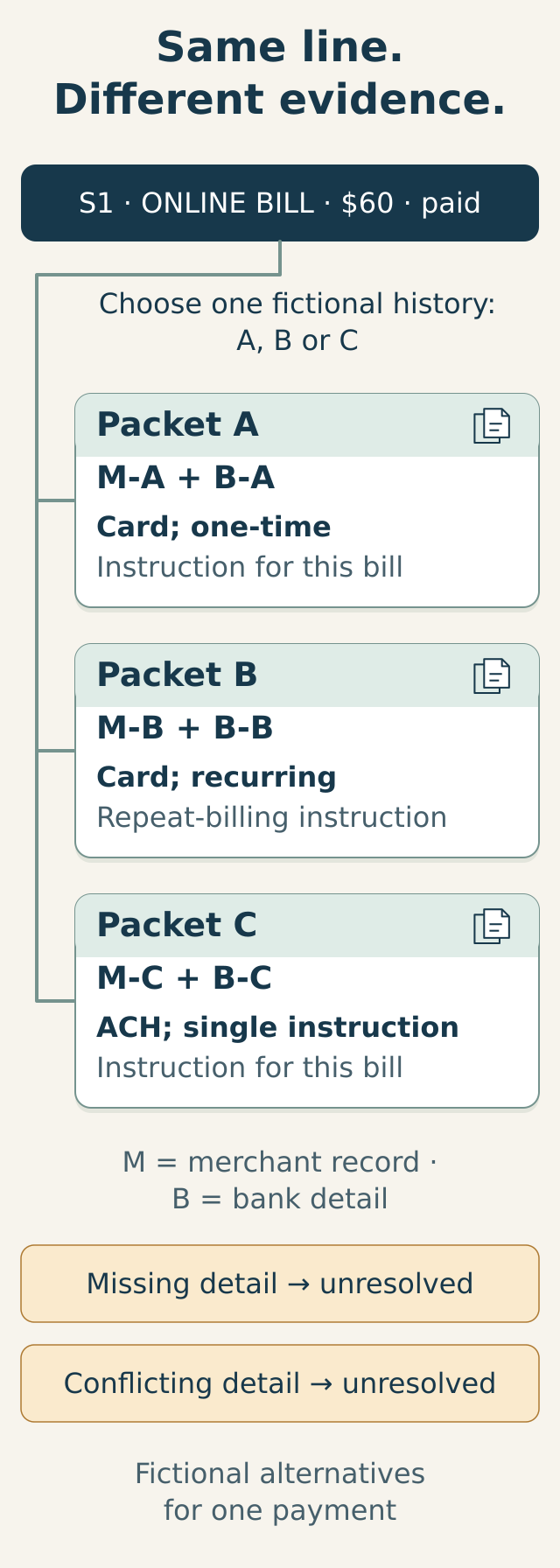
Everything in these packets is fictional. A, B and C are mutually exclusive versions of one $60 payment, never three withdrawals to add together. Each version starts with statement reference S1: ONLINE BILL, $60, shown as paid. The merchant instruction and bank detail are assumed to agree within each packet. Each B record identifies S1.
| Evidence | Packet A | Packet B | Packet C |
|---|---|---|---|
| Merchant record | M-A: card payment requested for this bill. | M-B: card authorization for repeat billing. | M-C: bank-account withdrawal authorized for this bill. |
| Reported rail and applicable coding | B-A: debit card; one-time | B-B: debit card; recurring | B-C: ACH; single instruction |
| Processing status | Paid, confirmed by B-A. | Paid, confirmed by B-B. | Paid, confirmed by B-C. |
Compare the merchant instructions with the reported detail, then check processing status. A and C both began with an instruction for this bill alone; their payment methods differ. A and B both used a card; their reported coding differs. The shared $60 and ONLINE BILL label contribute no further detail. A familiar merchant name or a pattern of similar monthly amounts would not fill the missing fields.
Why the distinction matters for the fee
ATM and one-time debit-card overdraft fees require separate written notice, a reasonable opt-in opportunity, affirmative consent and written confirmation stating the right to revoke at any time. Electronic delivery requires agreement.
One-time card payments can occur online or by telephone. Banks that adapt systems to distinguish one-time and recurring card transactions may rely on third-party coding.
Only A invokes this requirement. ACH, checks and recurring card payments fall outside it; fee validity remains undetermined.
Payment can occur without opt-in, which never guarantees payment. See Regulation E.
The table supplies agreed facts for an illustration. A real bank’s label is still something to examine against the underlying records. The table cannot establish whether a real system meets the rule.
When the documents leave a gap
- Only S1 is available: leave the method and coding unresolved. Ask the bank to identify the rail, applicable coding and paid, returned or pending status for that entry. One payment attempt does not supply those missing records.
- The records disagree: suppose the merchant record describes one manual card payment, while the bank describes it as recurring. Keep both. Ask which coding the bank received and relied on. Neither record automatically settles the conflict.
- A response answers a different question: “You paid online” leaves the processing method open. “The account has overdraft service” leaves S1’s classification open. Keep the unanswered point visible rather than checking the whole matter off.
Connect the classified payment to the actual fee
Separately identify the fee entry, its posting date and the transaction or period the bank says it concerns. The closest earlier debit is only a nearby entry until that connection is explained. For your notes, keep the statement reference, payment status, supporting document for each field, transaction-paid date, fee date and stated fee connection together. These are suggested note fields, not an official form.
Daily, sustained and mixed-transaction fees need separate tracing.
Payment authorization and overdraft opt-in are separate records. For A, ask which notice, consent and confirmation the bank associates with S1. Keep each document’s date label intact. A missing customer copy leaves a gap; it does not prove the bank has no record.
A small arithmetic check for C
Assume C begins with $40, the $60 ACH withdrawal is paid, and a separate invented $15 fee posts: $40 − $60 = −$20; −$20 − $15 = −$35. This only reconciles the stipulated entries. It establishes no lawful fee, contractual amount owed, refund entitlement or typical fee rate. A pending or returned payment cannot be substituted for the assumed paid withdrawal.
Contact the bank promptly with what you have. There is no need to finish every field first. A focused starting question is: “Which entry or period does this fee concern?” The useful next answer should explain the particular gap in your packet.
General U.S. education, not individualized financial or legal advice. Fictional records and amounts. Sources checked October 21, 2026.
Hotel Card Hold: Compare Two Checkout Payment Paths
Compare two fictional hotel checkout choices while keeping the original card’s capacity and the actual payment in separate records.

Temporary Debit Credit: Reconcile What Stays and What Reverses
Follow a fictional $800 checking-account snapshot through three separate outcomes, then compare a $50 removal with reversing $300 and rebooking $250.
Identity-Theft Records: A Report-by-Report Matrix
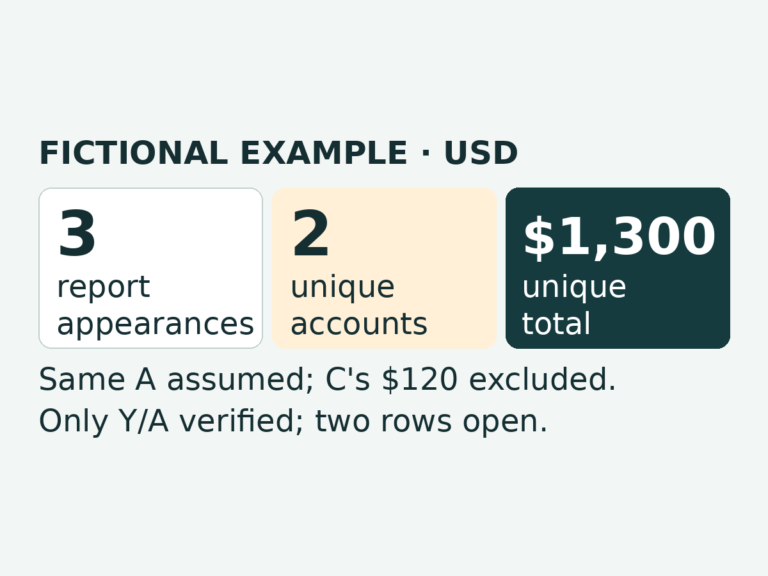
Use a fictional account-by-bureau matrix to separate three report appearances from two accounts and track which responses still need checking.