Medical Bill vs. EOB: How to Check What You Owe
Match your insurance EOB, itemized provider statement, and receipts to understand a remaining balance and prepare focused billing questions.

Your insurance Explanation of Benefits, or EOB, explains a processed claim; it is not a bill. To check a provider’s requested balance, compare the latest relevant EOB, the itemized provider statement, and your payment receipts for the same services. A mismatch is a reason to ask questions, not immediate proof that someone made an error.
The Centers for Medicare & Medicaid Services (CMS) explains how to read an EOB, including the important distinction between the patient balance and payments you may already have made.
Start with three documents
- The latest relevant EOB: save the version for the claim you are checking.
- An itemized provider statement: use the details, not only a payment reminder with a total.
- Your receipts or payment history: include payments made at the appointment and afterward.
CMS recommends requesting an itemized bill and contacting your insurer for an EOB and help checking errors. If a service seems unfamiliar, compare it with your records and ask the billing office to explain it. Medical-record access may involve a fee.
Put documents in date order. If there are two EOBs for the same claim, ask which reflects the current decision. Do not discard the older version: the change may help explain why a previous statement showed a different amount.
Match the services before matching the dollars
Check the patient, provider, service date, and claim reference. One statement can cover more than the single claim you are examining. Label the documents “same services confirmed” only after that connection is clear.
For example, comparing a $90 patient amount for one claim with a $150 account total is inconclusive if the statement also includes another visit. Ask for the part of the total associated with the claim in front of you.
Use partial identifiers in any working copy you share. Keep the complete documents securely for conversations with the verified provider or insurer.
What the main amounts mean
CMS distinguishes these EOB fields:
- Billed charge: what the provider billed.
- Allowed amount: the amount recognized for payment under the claim processing, which can differ from the billed charge.
- Insurer payment: the plan’s share.
- Patient responsibility: the patient’s share shown on the EOB. It may not subtract payments already made.
Also locate adjustments and patient-payment credits on the provider statement. Ask what an adjustment represents rather than assuming every subtraction is the same kind of write-off. Remark codes explain processing details; ask the insurer about any code you do not understand.
A worked example: why the unpaid balance can be $60
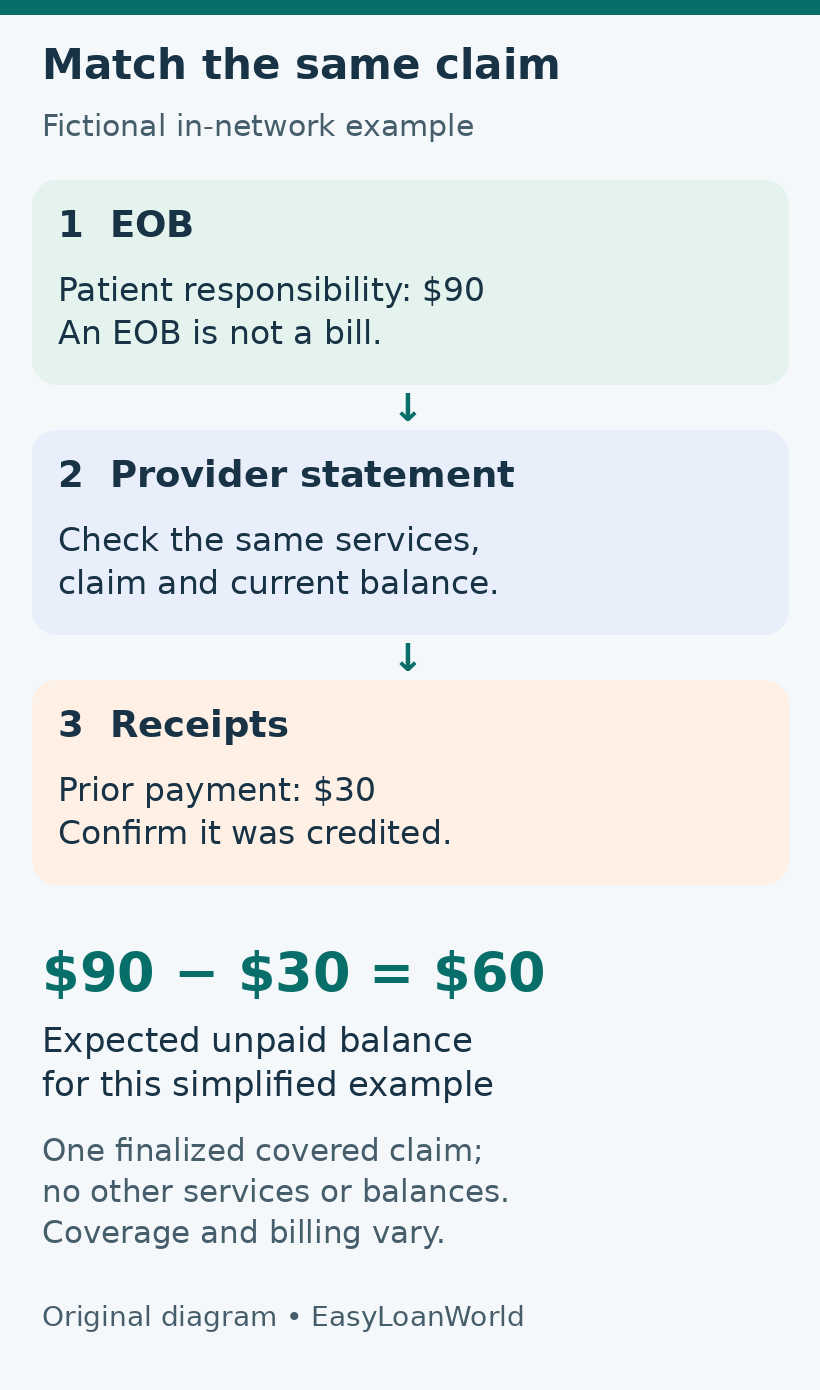
Fictional in-network example, illustrating arithmetic only. Assume one finalized covered claim, a contractual adjustment, no other services or balances, and all listed payments belonging to this claim.
- Provider billed charge: $600
- Contractual adjustment: $240
- Allowed amount: $360
- Insurer payment: $270
- EOB patient responsibility: $90
- Patient payment already made, supported by a receipt: $30
Check 1: $600 − $240 = $360. The contractual adjustment explains the difference between the billed and allowed amounts.
Check 2: $270 + $90 = $360. The insurer and patient shares add to the allowed amount.
Check 3: $90 − $30 = $60. After the documented patient payment, this simplified example leaves $60 unpaid.
Subtracting only the insurer payment from the original charge would produce $600 − $270 = $330. That calculation overlooks the contractual adjustment and the patient’s prior payment.
If the provider requests $90, the practical question is whether the $30 receipt was credited to this exact claim. Do not simply delete $30 from a different account balance. Confirm where the payment went and request an updated statement if a correction is made.
This example is not a universal formula for denied claims, multiple insurers, out-of-network care, or claims being reprocessed.
Who should you contact about a mismatch?
A payment appears to be missing
Start with the billing office and the receipt. Ask: “Can you show which claim and service dates this balance covers, and whether my payment on [date] has been applied?” Record the payment reference and the answer. If the receipt covers several services, ask how it was allocated.
The insurer’s decision or remark code is unclear
Ask the insurer: “What does this remark code mean, is this the current claim decision, and what is the next step if I disagree?” Request the specific document that explains the answer. A conversation about a balance is easier to follow when everyone is discussing the same version of the claim.
A service looks duplicated or unfamiliar
CMS recommends asking billing departments about suspected duplicate charges or codes that do not match care. A repeated code alone does not establish duplicate billing. Ask the provider to review the line rather than requesting a diagnosis or code change based only on an internet description.
The provider and insurer may need to coordinate. For either contact, finish with: “Which document will confirm the correction, and when should I follow up?”
A private reconciliation worksheet
For each card, record your answer, the document supporting it, and any unresolved question. Keep this locally. Do not put insurance IDs, diagnoses, complete claim details, or medical records in public comments.
1. Identify the claim
My record: patient, provider, service date, partial reference __________
Matching document: __________
Question: Are these exactly the same services? __________
2. Confirm the version
My record: EOB date and processing status __________
Matching document: __________
Question: Is a newer decision or reprocessing pending? __________
3. Trace the amounts
My record: billed amount, allowed amount, adjustment, plan payment __________
Matching document: __________
Question: Which unexplained line needs clarification? __________
4. Record the patient share
My record: responsibility for matched services __________
Matching document: __________
Question: What does this amount include? __________
5. Trace your payments
My record: receipts and credits for these services __________
Matching document: __________
Question: Where was each payment applied? __________
6. Compare the remaining balance
My record: statement balance and unexplained difference __________
Matching document: __________
Question: Does another visit or account explain the difference? __________
7. Save the conversation
My record: contact, date, and reference number __________
Matching document: call note or written reply __________
Question: What exact issue was raised? __________
8. Track the promised next step
My record: correction, response date, and any agreed hold __________
Matching document: written confirmation __________
Question: What should arrive next? __________
9. Keep deadlines separate
My record: provider due date and any appeal deadline __________
Matching document: statement and denial/plan instructions __________
Question: Who can clarify each deadline? __________
When comparing documents is not enough
A denied claim: you may need a formal plan appeal. HealthCare.gov explains internal appeals and records to retain. Follow your denial notice and plan instructions promptly; procedures and deadlines depend on coverage. Do not assume a billing-office inquiry counts as an appeal.
An unexpected out-of-network bill: review the appropriate protections and complaint route. CMS distinguishes these situations from its patient-provider dispute process tied to a good faith estimate, which is for eligible people who did not use insurance. That process is not a universal remedy for an insured claim. Owing a deductible alone is not a No Surprises Act violation.
An amount you cannot afford: ask the provider about available assistance and payment arrangements, even if the numbers reconcile. A correct calculation does not resolve affordability.
While a question is reviewed, ask whether billing or collection activity will be placed on hold and request written confirmation of any agreement. Do not assume an automatic pause or ignore due dates.
Common questions
Why could my bill be lower than the EOB amount?
Check whether a prior payment or later adjustment explains it. Ask for the account detail rather than assuming the smaller number is an error.
Why did one visit produce several documents?
Check whether each document describes a different provider, service, or claim version. Build a separate comparison for each matched set before adding totals.
What if I have no EOB yet?
Ask the insurer whether the claim was received and whether an EOB is available. Tell the billing office you are trying to match the claim, and clarify the statement’s due date.
Sources checked October 19, 2026. U.S. billing-literacy information, not individualized medical, insurance, legal, or financial advice.
Featured photo: Photo by Ivan S on Pexels. Used under the Pexels license. Illustrative stock photograph of medical paperwork. The pictured model is not an EasyLoanWorld adviser or medical reviewer and is not associated with the example bill; no endorsement is implied.

Credit-Builder Loan vs. Secured Card: A Cash-Access Checklist
Work through three fictional situations and four private questions before deciding whether a new account fits your needs.
Hotel Card Hold: Compare Two Checkout Payment Paths
Compare two fictional hotel checkout choices while keeping the original card’s capacity and the actual payment in separate records.
Overdraft Fee? Look Beyond the Online Bill Label
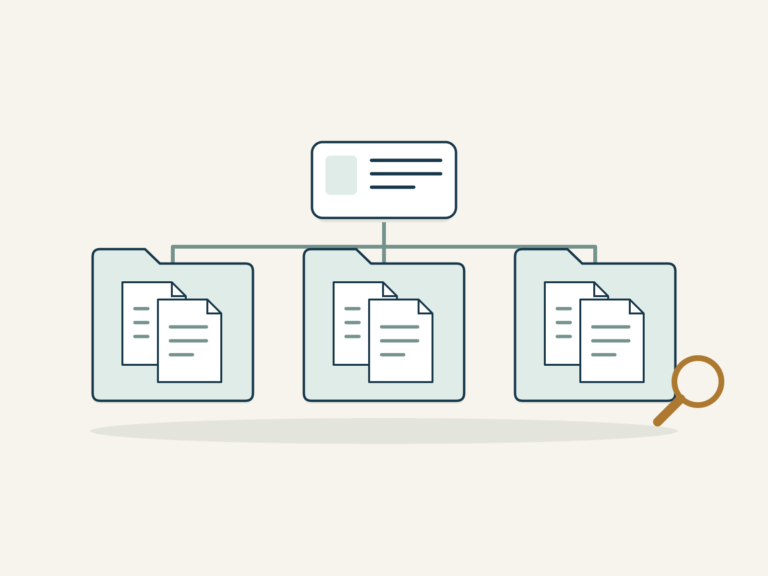
Compare three fictional document packets behind the same $60 ONLINE BILL entry, then identify what the records still leave unexplained.