Medical Payment Plans vs. Credit Cards: Compare the Written Terms
Compare who you owe, interest and fees, payoff deadlines, and the monthly amount needed before financing a verified medical balance.

A medical payment plan can be less expensive than carrying a credit card balance if it genuinely charges no interest or fees. But “payment plan” is a label, not a price. Compare the written agreement, the payoff deadline, and the payment you can sustain before choosing how to finance a medical bill.
Start this comparison with a verified remaining balance. If insurance processing, billing corrections, or financial assistance are still unresolved, keep those questions separate from the financing decision. Ask the billing office about assistance and how to apply before borrowing. CMS: Financial assistance.
Identify who you will owe
A provider may offer its own repayment arrangement or financing through another company. With a medical credit card, the issuer pays the provider and you repay the issuer. Plans can carry interest, deferred interest, or no interest; fees and credit-check requirements vary. Paying with a card can complicate obtaining hospital assistance, although it does not automatically eliminate the right to seek it. CFPB: Medical cards and payment plans.
Ask the office to name the legal creditor on the proposed agreement. A third-party payment website might be processing payments for the hospital or offering new credit. The website’s appearance alone does not answer which arrangement you are entering.
Give each option a plain-language label in your notes: direct provider arrangement, third-party installment credit, medical credit card, or regular credit card. Then copy the actual creditor’s name next to it. This makes it easier to know where to ask for a balance correction or hardship change later.
Separate a true 0% rate from deferred interest
With deferred interest, a promotion may waive interest only if you pay the qualifying balance in full by a specified date. Leaving a balance can trigger interest back to the original purchase date. Minimum payments typically do not clear the promotional balance in time. Other balances and payment allocation can affect progress, and the promotion’s expiration may differ from the usual payment due date. Ask how extra payments will be applied. CFPB: How deferred interest works.
A true 0% introductory APR works differently: leaving a balance when the zero-rate period ends does not itself create retroactive interest for that period. Afterward, normal interest may accrue on the remaining balance. The CFPB explains this distinction in its 2017 deferred-interest letter; that historical explanation is not a current rate quote.
To remove ambiguity, ask: “If I owe even a small amount when this promotion ends, will you add interest for the earlier months, or only charge interest going forward?” Request the relevant contract paragraph rather than relying on a verbal “interest-free” description.
Put both offers on the same worksheet
Copy this checklist twice, once for each option. Leave an answer blank until the provider or creditor supplies it. A blank is a question to resolve, not permission to assume the term is favorable.
- Legal creditor and product type: ____
- Starting balance to be financed: ____
- Assistance and bill adjustments resolved: ____
- APR now, APR later, and whether either can change: ____
- Interest calculation and any deferred-interest trigger: ____
- Setup, monthly, late, and other fees: ____
- Required minimum or scheduled installment: ____
- Payment needed for my target payoff: ____
- Exact promotional expiration and final installment date: ____
- Prepayment rules and instructions for extra payments: ____
- Credit inquiry and reporting terms: ____
- Automatic debit required or optional: ____
- Consequences of a missed payment: ____
- Hardship contact and available process: ____
- How a later provider adjustment or refund reaches this account: ____
Keep an “answer source” beside each entry: contract page, written message, or dated conversation. Important promises made by phone should be confirmed in writing before you rely on them.
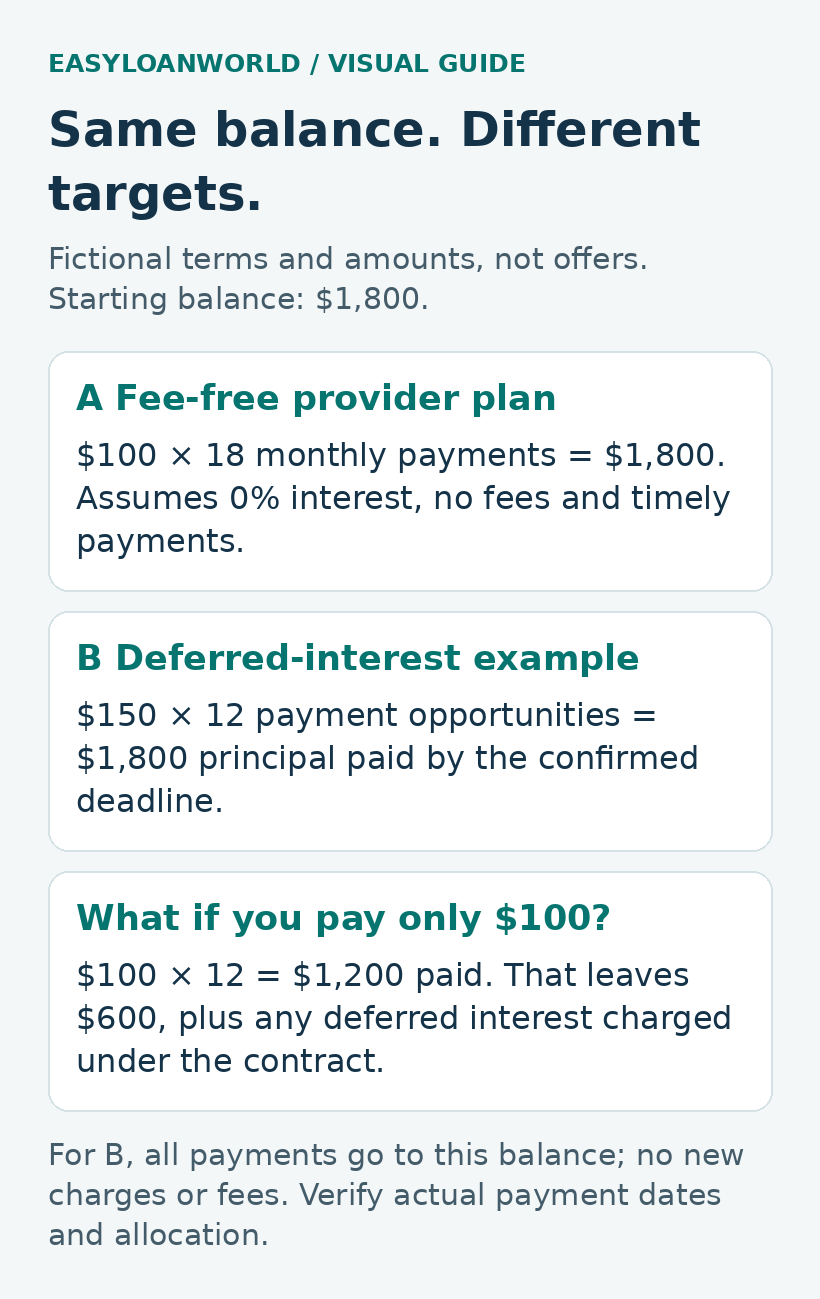
Example: the same $1,800 balance, different payment demands
The following options are fictional illustrations, not available offers or recommended products.
Option A: an explicitly fee-free provider plan
Suppose the written plan divides $1,800 into 18 equal monthly payments, charges 0% interest, and has no fees. The payment is $100: $1,800 divided by 18. Total repayment is $1,800, assuming timely payments and no additional charges.
Option B: a deferred-interest promotion
Suppose a different agreement provides 12 actual payment opportunities before its confirmed payoff deadline. Paying $150 each time clears $1,800 of principal, provided every payment is allocated to this balance and no fees or new charges are added.
Paying $100 each time instead covers only $1,200. That leaves $600 at the deadline. Under the hypothetical deferred-interest terms, additional interest may then be charged, so the problem is larger than simply finding the final $600.
Do not estimate that retroactive charge by multiplying the original balance by the APR. Changing balances and payment timing matter. Request the issuer’s calculation for the actual account.
The budget test
If the amount you can reliably spare is $120 a month, the $150 payoff target does not fit. A required minimum below $120 would not fix the shortfall. The budget supports the first fictional schedule more comfortably, subject to its actual terms, but it does not establish eligibility for any real plan.
Now test one weaker month. If you can pay only $60 once, how much must you add later, and is that realistic? Write out the catch-up amounts before agreeing. If the schedule fails that test, ask about more assistance or a different arrangement rather than building the decision around a perfect year.
Build a calendar around the agreement
Mark the contractual due dates and the promotional expiration separately. Count actual payment opportunities instead of assuming a “12-month” offer always leaves twelve convenient statement dates.
For the fictional $1,800 balance, targeting payoff in 11 payments would require roughly $163.64 per payment, with the final amount adjusted. That buffer only helps if it is affordable and payments reach the intended balance. It does not replace required minimum payments or verification of the real deadline.
After enrollment, retain the agreement and confirmation. At each statement, compare the remaining balance with your planned balance. If they differ, investigate promptly rather than waiting until the last month.
Questions worth asking before signing
- “What would I owe in total if I follow this schedule exactly?”
- “What changes if a payment is late or smaller than planned?”
- “Can I pay early, and how do I direct additional payments?”
- “If the hospital later reduces my bill, who processes the adjustment?”
- “Who can discuss hardship if my income changes?”
The useful comparison is not simply hospital plan versus card. It is one written set of costs, deadlines, and obligations versus another, measured against the money you can actually pay.
Educational information for U.S. readers, checked October 19, 2026. Examples are hypothetical; financing terms and assistance policies vary. This is not individualized financial advice.
Featured photo: Photo by Nataliya Vaitkevich on Pexels. Used under the Pexels license. Illustrative stock photograph of calculation tools; not an actual medical payment offer.

Credit-Builder Loan vs. Secured Card: A Cash-Access Checklist
Work through three fictional situations and four private questions before deciding whether a new account fits your needs.
Hotel Card Hold: Compare Two Checkout Payment Paths
Compare two fictional hotel checkout choices while keeping the original card’s capacity and the actual payment in separate records.
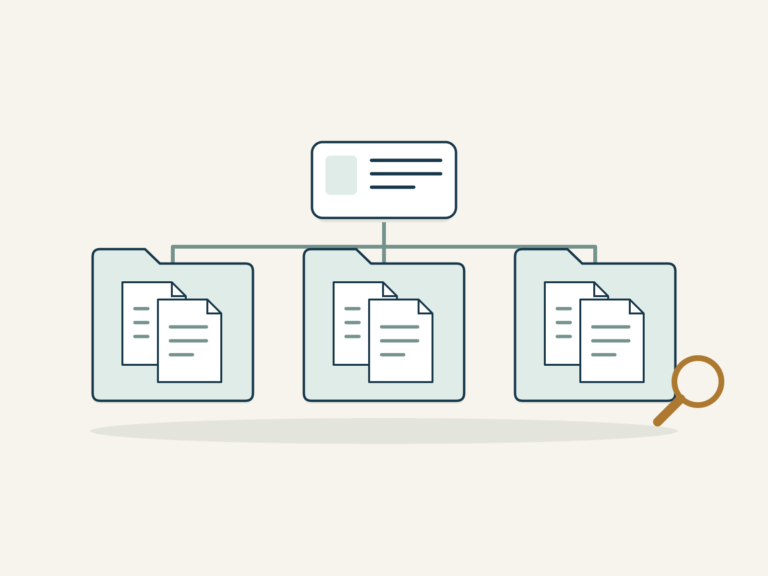
Overdraft Fee? Look Beyond the Online Bill Label
Compare three fictional document packets behind the same $60 ONLINE BILL entry, then identify what the records still leave unexplained.