Debt Settlement: Evaluate the Full Cost and Risks Before Enrolling
Look beyond a promised debt reduction: compare creditor payments, service fees, unresolved balances, collection risks, and possible taxes.

A debt settlement offer is worth evaluating in dollars, not just a promised percentage reduction. Add the money paid to creditors, service and account fees, and any balances left unresolved. Then consider the collection, credit, and possible tax consequences before committing to a program.
Settlement seeks an agreement to accept less than the amount owed. An estimate from a settlement company is not the same thing as an accepted agreement from your creditor.
Follow the money before judging the savings
Separate three destinations for your money: payments that actually reach a creditor, funds held for future negotiations, and fees paid to the service provider or account administrator. A deposit into a program account is not automatically a payment reducing your creditor’s balance.
Ask for a debt-by-debt statement showing where each dollar goes. For each debt, mark its status as proposed, accepted in writing, being paid under an agreement, or completed. This keeps an estimate from being mistaken for an accomplished result.
Understand what enrollment does not guarantee
Creditors do not have to accept proposed settlements, and some debts may remain unresolved. Programs may encourage missed creditor payments while funds accumulate. That can lead to additional interest and fees, collection activity, lawsuits, and credit damage. A dedicated account may also carry fees. Enrollment alone does not stop collection or legal action. CFPB: Debt relief risks.
Before signing, ask who handles a lawsuit and whether any legal representation is included. If you receive court papers, get legal help promptly and address the deadline. Do not assume a salesperson, account representative, or negotiation team is acting as your lawyer.
Ask when the company can collect its fee
For debt-relief services covered by the FTC’s Telemarketing Sales Rule, collecting a fee requires a successful change or settlement of a debt, your agreement to the creditor’s terms, and at least one payment under that agreement. Blanket advance permission for unknown settlements is not enough.
The rule applies to covered for-profit telemarketed services, including certain inbound calls; do not assume every provider or sales channel has identical coverage. Fees across multiple debts cannot be front-loaded. Money deposited in a qualifying dedicated account is different from a fee earned by the company. State rules may add restrictions. FTC: Debt relief services and the Telemarketing Sales Rule.
Request the fee basis, percentage, dollar amount, and earning conditions for each debt. “A percentage” is incomplete information: a percentage of the enrolled balance can produce a different charge from the same percentage of savings.
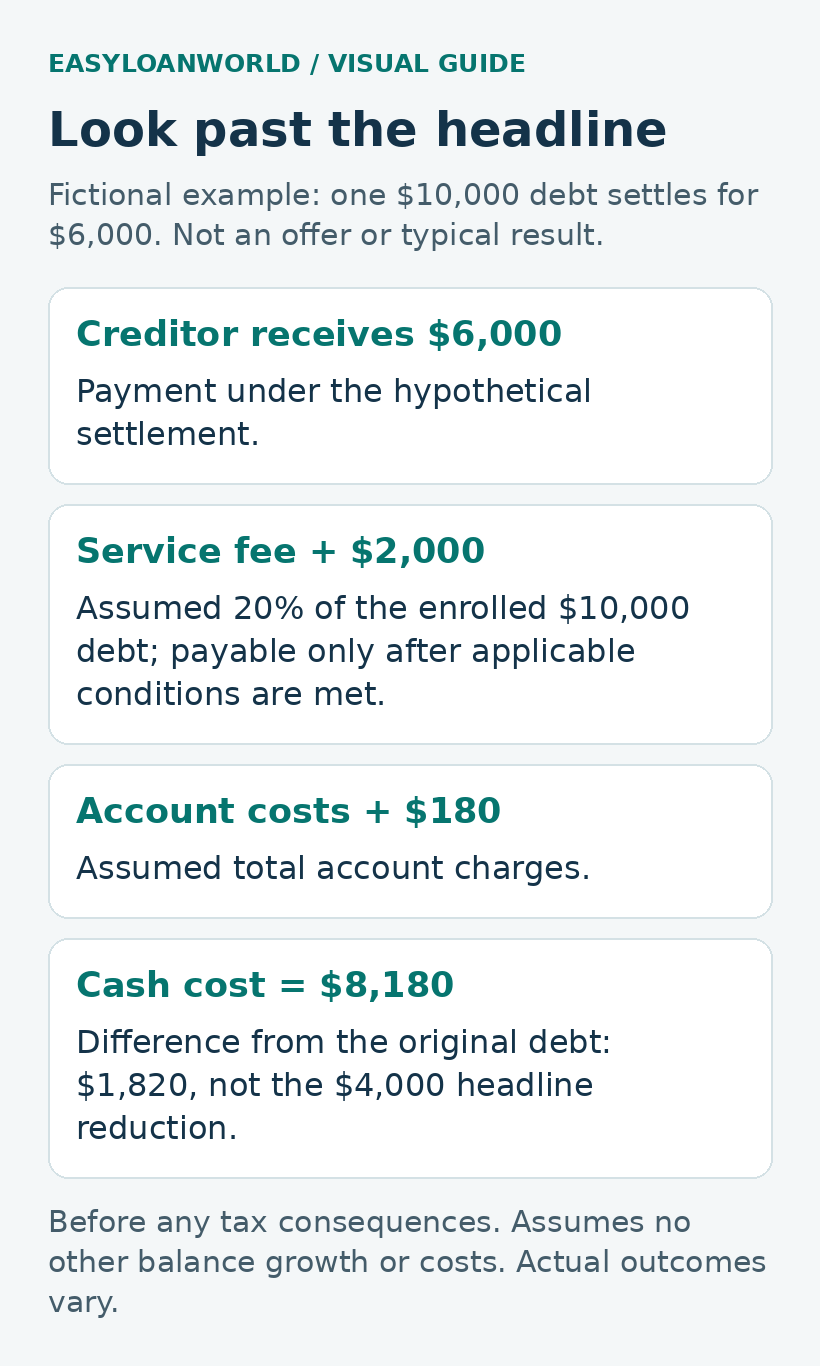
Example: where did the headline savings go?
These figures are invented for comparison. They are not typical outcomes, legal fee limits, or a real offer. Assume the fee becomes payable only after all applicable legal and contractual conditions are satisfied.
One debt is successfully settled
A $10,000 debt is settled for $6,000. The hypothetical service fee is 20% of the original enrolled balance, or $2,000. Account costs total $180. Assume no other balance growth or costs.
- Creditor payment: $6,000
- Service fee: $2,000
- Account costs: $180
- Total cash cost before any tax consequences: $8,180
The creditor accepted $4,000 less than the original debt. But the difference between that original $10,000 and the illustrated cash cost is only $1,820. The fee and account costs explain why those two numbers differ.
A second debt remains unresolved
Now suppose the person enrolled two $10,000 debts, totaling $20,000. The first settles under the terms above. The second remains unpaid and has grown to $11,000.
The snapshot is $8,180 already spent plus $11,000 still owed, or $19,180 before taxes or further costs. That is only $820 below the original $20,000, and the program has not resolved every debt.
The $19,180 is not cash already paid. It combines spending with an outstanding liability. Keep those categories separate in your own worksheet, and do not count accumulated interest twice if it is already included in the current balance.
Leave room for the tax question
Canceled debt is generally taxable unless an exception or exclusion applies. Bankruptcy or insolvency exclusions have specific conditions; being unable to afford monthly payments does not by itself establish insolvency. Whether a Form 1099-C arrives does not alone determine your reporting obligation, and $600 is not a tax-free allowance. Ask a qualified tax professional how the rules apply to your facts. IRS: Canceled debt and taxes.
Until that question is resolved, label an estimate “before possible taxes.” Do not convert an uncertain exclusion into assumed savings.
A debt-by-debt offer worksheet
Use masked account identifiers. This organizer is for private use, not a form to post online or send indiscriminately.
- Verified creditor and account ending: ____
- Starting balance/date and current balance/date: ____
- Disputed amount or ownership question: ____
- Lawsuit or response deadline: ____
- Included in the program: ____
- Creditor has actually agreed, with document/date: ____
- Written settlement amount and payment schedule: ____
- Service fee basis, rate, dollars, and earning conditions: ____
- Required deposits and dedicated-account costs: ____
- Already paid to creditor, already paid in fees, and still in reserve: ____
- Remaining balance or obligation: ____
- Written completion or release conditions: ____
- Tax questions still unresolved: ____
- Withdrawal, refund, and account-return terms: ____
Below the individual accounts, make four separate totals: cash already paid, debt still owed, expected future payments, and assumptions not yet confirmed. An optimistic projection should never replace the current-status totals.
Test whether you can fund the proposal
Use the money left after essentials, existing obligations, and a realistic household reserve. Compare that amount with the proposed deposit schedule. Then test a month with lower income or an unexpected essential expense.
Ask: “If I cannot maintain this deposit, what happens to negotiations, already-earned fees, and the debts that remain?” A plan that depends on repeated shortfalls being covered by new borrowing needs further examination.
Check a prospective company with your state attorney general or local consumer protection agency. No complaints is not proof that an offer is suitable. Get costs and results claims in writing, and be skeptical of guaranteed reductions or supposed special government bailouts. Programs can fail when deposits become unaffordable, leaving debts unresolved after fees have been paid for completed settlements. FTC: How to get out of debt.
Compare alternatives without mixing up the services
Credit counseling and a debt management plan generally focus on organized repayment and possible rate or fee concessions. Settlement seeks reduced balances; consolidation involves borrowing, and credit repair addresses credit-report issues. These are different tools. If repayment looks unrealistic, a bankruptcy consultation may help clarify legal options. CFPB: How debt services differ.
You can also explore negotiating directly. Verify the debt, decide what you can afford, and obtain the agreement and promises in writing before paying. Make sure the writing explains what happens after the agreed amount is paid. For disputed, old, or litigated debts, seek legal advice before making a payment or commitment. CFPB: Negotiating with a collector.
If you are already enrolled
Request a current account statement and the written settlement documents for each creditor. Reconcile deposits, creditor payments, fees, and remaining reserves. Ask about cancellation and fund-return terms before changing the arrangement, and separately identify any court deadlines.
The goal is a clear picture of what has happened and what remains. Neither a reassuring progress percentage nor a disappointing first result answers that question by itself.
Educational information for U.S. readers, checked October 19, 2026. This is not individualized financial, legal, or tax advice. Applicable rules, contracts, and outcomes vary.
Featured photo: Photo by Kampus Production on Pexels. Used under the Pexels license. Illustrative stock photograph of paperwork; not an actual settlement proposal or an endorsed provider.

Credit-Builder Loan vs. Secured Card: A Cash-Access Checklist
Work through three fictional situations and four private questions before deciding whether a new account fits your needs.

Hotel Card Hold: Compare Two Checkout Payment Paths
Compare two fictional hotel checkout choices while keeping the original card’s capacity and the actual payment in separate records.
Overdraft Fee? Look Beyond the Online Bill Label
Compare three fictional document packets behind the same $60 ONLINE BILL entry, then identify what the records still leave unexplained.