Shorter vs. Longer Personal Loan Terms: Choose a Repayment Timeline
Compare repayment timelines with an original $10,000 example and a worksheet for checking required payments, extra-payment rules and your payoff date.
U.S. personal loan education • Sources checked October 19, 2026
A shorter personal loan term usually trades a higher required payment for an earlier finish. When principal, fixed interest rate and fees are equal, a shorter fully amortizing schedule also costs less interest. A longer term lowers the required payment but keeps the commitment on your calendar longer. Actual offers may change the rate and charges along with the term, so compare the written schedules rather than assuming that one term is always better.
The useful question is: Which repayment timeline can I maintain, including months when I make no extra payment? Start with an affordable payment limit already worked out from your household finances. This guide helps you choose the timeline, rather than calculate that limit again.
What changing only the term does
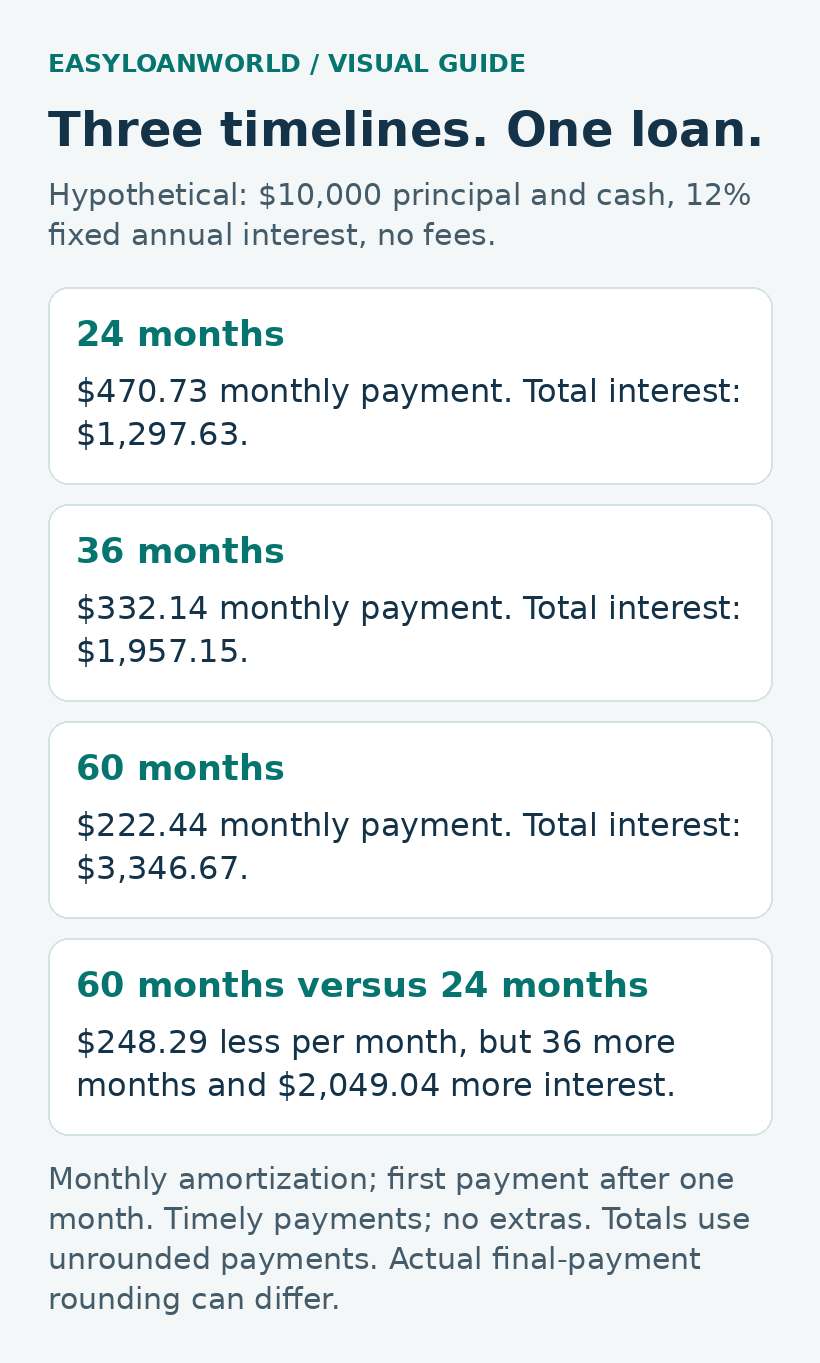
Here is an original hypothetical comparison, not an available loan offer. Each option provides $10,000 of usable cash and has $10,000 principal, a fixed 12% annual contract interest rate, monthly amortization and no fees or optional products. The first installment is due one month after funding. All payments arrive on time.
24 months: the earliest scheduled finish
- Approximate required monthly payment: $470.73
- Total scheduled payments: $11,297.63
- Total interest: $1,297.63
36 months: an additional year of payments
- Approximate required monthly payment: $332.14
- Total scheduled payments: $11,957.15
- Total interest: $1,957.15
60 months: the lowest required payment here
- Approximate required monthly payment: $222.44
- Total scheduled payments: $13,346.67
- Total interest: $3,346.67
Choosing 60 instead of 24 months reduces the displayed monthly requirement by about $248.29. It also adds 36 scheduled months and approximately $2,049.04 in interest. Those are three different consequences. The smaller payment does not make the extra interest disappear; the lower interest total does not prove that $470.73 fits your finances.
Calculation note: monthly rate = 0.12 ÷ 12. Payment = principal × monthly rate ÷ [1 − (1 + monthly rate)−number of payments]. Totals use unrounded payments, so multiplying the displayed rounded payment by the term will not reproduce every total exactly. Actual accrual dates and final-payment rounding may differ. The model uses contract interest, not a fee-inclusive APR.
Put the last payment on a real calendar
Write the first and final scheduled payment dates beside each offer. Then mark known changes between them: an expected move, the end of a temporary work assignment, a planned reduction in hours, or another commitment that starts later. You are checking the duration of the obligation, not predicting every future expense.
Use two columns in your notes: “already arranged” and “possible.” A signed change in working hours belongs in the first column. A hoped-for promotion belongs in the second. Do not make an otherwise unworkable schedule depend on an uncertain raise, bonus, refinance or asset sale.
Try finishing this sentence for each option: “If I pay only the required amount, this loan ends in ___, and the main change I must plan around before then is ___.” A blank answer is a reason to inspect the timeline more closely, not a reason to assume nothing will change.
Can you take a longer term and pay extra?
Extra payments depend on your agreement. For covered loans, federal disclosures address schedules, total payments and prepayment terms. Read the agreement and CFPB Regulation Z §1026.18(g), (h) and (k).
Before counting on extra payments, send the lender a specific question: “If I pay more than the required installment, how is that amount applied, and what do I need to do to have the extra amount reduce principal?” Ask whether a payment also advances the next due date; principal reduction and a changed due date are not necessarily mutually exclusive.
Request confirmation of the interest calculation method, any early-payment charge, whether your required installment stays the same, and how to obtain a dated payoff amount. Ask what happens to an automatic payment when you make a separate extra payment. Keep the response with your loan documents.
For your own comparison, write two plans: the required schedule and your hoped-for faster schedule. Make the decision viable under the required schedule first. Treat the faster version as an optional outcome that needs both available money and workable contract terms.
A four-step decision worksheet
Copy these prompts onto a separate page for each actual offer. Use “unanswered” instead of guessing. Record the document or written lender response that supplies each answer.
1. Copy the schedule
- Creditor and quote date: ___
- Usable cash received and note principal: ___
- Interest rate; fixed or variable; fees; disclosed APR: ___
- Number of installments; first due date; final scheduled due date: ___
- Required installment; disclosed total of payments; separate upfront cash: ___
2. Test the required commitment
- Does this installment pass my previously prepared affordability test? ___
- What known changes occur before the last payment? ___
- Is the plan workable without speculative income or another loan? ___
3. Inspect flexibility
- Where are the early-payment and interest-method clauses? ___
- How are excess payments allocated, and must I give instructions? ___
- What stays due after I overpay, and how do I request final payoff? ___
- Unresolved question, answer source and date checked: ___
4. Record the choice
Write why your chosen timeline works, what additional cost you accept if choosing a longer schedule, and a date to review your plan. More than one offer may pass. Neither may pass. If none works without another borrowing assumption, reduce the amount needed or reconsider the expense plan before committing.
Questions readers often ask
Is the shortest term always best?
No. In the example it has the lowest interest total, but that does not make its higher installment manageable. Choose among schedules you can sustain.
Does a longer term always have a higher rate?
Do not assume that. Compare the actual quoted rates and schedules. This example holds the rate constant to isolate the effect of time.
Can I shorten the term after signing?
Ask whether extra payments can bring forward payoff under your agreement. Changing the contractual schedule itself is a separate question for the lender.
Does early payoff refund the origination fee?
Do not include a refund in your plan without checking the agreement, applicable law and lender’s written payoff explanation.
This is general U.S. educational information, not individualized financial or legal advice. The hypothetical comparison does not predict your eligibility or available terms.
Featured photo: Photo by cottonbro studio on Pexels. Used under the Pexels license. Illustrative stock photograph of scheduling tools; not an actual loan repayment schedule.

Keep Savings or Pay Extra on a Personal Loan? Compare Cash and Debt
A fictional three-payment comparison shows how extra principal changes cash, debt, and interest, then tests which expenses the remaining cash can cover.

Payday Alternative Loans: Your Options
Screen three cash needs, then compare actual offers.

Stop Loan Autopay: Separate the Debit From the Debt
Review a fictional $210 payment, trace a $420 cash outflow, and compare the supporting records before treating an unexplained difference as resolved.