Keep Savings or Pay Extra on a Personal Loan? Compare Cash and Debt
A fictional three-payment comparison shows how extra principal changes cash, debt, and interest, then tests which expenses the remaining cash can cover.

Before sending savings toward a personal loan, ask two questions: how much interest would the payment avoid, and which expenses could the cash left behind still cover? A lower loan balance can look attractive while leaving a necessary bill unfunded.
This fictional comparison starts with the same $4,000 cash and $10,000 existing loan. It tests keeping the cash, paying $1,500 extra, and paying $3,000 extra. All three reach the same checkpoint after three scheduled payments. Then each faces the same separate expense tests.
Define the money you can actually use
NCUA recommends keeping some savings in an easily accessible account for emergencies.
For this exercise, available cash means money accessible by an expense’s due date. The $4,000 is left after known bills have been earmarked, and immediate access is assumed. It is an example input, not a suggested reserve for your household.
The loan uses a fictional 12% nominal annual interest rate, divided into 1% monthly periods. Each month’s interest is rounded to cents before a $500 month-end installment is applied. The installment comes from separately budgeted ongoing income in every option, not from the $4,000. There is no reserve replenishment.
We assume the extra payment reduces principal immediately before the next interest period. There are no prepayment fees, arrears, separate accrued interest, or due-date changes, and the scheduled installment stays $500. Check those assumptions against your own lender’s terms and payment instructions before using this model.
Savings earnings, taxes, alternative investments, and identical other household spending are excluded. The comparison covers only three payments, not the loan’s lifetime.
First, see what the extra payment changes today
| Measure | Keep all cash | Pay $1,500 extra | Pay $3,000 extra |
|---|---|---|---|
| Available cash | $4,000 | $2,500 | $1,000 |
| Loan principal | $10,000 | $8,500 | $7,000 |
| Cash minus debt | −$6,000 | −$6,000 | −$6,000 |
Paying $1,500 extra reduces both cash and debt by $1,500. Paying $3,000 extra reduces both by $3,000. Neither transfer creates an immediate gain in cash minus debt: that figure stays at minus $6,000.
Cash minus debt is deliberately narrow. Here it includes only these two accounts, not your household’s full net worth. It cannot tell you whether you can pay a bill: a loan balance is not spendable cash, and this model offers no way to draw the prepaid money back out.
Compare the same three-payment checkpoint
| Measure | Keep all cash | Pay $1,500 extra | Pay $3,000 extra |
|---|---|---|---|
| Available cash | $4,000 | $2,500 | $1,000 |
| Loan principal | $8,787.96 | $7,242.51 | $5,697.06 |
| Interest charged over three months | $287.96 | $242.51 | $197.06 |
| Cash minus debt | −$4,787.96 | −$4,742.51 | −$4,697.06 |
For example, keeping all the cash produces first-month interest of $100. After the $500 payment, principal is $9,600. The next two interest charges are $96 and $91.96, giving $287.96 in total.
The $1,500 extra payment avoids $45.45 of interest over this horizon. The $3,000 extra payment avoids $90.90. Those are also their improvements in cash minus debt relative to keeping all the cash. Do not add the original extra principal payment again as another gain: it already reduced both sides of the comparison.
All three positions also reflect $1,500 of scheduled payments funded from income. That shared contribution is not an advantage unique to prepayment. The difference between choices is the interest avoided, alongside how much cash remains available.
Now test whether the expense is actually funded
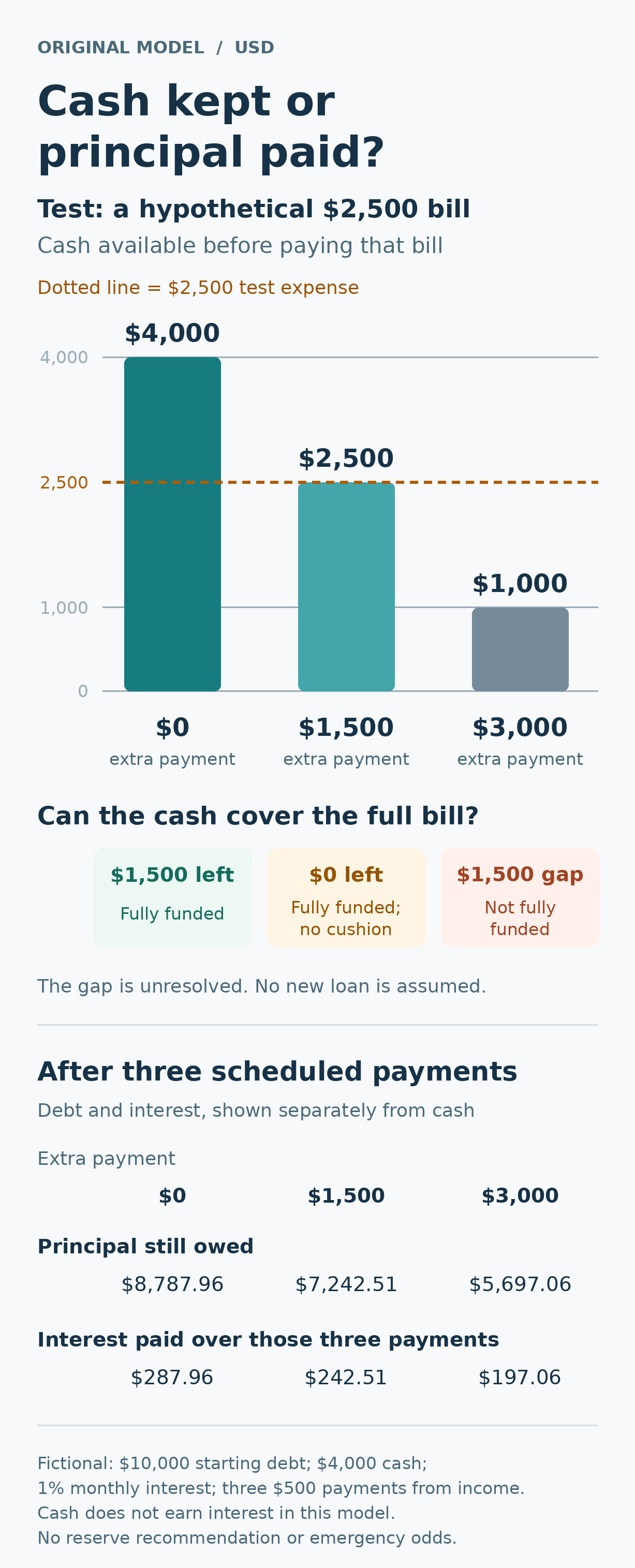
Suppose one unplanned necessary expense falls due immediately after the third payment. Each row below is a separate possibility, not a series of bills. The amounts carry no implied probability. A funded result means the full expense can be paid from that option’s remaining cash.
| Expense due | Keep all cash | Pay $1,500 extra | Pay $3,000 extra |
|---|---|---|---|
| $0 | Funded; $4,000 cash left | Funded; $2,500 cash left | Funded; $1,000 cash left |
| $1,000 | Funded; $3,000 cash left | Funded; $1,500 cash left | Funded; $0 cash left |
| $2,500 | Funded; $1,500 cash left | Funded; $0 cash left | Unresolved; $1,500 shortfall |
| $4,500 | Unresolved; $500 shortfall | Unresolved; $2,000 shortfall | Unresolved; $3,500 shortfall |
The $3,000 prepayment covers the $1,000 expense exactly, leaving zero cash. The $1,500 prepayment does the same for the $2,500 expense. Zero is a narrow mathematical pass for that single bill, not evidence of an adequate reserve or a robust plan for another expense.
Under the $2,500 test, keeping all the cash leaves $1,500 after paying the bill. Cash minus debt becomes minus $7,287.96. Paying $1,500 extra leaves no cash after the bill, with cash minus debt of minus $7,242.51. The latter is $45.45 better on this two-account measure, but has $1,500 less available cash.
The $3,000 prepayment leaves a $1,500 unresolved shortfall in that test. There is no completed post-expense position to rank beside the two fully funded options. Treating the expense as paid would assume a funding source the example does not have.
The $4,500 expense exceeds every modeled reserve. Even keeping all the cash leaves $500 unfunded. A shortfall blocks the stated cash-funded plan; it does not prove default will occur. Any proposed remedy needs its own confirmed amount, timing, and consequences. Future credit is not assumed available.
Set a payment ceiling from your own test
A useful starting calculation is: available cash minus the expense you want to test minus the cash you choose to retain afterward. If the result is nonnegative, it is the largest extra payment that satisfies those particular inputs. Cap it at both available cash and outstanding loan principal, and check that the lender’s payment rules fit the model.
For example, choose a $2,500 expense test and $500 of cash remaining afterward. From $4,000 available cash, the extra-payment ceiling is $1,000. Neither the $1,500 nor the $3,000 option satisfies that chosen test. These are personal test inputs, not a universal emergency-fund recommendation.
If the result is negative, even a zero extra payment cannot meet that expense-and-cash target from the available money. Do not treat a negative result as permission to spend. Revisit the assumptions or identify a verified funding plan before committing the cash.
A short worksheet before you decide
- Write down cash accessible by the due date, after earmarking known bills: $____.
- Confirm where each scheduled loan installment will come from, and whether any cash replenishment is genuinely budgeted.
- Choose an expense test of $____ and cash you want remaining afterward of $____.
- Calculate the extra-payment ceiling. Mark any option with an unresolved shortfall before comparing its interest savings.
- Verify the lender’s allocation, fees, interest treatment, and unchanged installment. Recalculate if any assumption differs.
The practical decision is which payment, if any, meets your chosen cash test while reducing interest. Keep spendable cash, debt, and the narrow cash-minus-debt figure visible together. A better number in one column does not settle the whole choice.
Payday Alternative Loans: Your Options
Screen three cash needs, then compare actual offers.

Stop Loan Autopay: Separate the Debit From the Debt
Review a fictional $210 payment, trace a $420 cash outflow, and compare the supporting records before treating an unexplained difference as resolved.

Personal Loan Late Payments: Verify the Catch-Up Amount
Organize a dated payment record, separate the next installment, and check a fictional catch-up calculation against the lender’s response.