Co-Signer vs. Co-Borrower: Understand the Responsibility Before Signing
Separate repayment liability, access to proceeds, ownership and release conditions before sharing a personal loan with another person.

U.S. personal loan education • Sources checked October 19, 2026
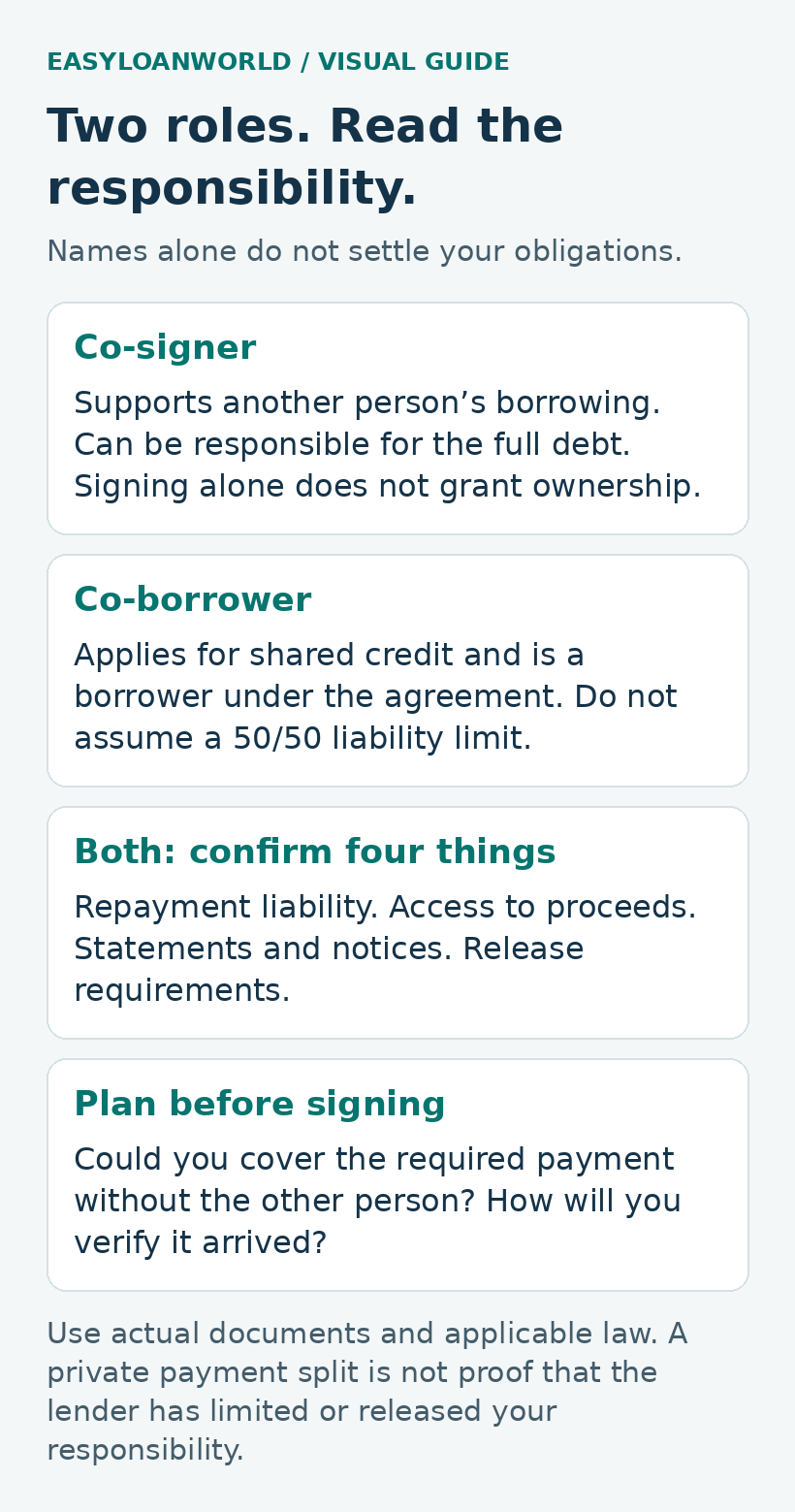
A co-signer supports someone else’s borrowing and can take on repayment responsibility without receiving ownership merely by signing. A co-borrower applies for shared credit and is a borrower under the agreement. Treat these labels as a starting point. Before signing, separate four questions: What can the lender require from me? Who controls the money? What can I verify? What actually ends my responsibility?
Use the lender’s proposed documents to answer those questions. A reassuring conversation between two people cannot substitute for knowing what each person signs.
Compare roles without assuming equal rights
The FTC explains that co-signing can expose you to the debt, additional costs and credit consequences, without giving you title to the financed property. Read its co-signing consumer guidance before accepting the role.
For joint credit, the CFPB’s Regulation B interpretation distinguishes people applying together for shared credit from an additional person required to support an application. A signature making collateral available is not necessarily a promise to repay personally. See Regulation B’s interpretation of section 1002.7(d).
Instead of assigning rights from a label, ask the lender to walk through these situations:
- Applying: Which people are requesting the credit, and in what capacity must each sign?
- Receiving money: To whom will proceeds be sent? Who can direct the disbursement?
- Repaying: What amount can the lender require from each signer under this agreement?
- Owning a purchase: What do separate ownership or title documents say?
- Checking progress: What statements, notices and payment history can each person obtain?
- Leaving: Which document would establish that a person’s repayment responsibility has ended?
Do not assume a co-borrower automatically owns half a purchase or receives half the cash. Ask for the relevant document instead. If you cannot explain your signing capacity in a sentence, request clarification before proceeding.
Why “only a backup” can be misleading
A co-signer may face collection without the creditor first exhausting efforts against the main borrower, although some states require a different sequence. Do not assume a universal order of collection. The FTC’s explanation of co-signer obligations discusses this qualification.
Ask for every relevant notice as well as the agreement itself. The FTC’s Credit Practices Rule includes co-signer notice requirements within its coverage; institution and transaction scope matter. A notice explains risk but is not the repayment contract. See FTC guidance on the Credit Practices Rule.
For your decision, replace “I probably won’t have to pay” with a concrete question: “What would I do if the lender required payment from me?” Write the answer independently, before discussing it with the other person. That helps separate your actual capacity from your desire to help.
Why “only my half” needs a contract check
As one provider-specific example, Prosper’s public borrower guidance, checked October 19, 2026, states that joint applicants are jointly and severally liable. That is not a universal rule or a recommendation of the provider.
Consider this original hypothetical: Alex and Morgan are discussing an $8,000 personal loan. Their household plan says each contributes half the monthly installment. Suppose their actual contract validly makes each jointly and severally responsible for repayment. In that scenario, Morgan’s inability to contribute would not limit the lender’s claim against Alex to Alex’s private 50% share. Enforcement still depends on the agreement and applicable law.
The exercise is not to guess which person is more dependable. Each should answer separately: Could I handle the required payment if the other contributed nothing? What would I need to change? Who receives the money? Would I still choose to sign if our informal payment plan stopped working?
A private arrangement can organize contributions, but should not be assumed to amend the lender’s rights. If either person is relying on a legal limitation, get advice about the actual documents rather than treating this scenario as a legal conclusion.
A responsibility worksheet for each person
Create two individual cards and a shared contract card. Each person should fill out their own card before comparing answers. A difference between answers identifies a question to resolve; it is not something to smooth over with a verbal promise.
Individual card: complete separately
- My exact role as written in the documents: ___
- Documents I am asked to sign and my capacity on each: ___
- Maximum repayment obligation described, including possible costs: ___
- Money I receive or control, according to the disbursement instructions: ___
- Any ownership rights shown by separate title or purchase documents: ___
- Whether I could cover the required payment without the other’s contribution: ___
- What I need clarified by an independent adviser: ___
Shared card: confirm with the lender
- Payment amount, due date and agreed method: ___
- Whose authorized account makes the payment: ___
- What account access and notices each person can receive: ___
- How both will verify the lender received the payment: ___
- Who contacts the lender if a payment is at risk: ___
- Any release clause, requirements, application process and approvals: ___
- Evidence of release or payoff to retain: ___
- Unanswered question, written response and date: ___
“Sent my share” and “the installment reached the lender” are different milestones. Agree how you will verify the second without sharing passwords or assuming access you have not been granted. Ask the lender about supported account access and notifications.
Plan the exit before the first payment
Ask whether the agreement offers a release process and what must happen to use it. Refinancing, repayment and a lender-approved release are possibilities to investigate, not outcomes to assume. A private promise or relationship change should not be treated as proof that the lender has released someone.
Record the desired exit and the evidence needed to confirm it. For example: “We will ask about release eligibility after the stated conditions are met; we will not treat the request itself as approval.” Keep the eventual written lender-approved release, payoff evidence or other legally effective resolution. Obtain qualified local advice if responsibility is disputed.
Conversation starter: “Before either of us signs, let’s confirm what the lender can require from each person, who can access the money, how we will both see payments, and what would actually end each person’s responsibility.” This is a discussion aid, not an agreement template or release form.
Common questions before sharing a loan
Does co-signing give me ownership?
Co-signing alone does not. Check any separate ownership documents rather than inferring rights from repayment responsibility.
Is a joint loan automatically half each?
Do not assume that. Read the liability terms. A private contribution plan and the lender’s rights are separate issues.
Can I remove myself after a year?
A year passing is not evidence of release. Check the agreement’s process and obtain confirmation that your obligation has actually ended.
Will adding a co-signer guarantee approval?
No guarantee follows from adding a person. Ask what the lender allows and requires before involving someone in an application.
General U.S. education, not individualized financial or legal advice. Use the actual proposed and signed documents; lender terminology alone does not settle your rights or liability.
Featured photo: Photo by RDNE Stock project on Pexels. Used under the Pexels license. Stock photograph illustrating a discussion. The people shown are not identified as borrowers, co-signers or advisers.

Keep Savings or Pay Extra on a Personal Loan? Compare Cash and Debt
A fictional three-payment comparison shows how extra principal changes cash, debt, and interest, then tests which expenses the remaining cash can cover.

Payday Alternative Loans: Your Options
Screen three cash needs, then compare actual offers.

Stop Loan Autopay: Separate the Debit From the Debt
Review a fictional $210 payment, trace a $420 cash outflow, and compare the supporting records before treating an unexplained difference as resolved.