Refinancing Federal Student Loans: Benefits to Check Before You Decide
Compare loan-by-loan protections, private contract terms and a hypothetical cost example before choosing federal-to-private student-loan refinancing.

When a private refinance pays off federal student loans, the included debt loses its federal status and access to applicable federal benefits. You cannot reverse that completed change back into the original federal loans. The CFPB warns about this permanent trade-off.
Before comparing rates, make a loan-by-loan list of what the offer would repay. Then gather evidence about the protections attached to those loans and the terms of the replacement contract. A smaller payment answers only one part of that decision.
Current-policy check: Federal Student Aid says it is updating guidance while implementing program changes. Confirm your specific account’s options before acting; this guide does not determine eligibility.
First identify which loans would change
Create a private inventory for each loan: type, balance, rate, remaining payment schedule, servicer, disbursement date and whether the proposed refinance would pay it off. Use a short nickname rather than a full account number on a working comparison sheet.
Verify loan type through official records, the promissory note and the servicer. A private company’s name alone does not establish whether the loan is private. Federal Student Aid’s exit-counseling guide distinguishes the holder, servicer and loan type.
Combining federal and private balances through a private lender turns the included federal debt into private debt. The government does not consolidate private loans into federal loans, explains the FTC’s student-loan guidance. Refinancing only existing private loans leaves separate, untouched federal loans outside that transaction.
A federal Direct Consolidation Loan is a different transaction from private refinancing: it keeps the debt federal.
Federal consolidation can still affect available options, benefits and payment counts. Federal Student Aid’s current repayment guidance calls for checking personalized results. Loan type and disbursement date matter, so verify the consequences for each loan before consolidating.
Build a benefit-by-benefit evidence sheet
For each section below, record four things: what applies to the current loan, what the private agreement provides, where the answer is documented, and what remains unresolved. An unanswered question should stay marked “unknown.”
1. Payment flexibility if income falls
Private refinancing removes the refinanced debt’s access to federal repayment options, including applicable income-linked repayment. A private lender may offer its own relief, but the terms do not become federal protections.
- Which repayment options are available for this specific loan and borrower today?
- How would a fall in income affect the required payment under those options?
- What adjustment does the private contract allow, and is approval discretionary?
- Would the proposed payment fit a realistic lower-income budget?
2. Temporary hardship and interest
Federal benefits can include approved deferment or forbearance. The exit-counseling guide also identifies interest treatment for eligible subsidized loans during qualifying deferment. Verify whether that applies to your loan and period; a payment pause is not universally interest-free.
- What circumstances qualify for each current or proposed relief option?
- What documents and approval are required, and how long may relief last?
- Does interest continue, and when could unpaid interest be added to principal?
- How are payments recalculated when relief ends?
3. Forgiveness, discharge and unresolved applications
Federal Student Aid describes service-related forgiveness and school-related or disability discharge, subject to requirements. Review any pending application and documented progress before payoff. A potential path or application is not an award.
- Is there an application, payment-history record or claim that needs an official answer?
- What would paying off the federal loan do to that specific opportunity?
- Does the private contract provide discharge for death or permanent disability?
- What happens to a co-signer’s obligation in each event?
Request the relevant agreement section, rather than treating a marketing phrase such as “borrower protection” as an answer. Keep any sensitive employment, school or health records in your own secure files.
4. Rate, payment and continuing obligations
Private refinance rates may be fixed or variable. Extending repayment can lower the monthly bill while increasing total cost. Compare the full terms, not only the first payment.
- Record the APR, rate type, term, fees and total scheduled payments.
- Identify rate discounts and the conditions that can end them.
- For a variable rate, record how it changes and any stated limits.
- Identify every borrower and co-signer who would remain responsible.
5. Missing evidence and who can resolve it
Finish each section with: “Unanswered question: ____. Contact: ____. Response date: ____. Document and section: ____.” Ask the federal servicer about current federal options and account history; ask the proposed private lender about its own agreement. A statement from one does not replace evidence from the other.
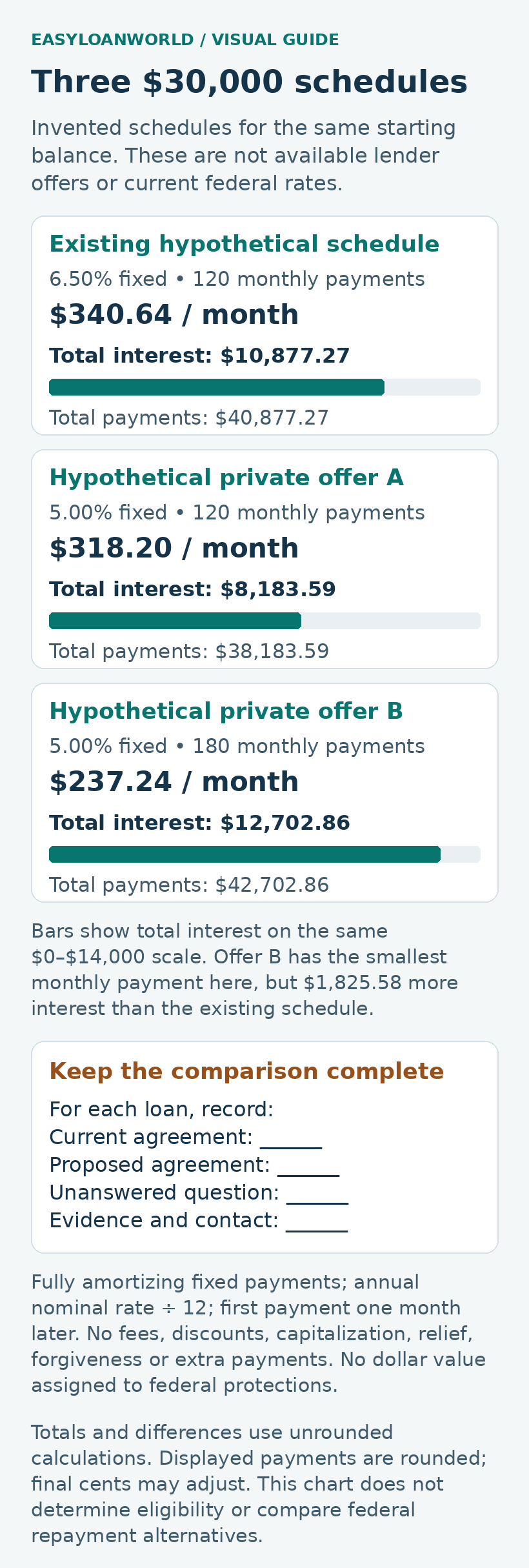
What a lower payment can hide: a $30,000 example
These are invented schedules, not current federal rates or available lender offers. Each starts with $30,000, has fixed, fully amortizing monthly payments and a first payment one month later. The nominal annual rate is divided by 12. There are no fees, discounts, capitalization, relief, forgiveness or extra payments.
Keep the hypothetical existing schedule
- Rate: 6.50%; 120 payments remaining.
- Monthly payment: approximately $340.64.
- Total scheduled payments: $40,877.27.
- Total interest: $10,877.27.
Hypothetical private offer A
- Rate: 5.00%; 120 payments.
- Monthly payment: approximately $318.20.
- Total scheduled payments: $38,183.59.
- Total interest: $8,183.59.
Hypothetical private offer B
- Rate: 5.00%; 180 payments.
- Monthly payment: approximately $237.24.
- Total scheduled payments: $42,702.86.
- Total interest: $12,702.86.
Offer A reduces the calculated payment by about $22.45 a month and scheduled interest by about $2,693.69. Offer B has the lowest monthly payment, but its longer schedule costs about $1,825.58 more interest than keeping the hypothetical existing schedule.
Totals and differences use unrounded payment calculations; cent-rounded payments and an adjusted final payment can change the exact totals slightly. Subtracting the displayed rounded monthly figures may produce a one-cent difference.
Crucially, none of these figures values lost federal protections. They also do not predict costs under any federal repayment alternative. Use your actual account’s schedule and verified offer terms; do not assign an unresolved benefit a value of zero simply because a calculator leaves it out.
Resolve the gaps before authorizing a payoff
Review the list of loans to be repaid, the evidence sheet and the private agreement together. Check that the final documents match the offer you evaluated. If a protection, pending application or payoff consequence remains unclear, obtain an account-specific answer before committing.
You do not need to pay an outside company for federal repayment-plan help. Start with your official servicer. The FTC also warns against sharing your StudentAid.gov credentials.
Keep the comparison and supporting documents for your records. They help establish what you reviewed; they do not preserve federal eligibility after an included federal loan is paid off through private refinancing.
U.S. consumer education. Sources checked October 19, 2026. Program rules and individual eligibility can change. This guide is not a lender recommendation or personalized financial or legal advice.
Featured photo: Photo by Janko Ferlič on Unsplash. Used under the Unsplash license. Illustrative stock photograph of a library. No institution, borrower or loan program endorsement is implied. Photo by Janko Ferlič on Unsplash.

Credit-Builder Loan vs. Secured Card: A Cash-Access Checklist
Work through three fictional situations and four private questions before deciding whether a new account fits your needs.
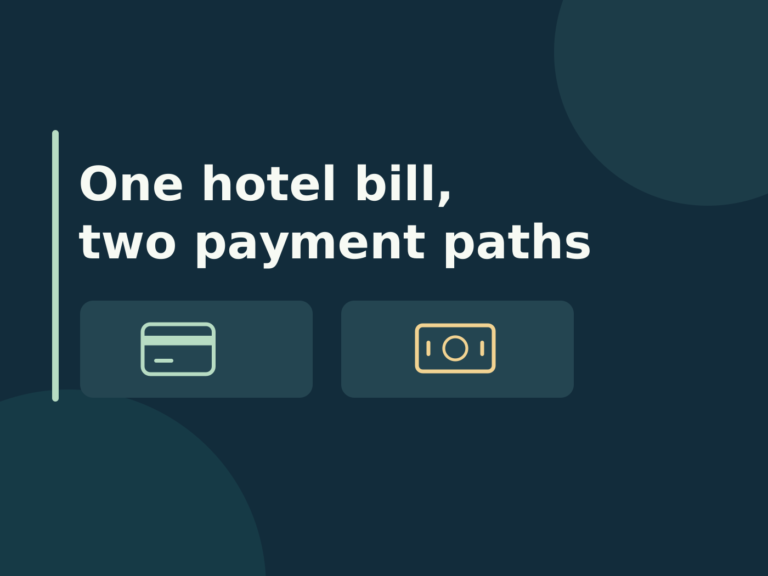
Hotel Card Hold: Compare Two Checkout Payment Paths
Compare two fictional hotel checkout choices while keeping the original card’s capacity and the actual payment in separate records.
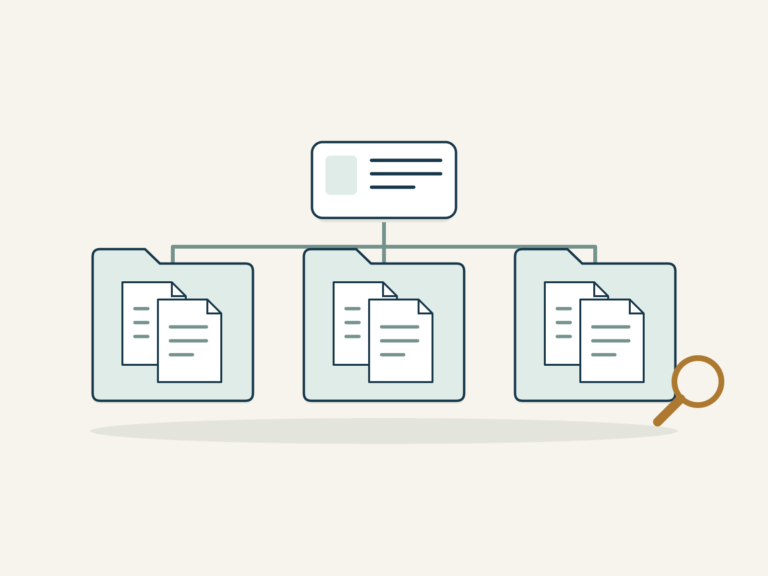
Overdraft Fee? Look Beyond the Online Bill Label
Compare three fictional document packets behind the same $60 ONLINE BILL entry, then identify what the records still leave unexplained.