Loan Denial Notice: What to Check Before Applying Again
Read a personal-loan denial notice, separate lender reasons from score factors, and track report requests and evidence before applying again.

Before applying again after a personal-loan denial, save the complete notice and identify what the lender actually decided. Then match each stated issue to the record that can answer it. A new application is not a substitute for understanding an unresolved question.
This checklist is for U.S. consumer personal-loan applications. Keep your notes privately; do not send denial notices, credit reports, identification documents or account details to EasyLoanWorld.
First, identify the action and the application
Keep every page, the envelope or delivery record, and relevant application messages. Check the lender, product and application reference before acting, especially if you recently made several requests.
A notice of incompleteness specifies missing information and a response period. Do not assume that request is a denial; read the action and deadline carefully. Regulation B addresses these notices separately.
Make a short notice inventory:
- Lender, product and date you applied.
- Action described, notice date and date received.
- Private application reference, without copying sensitive identifiers into a shared document.
- Reasons supplied or instructions for obtaining them.
- Reporting company and report or score date, if shown.
- Outstanding question and the next step you need to take.
If something is missing or unreadable, ask the lender for the complete information. Do not fill a gap by guessing what a generic phrase means for your application.
Separate the decision, score information and report instructions
For consumer credit denials, Regulation B generally requires specific principal reasons or notice of how to request them. Credit-score factors do not replace the lender’s actual denial reasons.
When a decision relies wholly or partly on a consumer report, federal law requires reporting-company contact information and an explanation that the company did not make the decision and cannot supply the lender’s specific reasons. Disclosure of a numerical credit score is conditional on a score actually being used in the adverse action.
Read the document in three passes. Mark the lender’s reasons first. Next, identify any score section. Finally, locate report-request and dispute instructions. Put a question mark beside anything you cannot confidently place.
The practical question is: “Which organization has the record I need to understand this issue?” Keep that question separate from “Will someone approve me?” The first helps you gather evidence; the second cannot be answered by this checklist.
Track two different requests when they apply
Request the reasons from the lender
If the notice offers reasons on request, request them within 60 days of the creditor’s notification; the lender must provide them within 30 days of your request. Notification occurs when the notice is delivered or mailed, or when the decision is communicated orally. It is not necessarily when you read a mailed notice. See section 1002.9(a)(2)(ii) and its interpretation.
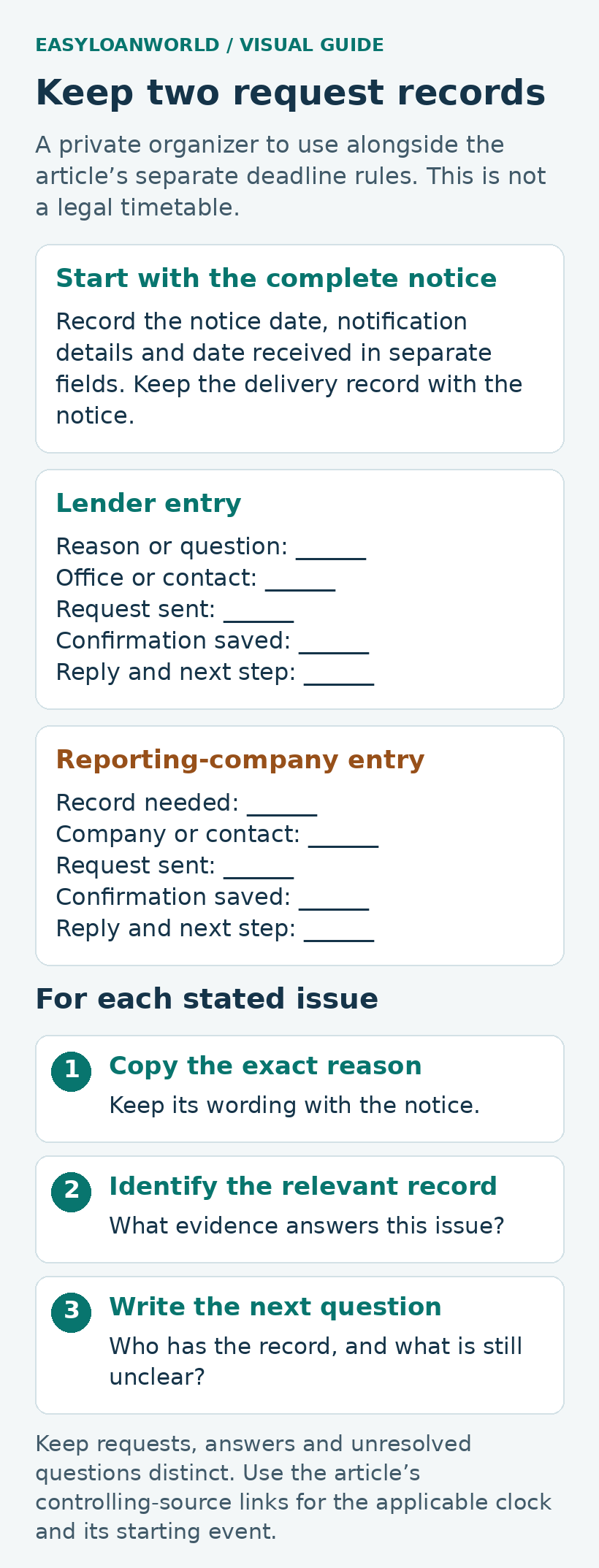
Use the identified person or office and retain your request confirmation. Act promptly rather than planning around the final day. Record: request sent, recipient, confirmation reference, response received and remaining question.
You can ask: “Please identify the specific reasons for this application decision and how I can obtain them in writing. If an application detail was entered incorrectly, which office should review it?” Follow the notice’s request instructions; this suggested wording is not a mandatory form.
Request the qualifying free report from the reporting company
For a report-based denial, request the qualifying free report from the reporting company named in the notice no later than 60 days after receiving the notice. This receipt-based rule appears in 15 U.S.C. 1681j(b). It is not a general deadline for disputing all reporting errors.
Keep a separate entry for that request: company, notice received, request sent, confirmation and report received. Preserve both notice and receipt dates rather than treating them as interchangeable.
Ordering a report does not itself ask the lender to reconsider. Asking the lender for reasons does not itself obtain the reporting company’s file. Neither request is a promise that an application issue will be resolved within the request window.
Turn each reason into an evidence question
Give each stated reason its own four-line note:
- The exact reason as provided.
- The record that supports it or makes you question it.
- The organization with the relevant record.
- The question asked, reply received and remaining next step.
If a credit-report entry may be wrong
Follow the CFPB’s official dispute instructions. Filing a dispute does not establish that the entry is wrong or guarantee removal.
If the application or verification record may be wrong
Compare the submitted answer with the underlying record. Ask the lender how to correct or clarify it and whether the original application can still be reviewed. Keep the original submission and any correction distinguishable. Never alter evidence to produce a preferred answer.
If the information is accurate
Consider what can realistically change and whether borrowing still fits your situation. Do not label accurate information an error simply because the decision was disappointing. An explanation can help you make a better next decision without producing an immediate route to approval.
A fictional example: two reasons need two checks
Imagine an applicant receives two reasons: monthly obligations are high relative to documented income, and one stated income source could not be verified. These are invented facts, not a lender’s universal approval standard.
The applicant’s evidence plan has two parts. First, ask which obligation and income figures were used and compare them with the records. Second, locate the requested evidence for the unverified income source and ask what further review the lender permits.
If the figures are accurate, the next decision is about the borrowing need and budget. Resolving the verification question would not by itself establish that the other reason disappeared. Changing a score alone would not answer both questions either.
Decide what you need to know before reapplying
- What has specifically changed, and what evidence shows it?
- Is a factual dispute or verification question still unresolved?
- Does this lender allow reconsideration or require a new application?
- What is its stated reapplication policy?
- Would another request involve a new credit inquiry or fresh documentation?
- Does the remaining borrowing need and payment still fit your budget?
Get the lender’s actual answers instead of assuming a standard waiting period or applying repeatedly without new information.
If you suspect unfair treatment or need help understanding a report-based denial, consult the CFPB’s denial guidance and complaint resources. A complaint is not a guarantee of reconsideration, approval or compensation.
General U.S. consumer education, not individual legal advice. Sources checked October 19, 2026.
Featured photo: Photo by Cht Gsml on Unsplash. Used under the Unsplash license. Illustrative stock photograph of blank envelopes. These are not actual lender notices or credit records. Photo by Cht Gsml on Unsplash.

Keep Savings or Pay Extra on a Personal Loan? Compare Cash and Debt
A fictional three-payment comparison shows how extra principal changes cash, debt, and interest, then tests which expenses the remaining cash can cover.

Payday Alternative Loans: Your Options
Screen three cash needs, then compare actual offers.

Stop Loan Autopay: Separate the Debit From the Debt
Review a fictional $210 payment, trace a $420 cash outflow, and compare the supporting records before treating an unexplained difference as resolved.