Extra Personal-Loan Payments: Check Principal, Due Dates and Interest
Check how an extra personal-loan payment affects principal, your next due date and interest. Use a payment audit and a clearly hypothetical schedule.

Before making an extra personal-loan payment, confirm how much will reduce principal and what will remain due next. After the payment completes, check the allocation against those instructions. A payment confirmation, a lower principal balance and a later billing date answer different questions.
Use only cash you can spare after required payments and essential bills. This guide helps you audit one existing loan; it does not decide which debt to prioritize or promise a particular saving.
Read five fields separately
Make a private before-payment note using the account’s exact labels:
- Principal: Remaining loan principal and its as-of date.
- Interest and fees: Amounts currently accrued or due and the allocation order.
- Next obligation: Required amount and due date.
- Automatic withdrawal: Amount and date still scheduled.
- Repayment projection: Expected finish date under the payments you actually intend to make.
A later displayed due date does not, by itself, tell you whether principal fell or interest stopped. Principal reduction also does not establish that the next installment disappeared. Allocation and billing-date advancement are separate effects that can coexist.
Upstart’s servicing help says additional payments do not replace the scheduled installment or postpone its due date, and are allocated to principal and interest according to the agreement.
Best Egg’s guidance says paying ahead may advance the due date, while enrolled automatic payments continue at the fixed scheduled amount.
Those examples show why you must verify your own loan’s treatment. They are not recommendations of either provider. Do not apply one company’s explanation to another account.
Ask what an extra-payment instruction can actually do
Contact the servicer through a verified channel and ask:
- Which fees and accrued interest must be satisfied before money reduces principal?
- Can I give a principal-reduction instruction, and what method is accepted for this loan?
- What will happen to the next required amount, its due date and the scheduled automatic debit?
- Does a prepayment charge or other contractual charge apply? Where is it explained?
- Where can I see the completed allocation and an updated repayment projection?
These are questions, not guaranteed account features. Writing “principal only” in a memo does not override the agreement.
For example, SoFi’s payment guidance currently says principal-only payments are unavailable and describes allocation to fees, then accrued interest, then principal. That is a provider-specific policy.
Do not confuse interest already accrued with a charge for early repayment. Ask separately about an unexpected fee and the term said to authorize it; its appearance on a screen does not resolve whether it is correct.
Example: $100 extra changes the principal reduction
This is a fictional monthly-period model, not a named lender’s policy, a current offer or a prediction for your account.
- Starting principal: $5,000.
- Fixed annual contract interest rate: 12%; monthly rate: 1%.
- First payment: one month later; all payments occur at month-end after monthly interest is added.
- Interest: rounded to cents each month, with half cents rounded up.
- No fees, prepayment charges, skipped payments or rate changes.
- All payment dollars above that month’s interest reduce principal.
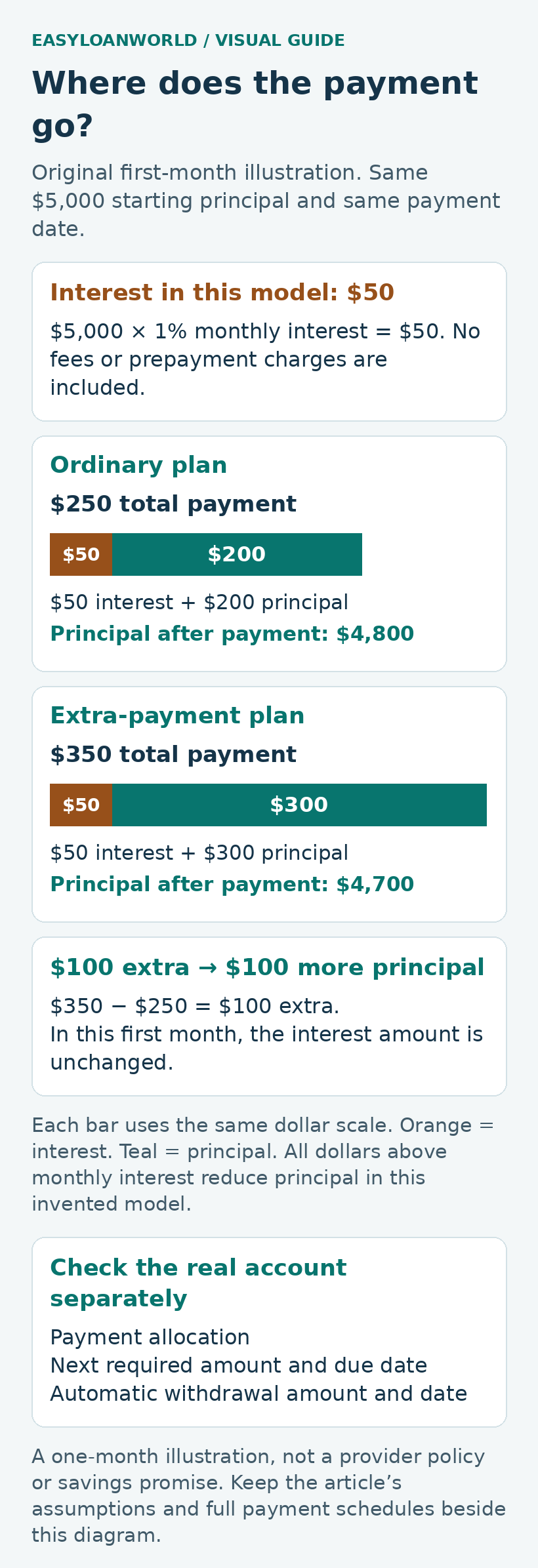
The assumed regular installment is $250. The extra-payment plan sends $350 total each month, including $100 extra, except for a smaller final payment. No reduction in the required $250 installment or re-amortization is assumed.
First month: ordinary plan
Interest is $5,000 × 1% = $50. Of the $250 payment, $50 covers interest and $200 reduces principal. Remaining principal is $4,800.
First month: extra-payment plan
Interest is still $50 because the starting balance, rate and payment date are identical. Of the $350 total payment, $50 covers interest and $300 reduces principal. Remaining principal is $4,700.
The $350 is not the extra amount; $100 is. The $50 interest is not an early-payment penalty. Later interest must be recalculated from each plan’s changing balance.
Follow both schedules through the smaller final payment
Applying the stated monthly calculation repeatedly produces:
- $250 plan: 22 payments of $250, followed by $106.76 on monthly payment date 23. Total paid: $5,606.76, including $606.76 interest.
- $350 plan: 15 payments of $350, followed by $172.63 on monthly payment date 16. Total paid: $5,422.63, including $422.63 interest.
Within this model, the extra-payment plan costs $184.13 less interest and finishes seven monthly payment dates earlier. These are outputs of invented assumptions, not promised savings.
The second month illustrates why the schedules separate: interest is $48 on $4,800 in the ordinary plan, versus $47 on $4,700 in the extra-payment plan. The calculation continues from each new balance.
The 16-payment result assumes the $350 plan continues until its smaller final payment. A single $100 extra payment is a different scenario. If later extras stop or their timing changes, recalculate; do not keep using the finish date from the original plan.
Do not multiply 23 × $250 or 16 × $350 to obtain the totals: each would overstate the smaller last payment. Dividing an unchanged estimate of future interest by $100 also misses the changing principal balances.
Upstart’s allocation explanation describes daily simple interest, where payment timing affects accrued interest and the principal share. It excludes Relief Loans. A daily-interest account can differ from this monthly model.
OneMain’s precomputed-interest explanation provides another counterexample: early-payoff treatment can involve a rebate under the loan’s terms. Do not use this monthly model for a precomputed-interest contract.
Use the agreement’s actual interest method and confirmed payment dates when checking your own projection. Do not assume all personal loans are penalty-free, that a fee will be refunded or that an extra payment automatically lowers the required installment.
Reconcile the posted result
Keep this payment-audit card privately. EasyLoanWorld does not need your loan records or account details.
- Before: Principal balance and timestamp.
- Instruction: Amount submitted, date, accepted direction and confirmation reference.
- Completion: Posted or credited date and total payment recorded.
- Allocation: Dollars recorded against fees, interest and principal.
- After: New principal and any other principal adjustment.
- Next: Required amount, due date and automatic-debit amount/date.
- Projection: Updated finish estimate and the future payments it assumes.
If no other principal adjustment occurred, opening principal minus the posted principal reduction should reconcile to closing principal. In the fictional first month, $5,000 − $300 = $4,700. Real records may require explaining other adjustments before that comparison is meaningful.
A scheduled transaction is not yet proof of completed allocation. If the result differs from what you understood, save the instruction and confirmation, identify the exact discrepancy and ask the servicer to explain it. Do not assume fraud, an error or a right to reallocation without evidence.
Keep required payments current while you investigate; do not cancel autopay merely because you paid extra. When you are actually ready to finish the loan, request a dated payoff amount and reconcile pending transactions separately.
U.S. consumer education. Contract and servicing rules vary. Sources checked October 19, 2026.
Featured photo: Photo by Kim Leary on Unsplash. Used under the Unsplash license. Illustrative stock photograph of stacked coins. The stacks do not represent the example payment amounts or promised savings. Photo by Kim Leary on Unsplash.

Keep Savings or Pay Extra on a Personal Loan? Compare Cash and Debt
A fictional three-payment comparison shows how extra principal changes cash, debt, and interest, then tests which expenses the remaining cash can cover.
Payday Alternative Loans: Your Options
Screen three cash needs, then compare actual offers.

Stop Loan Autopay: Separate the Debit From the Debt
Review a fictional $210 payment, trace a $420 cash outflow, and compare the supporting records before treating an unexplained difference as resolved.