Loan Scams: Verify the Lender and Offer Before Sharing Data
Check a loan offer’s company, contact channel and payment request before sharing data. Use an independent-verification worksheet and official reporting links.

Verify the company, the contact channel and the specific request separately before sending money or personal information in response to a loan offer. Finding a real company with the same name does not prove that a message came from it.
Step away from the incoming message and use an independently confirmed route. These checks reduce uncertainty; they do not certify a loan as genuine, affordable or risk-free. Pressure to act quickly is a reason to slow down.
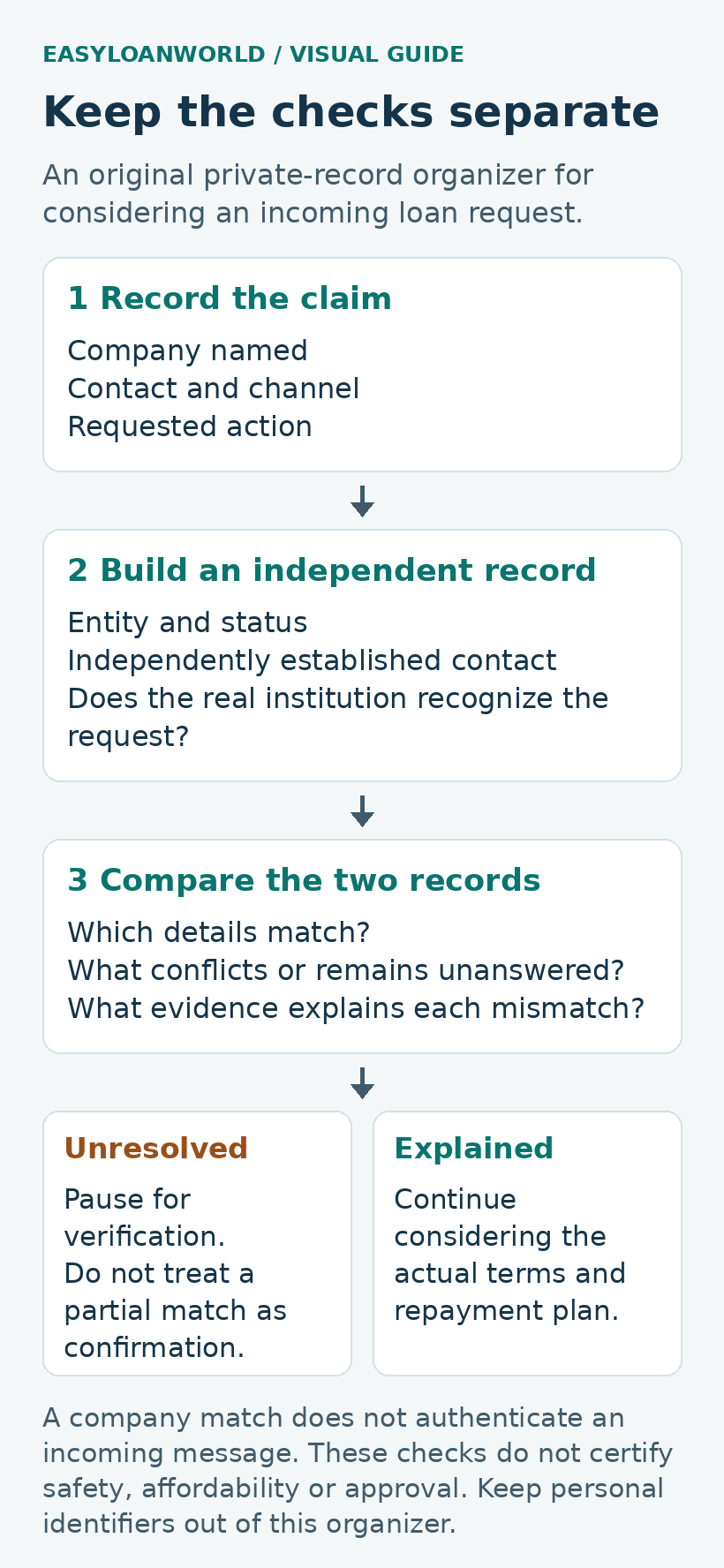
Start with what you did, not what the message claims
Did you actually apply to this company? Is the message about an application you recognize? Record the claim without accepting it as true.
The FTC warns about unexpected loan-application texts that seek confirmation or personal details. Do not reply or click a link merely to deny or cancel an application you never made. Use your phone’s report-junk option or forward suspicious texts to 7726.
If you are concerned a real application exists, contact the actual institution independently. The suspicious message’s cancellation link and callback number are not independent verification routes.
Distinguish a fee from a fee-for-guaranteed-credit promise
The FTC’s advance-fee loan guidance warns about paying for promised or guaranteed credit. It also explains that legitimate lenders can charge application or appraisal fees before considering an application. An upfront fee alone is not proof of fraud.
In a suspicious loan-release demand, requests for gift-card numbers, cryptocurrency or a transfer deserve particular caution. Do not make a small “test” payment to establish whether the promise is real.
Ask what the charge buys, who receives it, when it becomes payable and where it appears in the proposed terms. Does the caller claim payment guarantees approval? Has the actual institution confirmed the request through an independent channel?
A written label such as “insurance” or “processing” does not resolve those questions. This guide does not decide whether a particular fee is lawful, refundable or worthwhile.
Identify the entity before choosing a lookup
Write down the exact legal entity named in the proposed agreement. Clarify whether the contact claims to represent the lender, an intermediary or another service. If a brand and legal name differ, ask the real institution to explain the relationship rather than assuming fraud.
Lookup routes differ. For example, Washington’s financial regulator directs consumer-loan-company checks to NMLS Consumer Access and provides separate routes for banks, credit unions and other activities. That is a Washington example, not a nationwide licensing rule.
Do not assume every lender must appear in NMLS, hold the same state license or be FDIC-insured. Ask the appropriate authority which license, charter or exemption applies to the particular entity and activity. A missing search result calls for clarification, not an automatic fraud verdict.
The CFPB’s state bank-regulator directory is a starting point; check the current official agency site.
Record which authority and lookup you used, the entity matched, the status shown and the date checked. A result about a similarly named business is not a match. Even a correct match does not authenticate this offer.
Connect the message to the real company
The FDIC warns that scammers can copy bank identities and misuse its logo. For a claimed FDIC-insured bank, its guidance points to BankFind to check the name and website. A logo alone is insufficient. Use independently known contact details to verify the request.
For an existing relationship, a trusted statement or card can provide a contact route. Otherwise, establish the official site independently. Ask the institution whether it recognizes the representative, application reference, offer and proposed document-upload or payment route.
A bank-directory result concerns the institution it covers. It is not a universal lender-license search or a safety rating for an incoming offer. Likewise, a polished website or a lack of complaints does not settle who contacted you. A complaint deserves investigation rather than an automatic conclusion about a similarly named company.
Keep two records and a list of contradictions
This is a private comparison method, not a compliance form. Do not put Social Security numbers, account numbers or login details in it.
- The message claims: Company, website domain, callback number, representative, reference and requested action.
- The independent route establishes: Entity, appropriate regulator or status, official contact route, and whether the specific request is recognized.
- Still unresolved: Each mismatch, unanswered question and the evidence needed to resolve it.
Do not smooth over a conflicting domain or unrecognized representative because another detail matches. Equally, do not label a real business a scam solely because a search was inconclusive. Leave the request unresolved until you have an adequate explanation.
Two fictional decisions
A company record matches, but the contact does not
An invented message names a company found in the appropriate official lookup. Reached independently, the real company says the sender and upload request are not theirs.
The company record did not authenticate the sender. Do not use that upload link or send documents. Preserve the message safely and use official reporting guidance. This scenario names no real business and makes no allegation about one.
A caller promises a loan after an “insurance” transfer
In this separate fictional scenario, the caller promises unconditional approval after an advance transfer. The recipient cannot independently confirm the caller or request. Do not pay for that promise.
A disclosed application fee from an independently verified provider would be a different situation, but it would still not guarantee approval, affordability or a refund. Confirm the actual terms and contact; a fee label is not a shortcut to either acceptance or rejection.
Before sharing a document, resolve the request itself
Copy these prompts into your private record:
- Who exactly will receive the information, through which verified channel?
- What document or information is requested, and for what stated purpose?
- Has the real institution confirmed the request and submission route?
- Is the requested information more extensive than the explained purpose?
- What remains inconsistent? Who resolved it, when and with what evidence?
- Decision: pause for verification, decline, or continue considering through the verified route.
“Continue considering” does not mean “safe” or “approved.” Review the borrowing need, repayment plan and actual terms separately. Ask the verified institution what an application requires rather than assuming blanket redaction will leave it complete.
Do not send documents to EasyLoanWorld or post them in comments. Do not give an unsolicited contact remote control, login secrets or authentication codes.
If money or information was already sent
Follow the FTC’s steps after a scam:
- Money: Promptly contact the real bank or payment service and ask whether reversal or recovery is possible. A refund is not guaranteed.
- Credentials: Use the real service’s recovery and security steps, including password and two-factor-authentication guidance.
- Personal information: Use IdentityTheft.gov guidance for what was exposed. Report the suspected scam at ReportFraud.ftc.gov.
Keep dates, messages, screenshots, payment confirmations, a description of information shared and official support references together privately. Avoid publicly reposting sensitive details. Do not confront the suspected sender or pay a second fee to recover the first payment. Reporting is not a promise of reimbursement or an individual response.
U.S. consumer education. Verification and reporting options depend on the institution, activity and circumstances. Sources checked October 19, 2026.
Featured photo: Photo by MJ Duford on Unsplash. Used under the Unsplash license. Illustrative stock photograph of a magnifying glass and laptop. It does not depict an actual lender, investigation or verified loan offer. Photo by MJ Duford on Unsplash.

Keep Savings or Pay Extra on a Personal Loan? Compare Cash and Debt
A fictional three-payment comparison shows how extra principal changes cash, debt, and interest, then tests which expenses the remaining cash can cover.
Payday Alternative Loans: Your Options
Screen three cash needs, then compare actual offers.

Stop Loan Autopay: Separate the Debit From the Debt
Review a fictional $210 payment, trace a $420 cash outflow, and compare the supporting records before treating an unexplained difference as resolved.