Debt Consolidation Loan vs. Balance Transfer: Compare the Payoff Plan
Compare a consolidation loan and balance transfer using the same debt and repayment budget, including fees, promotional expiry and partial transfers.

Compare a debt-consolidation loan and a balance transfer by asking how much of the same debt each offer actually retires, then applying one repayment budget. For a promotional card, carry the calculation past the promotion’s expiration whenever a balance will remain.
The fictional example below replaces $6,000 of existing card debt and pays $300 a month toward either option. It shows the balance at promotional expiry, the cost afterward and the different budget needed to finish before that deadline. It is an offer-comparison method, not a product ranking.
Make the starting debt match
The CFPB explains that consolidation combines debts into a loan payment. A longer repayment period can increase overall cost.
Write down which old balances would actually be cleared. Compare net debt retired, rather than assuming equal quoted credit amounts buy the same result.
As Discover’s loan FAQ explains, a lender may deduct an origination charge from proceeds. Verify the particular offer’s fee treatment before equating its principal with money available to pay creditors.
The CFPB confirms that a zero-percent transfer offer can still carry a transfer fee. Include that charge in the comparison.
Eligibility also matters. For example, Chase’s transfer FAQ excludes paying cards or loans issued by Chase or its affiliates. That is a provider-specific restriction. Ask your actual issuer which debts and amounts qualify.
Worked example: $6,000 retired, $300 available monthly
Assume either transaction fully clears exactly $6,000 at time zero. No old interest, pending purchase or charge remains. There is no extra cash borrowed or household cash contribution.
Both options receive $300 at each month-end, beginning one month later, except for the final smaller payment. Assume all required minimums are met. The loan permits extra repayment without penalty and applies it after interest. There are no new purchases, annual fees, late payments, additional charges or discounts.
The model adds monthly interest before payment, using nominal annual rate divided by 12, with no intermediate rounding. It is a simplified illustration, not a statement estimate or disclosed-APR calculation. Real payment dates, day counts, allocation, rounding, fee rules and variable rates can change the outcome.
Route A: fixed-rate consolidation loan
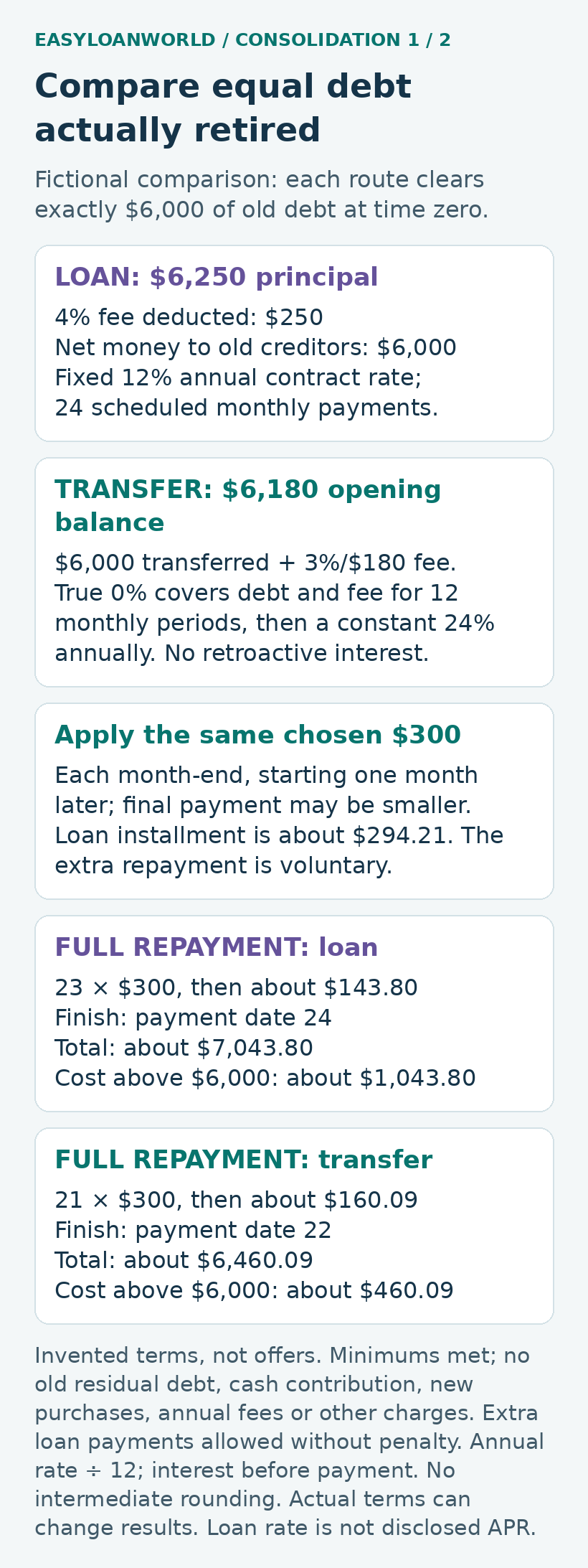
Assume a fixed 12% annual contract interest rate over 24 scheduled months, with a 4% fee deducted from principal:
- New principal: $6,250.
- Deducted fee: $250.
- Net money retiring old debt: $6,000.
- Modeled required installment: about $294.21.
The selected $300 payment is voluntary extra repayment, not the contractual minimum. At that pace, the model uses 23 payments of $300 and a final payment of about $143.80 on payment date 24.
Total repayment is about $7,043.80: $6,000 of original debt, the $250 new fee and approximately $793.80 of new interest. Cost above the debt retired is about $1,043.80. The fee is already financed; do not add it again to total payments.
Route B: promotional balance transfer
Assume a 3% fee on the $6,000 transferred amount, added to the new card. That creates a $6,180 opening balance, including the $180 fee.
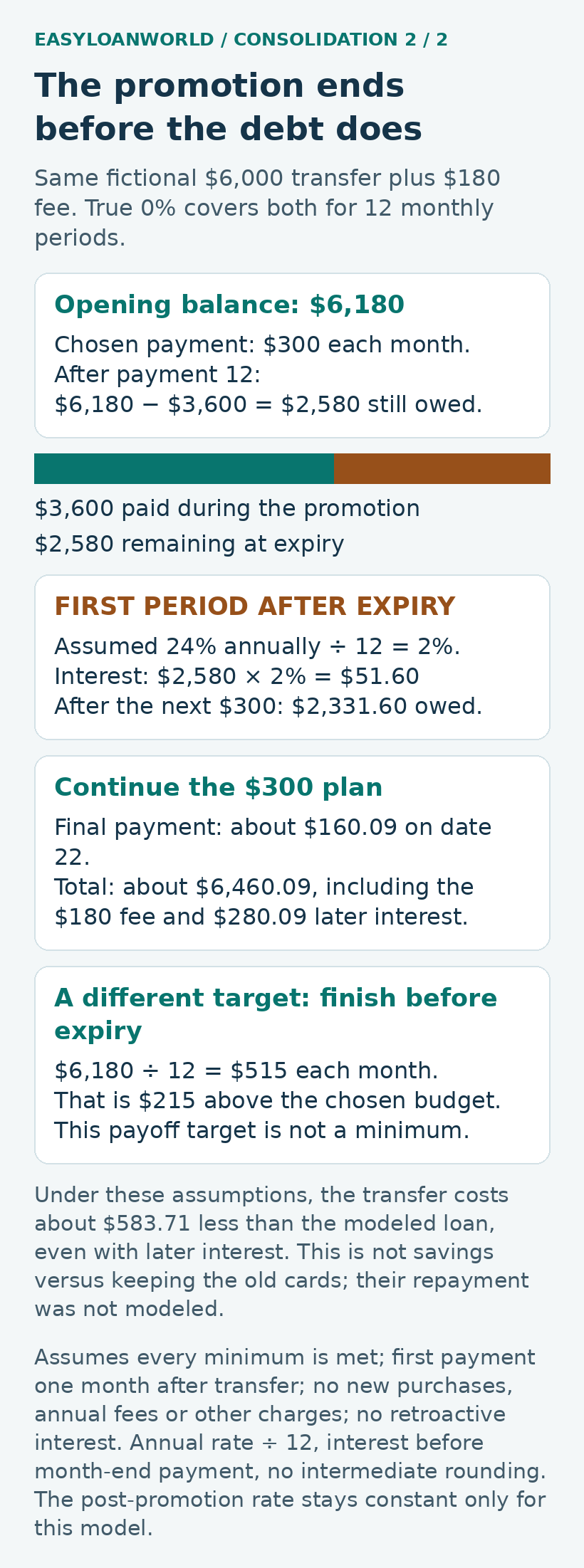
In this invented offer, true 0% applies to both the transferred debt and its fee for exactly 12 monthly periods. Immediately after payment 12, a constant 24% annual rate begins, modeled as 2% monthly. No interest is added retroactively for the first 12 periods; this example is not a deferred-interest arrangement.
- Twelve payments of $300 remove $3,600.
- $2,580 remains when the promotion ends.
- The first post-promotion interest charge is $2,580 × 2% = $51.60.
- After the next $300 payment, the balance is $2,331.60.
Continue at $300. The full model uses 21 payments of $300, then a final payment of about $160.09 on payment date 22.
Total repayment is about $6,460.09: $6,000 of old debt, the $180 fee and about $280.09 of post-promotion interest. Cost above the debt retired is about $460.09.
Read both the deadline and the final result
Under these assumptions, the transfer costs about $583.71 less than the modeled loan and finishes two payment dates earlier. That is not a savings figure against keeping the old cards: their repayment path has not been modeled. Different offers can reverse the comparison.
For a different target, clearing this transfer during the 12 zero-interest periods requires $6,180 ÷ 12 = $515 per month. That is $215 above the chosen $300 budget.
The $515 figure is a payoff target, not an assumed required minimum. Paying $300 may satisfy the invented offer’s minimum, but it cannot meet the zero-balance deadline. A realistic comparison should show that gap rather than claim the balance will disappear during the promotion.
Leaving a balance does not automatically make this transfer more expensive than the loan. The example still favors it after including later interest. What matters is the remaining amount, its actual future rate and a sustainable payment path. Do not fill the gap by assuming another promotional offer will be available.
Chase’s guide to transfer terms highlights transfer limits, completion deadlines, fee minimums, annual fees and the fee’s own interest treatment. Record the actual promotional end date and subsequent rate. New purchases can create different-rate balances and complicate payment allocation.
If only part of the debt can move
Suppose a separate hypothetical offer accepts only $4,800 of the $6,000 debt, with a 3% fee. The new card starts at $4,944, while $1,200 stays on the old account. Combined debt starts at $6,144 before further interest.
The full-transfer calculation no longer applies. Record both required payments and rates, then divide the total $300 budget across the two accounts. Sending $300 to the new card while ignoring the old account understates the cash needed.
No payoff date or total cost can be calculated for this partial example without the old rate, minimum, payment split and dates, plus the new-card terms. If combined required payments exceed $300, the proposed budget has an unresolved shortfall.
Finish the comparison before committing
- Debt retired: eligible accounts, dated payoff amounts, net proceeds and anything remaining elsewhere.
- Payment plan: required amounts, selected budget, extra-payment treatment and final payment date.
- Promotion record: completion window, expiry date, qualifying balances, fee treatment, later rate and whether it can vary. Expiry may differ from a payment due date.
- Result: balance at expiry, cost through final payoff and any missing offer term.
- Existing-debt option: calculate keeping the old accounts under a stated plan before claiming savings against them.
Submitting a transfer request does not settle the source debt. Chase instructs borrowers to keep paying until the transfer has posted and paid the balance. Confirm completion before changing an existing payment plan.
The useful choice comes from a complete repayment path: equal debt retired, an achievable budget and all remaining balances accounted for.
Featured photo: Photo by Mediamodifier on Unsplash. Used under the Unsplash license. Blank stationery for illustration. Photo by Mediamodifier on Unsplash.

Keep Savings or Pay Extra on a Personal Loan? Compare Cash and Debt
A fictional three-payment comparison shows how extra principal changes cash, debt, and interest, then tests which expenses the remaining cash can cover.

Payday Alternative Loans: Your Options
Screen three cash needs, then compare actual offers.

Stop Loan Autopay: Separate the Debit From the Debt
Review a fictional $210 payment, trace a $420 cash outflow, and compare the supporting records before treating an unexplained difference as resolved.