Credit Card Billing Errors: Build and Track Your Dispute Record
Organize one questioned card entry, supporting documents, notice delivery evidence and the issuer response with a fictional duplicate-entry example.

A suspected credit-card billing error is easier to explain when one record connects the questioned entry, the supporting evidence and the issuer’s response. Start with the statement itself. Mark the item you question, describe why, and keep the amount distinct from the rest of the bill.
This guide organizes U.S. consumer credit-card billing-error records. It does not cover debit-card disputes, credit-report corrections, debt-collector notices or complaints about product quality. It is general education, not advice about your individual legal rights or payment decision.
Contact the issuer promptly. You can dispute a charge even if you already paid it. Keep copies and a dated follow-up record. For a billing-error notice, written acknowledgment is due within 30 days of receipt unless the required resolution is completed within that time. See the CFPB’s dispute guidance.
Identify the discrepancy before naming the outcome
Billing errors can include duplicate charges, wrong amounts or missing payment credits. Send supporting copies, retaining originals. The FTC’s billing-error guidance describes this process.
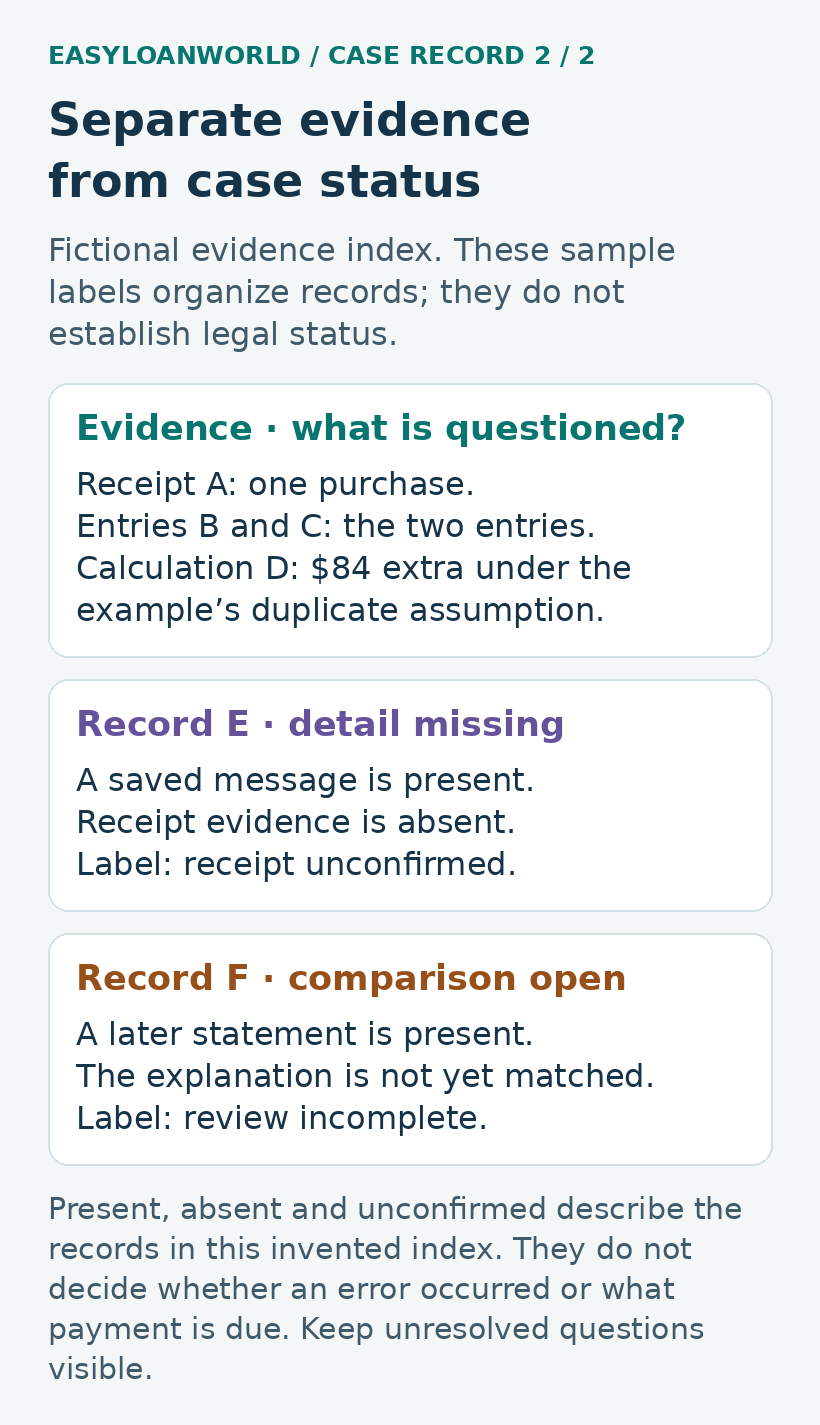
Create a private issue card with the statement period, entry identifier, billed amount, expected amount and reason for questioning it. Attach a document identifier to each factual assertion. “Receipt A shows one purchase; statement entries B and C appear to describe it twice” is easier to examine than “this entire bill is wrong.”
Record uncertainty honestly. Two identical amounts could reflect two separate purchases. Look at transaction descriptions, dates and the evidence you actually have before calling them duplicates. A missing receipt is a gap to investigate, not permission to invent the purchase history.
Keep a short list of unanswered factual questions beside the card. For example: do these entries correspond to the same order, or is one a different purchase? Avoid filling the explanation with unrelated frustrations; they can obscure the particular entry you want examined.
Preserve notice receipt, not just a sent message
Written notice must reach the disclosed billing-inquiries address within 60 days after the issuer transmitted the first statement showing the error. Electronic notice qualifies through the issuer’s designated accepted procedure. Resolution is due within two complete billing cycles after notice receipt, never later than 90 days. See Regulation Z.
Build a delivery card from the actual instructions and records. Save the relevant statement, the billing-inquiries instructions you followed, the notice version submitted and the delivery evidence. Distinguish when you prepared the notice, when you sent it and what establishes its receipt. An outgoing message screenshot and a receipt confirmation answer different questions.
A phone call or ordinary chat is not automatically qualifying notice. The clock does not start at discovery.
Do not wait for a perfect folder before acting. If instructions or dates are unclear, contact the issuer promptly for clarification and preserve the answer. A record labeled “date unconfirmed” is more useful than an unsupported last-day calculation. This guide deliberately does not calculate an individual deadline.
Include identifying account information and describe the error in your notice. Use the billing-inquiries destination rather than the payment address.
Keep those account details private. For your own index, a short document label can point to the full record without repeating sensitive information in every note. Check that each attachment is legible and corresponds to the item described; an unrelated page can make an otherwise clear explanation harder to follow.
A fictional duplicate-entry example
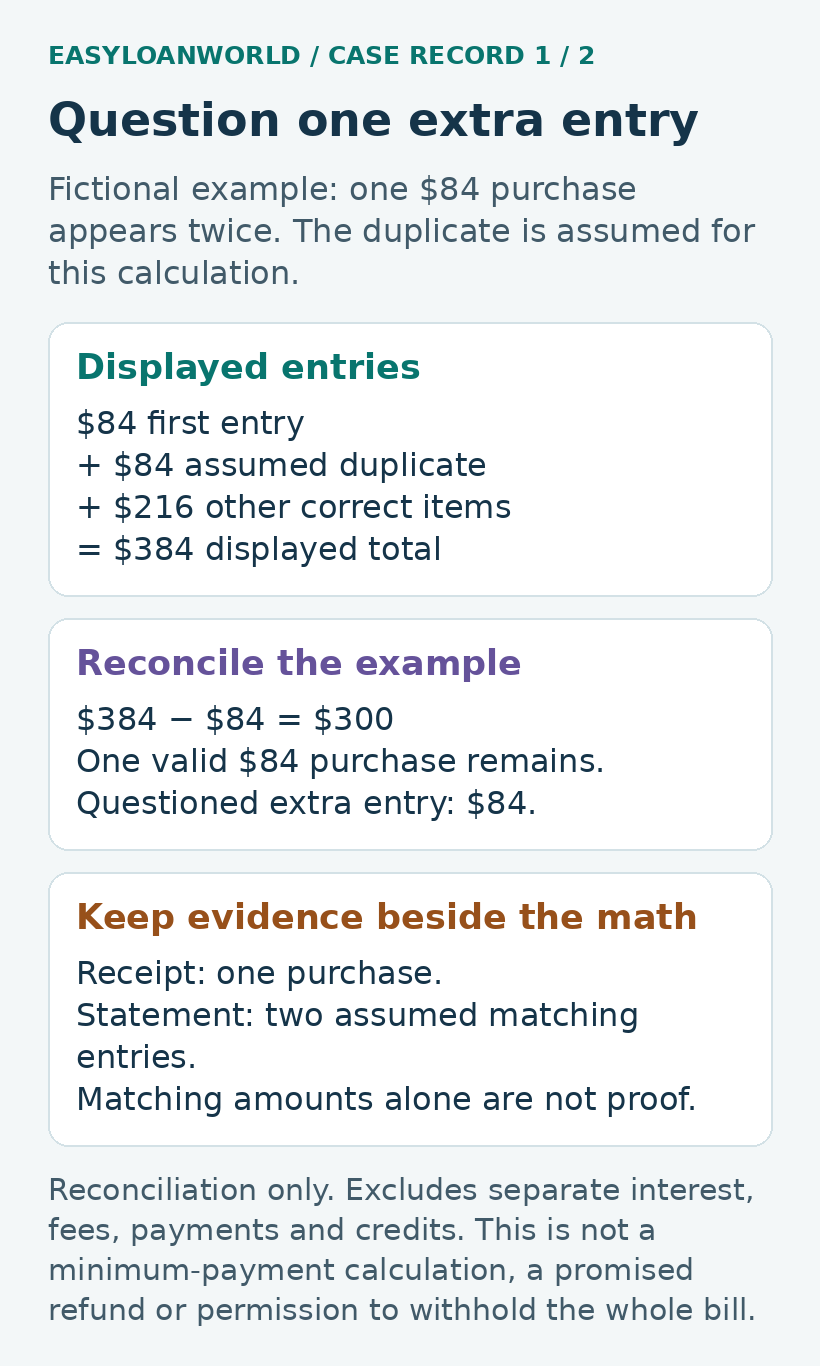
Suppose a receipt documents one $84 purchase. An invented statement contains two $84 entries that, for this example, are assumed to be duplicates of that single purchase. The apparent disputed amount is $84: one extra entry. It is not $168, because the example still includes one valid purchase.
Assume other correct statement items total $216. The displayed items sum to $384: $84 + $84 + $216. Removing the assumed duplicate produces $300: $84 + $216. These figures exclude separate interest, fees, payments and credits.
Label the arithmetic “reconciliation only.” It is not a minimum-payment calculation, a promised refund or permission to withhold the whole bill. The example’s conclusion depends on its duplicate-entry assumption; matching amounts alone would not prove that assumption in a real account.
In your issue card, separate the original evidence from the arithmetic. One line can identify the receipt and entries; another can show how you calculated the amount questioned. That lets a reviewer examine the facts without mistaking a subtraction for proof that an error occurred.
Keep payment handling separate from the evidence file
During a qualifying billing-error investigation, the disputed amount and related charges may be withheld, but undisputed amounts remain payable. Ask the issuer to clarify payment handling if uncertain. Interest is not universally suspended.
A temporary credit is not necessarily the final outcome.
Keep your payment questions beside, but separate from, the description of the error. Record the issuer’s explanation of what remains due and compare it with the statement. Do not treat the fictional $300 figure above as an instruction for your account, or use an unexplained adjustment to decide that every remaining obligation has disappeared.
Track the answer through the next statement
Make a status card containing the acknowledgment, any document requests, adjustments and final response. Identify which documents are missing rather than repeatedly sending the whole folder without explanation. When you receive a new message, record what it changes and what it leaves unanswered.
The issuer must provide a written correction explanation or, if it finds an amount owed, explain that determination and payment requirements.
Match the written result to the relevant statement entry. Keep an adjustment reference separate from the date of the final explanation so you can see whether both exist. If the response addresses a different amount or transaction, identify that mismatch specifically when following up.
Close your working record only when you can state what was decided, what the account now shows and which questions remain. A well-organized file cannot guarantee a favorable decision. It can make the evidence, delivery history and unresolved issues much clearer.
Featured photo: Blank paper and a calculator illustrate checking billing amounts. Photo: Mediamodifier / Unsplash. Used under the Unsplash license.

Credit-Builder Loan vs. Secured Card: A Cash-Access Checklist
Work through three fictional situations and four private questions before deciding whether a new account fits your needs.
Hotel Card Hold: Compare Two Checkout Payment Paths
Compare two fictional hotel checkout choices while keeping the original card’s capacity and the actual payment in separate records.
Overdraft Fee? Look Beyond the Online Bill Label
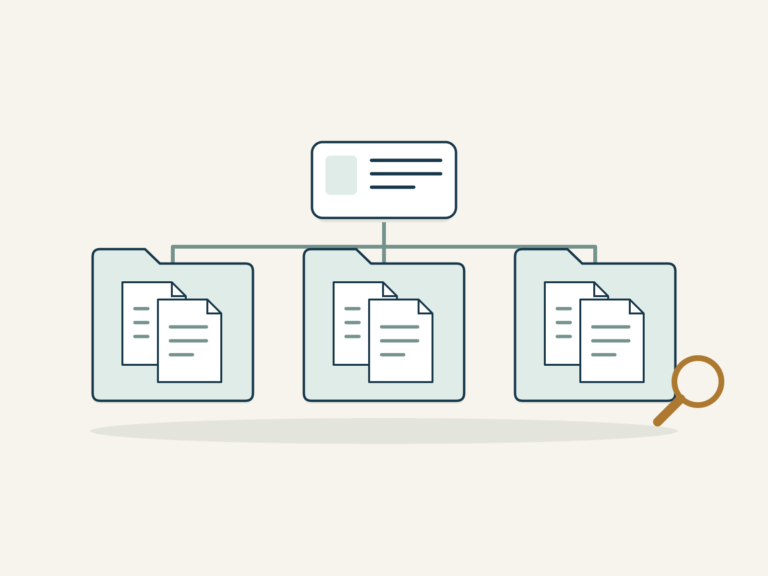
Compare three fictional document packets behind the same $60 ONLINE BILL entry, then identify what the records still leave unexplained.