Personal Loan Late Payments: Verify the Catch-Up Amount
Organize a dated payment record, separate the next installment, and check a fictional catch-up calculation against the lender’s response.

A missed personal-loan payment leaves several questions: which installment remains unpaid, what the lender says will bring payments current, and what comes due afterward. Build a dated catch-up record before treating a balance on a screen as the answer.
Contact the lender promptly if you cannot make a payment. Available arrangements depend on your situation and the lender; missed payments can lead to collection activity or credit reporting. The CFPB explains payment trouble. Do not delay contact while waiting for an assumed reporting threshold.
Identify the missing installment
Start with the payment schedule and the lender’s recent transaction record. For each questioned installment, note its due date and amount. Beside it, record any attempted payment, the attempt date, and whether the lender shows it as credited, returned or still unresolved.
A bank transaction and a lender entry are two records to reconcile. If they disagree, retain both rather than marking the installment paid from the payment attempt alone. Use the actual labels in each record; do not silently change “pending” into “posted.”
Ask the lender for the amount needed to bring payments current, an itemized explanation, and the date through which that amount applies. Also ask whether it includes the next scheduled installment. A total remaining loan balance answers a different question from a catch-up amount.
Keep the quoted amount and the next bill separate
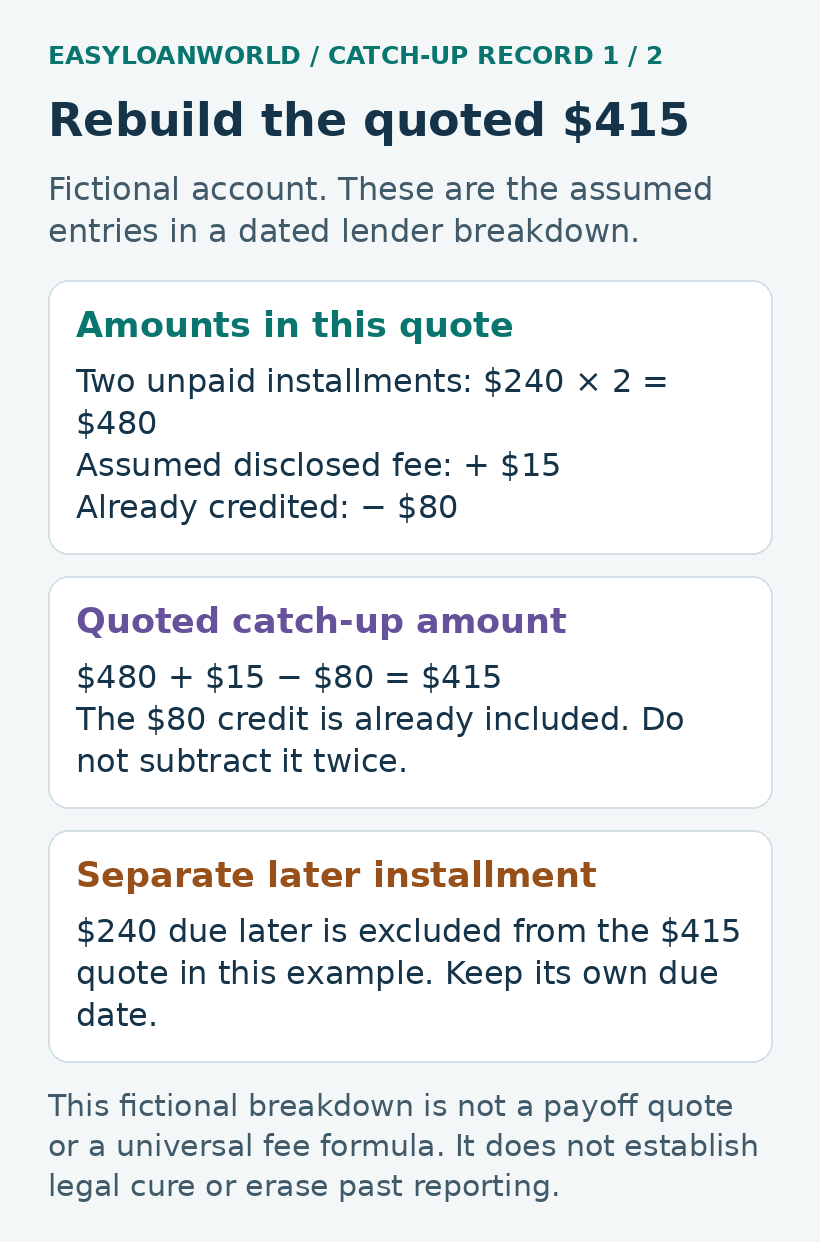
The following figures are fictional. Assume the lender has supplied a dated breakdown with exactly these entries, including a disclosed fee. This is a record-checking exercise, not a rule for calculating every lender’s charges.
- Two unpaid installments: $240 each, totaling $480.
- One assumed disclosed fee: $15.
- Payment already credited against these amounts: $80.
- Lender’s dated catch-up amount: $480 + $15 − $80 = $415.
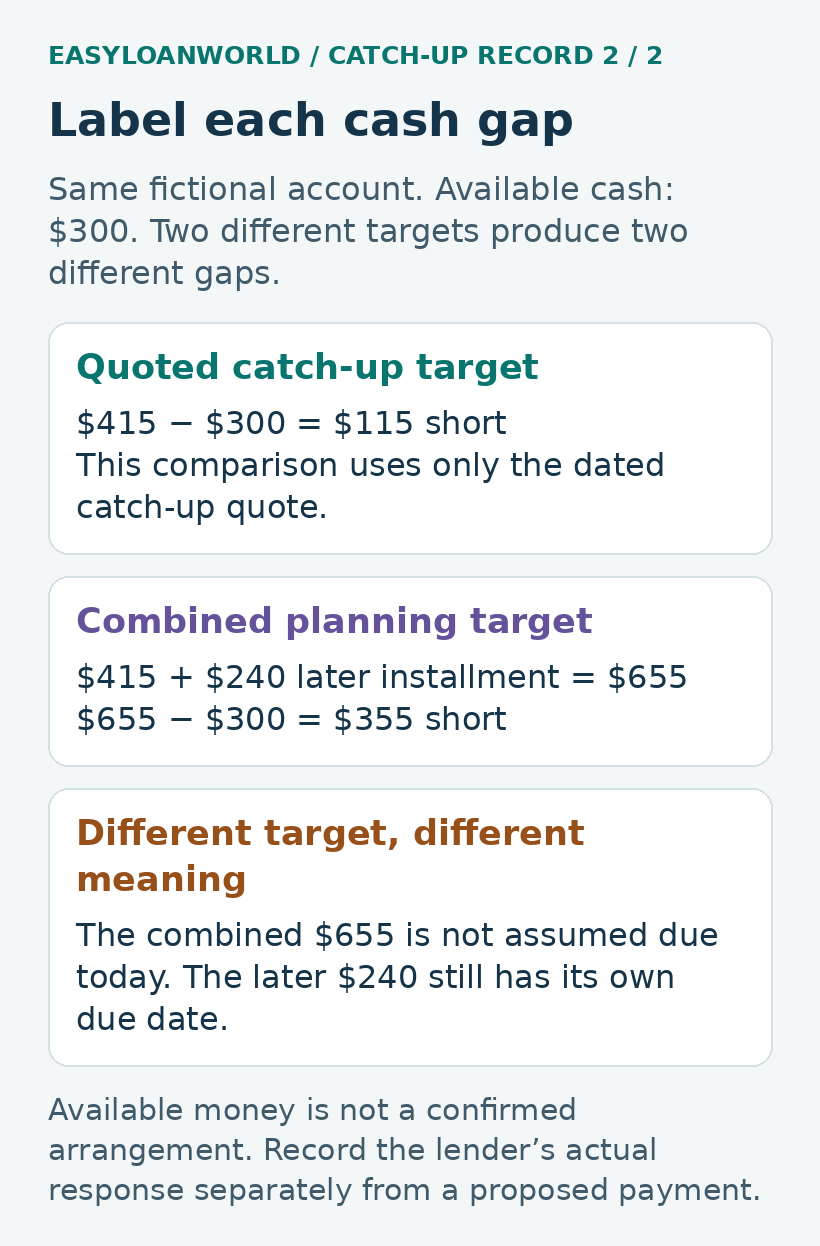
The next $240 installment is due later and, by assumption, is expressly excluded from that $415. Write it on a separate line with its own due date. Do not subtract the $80 again: the quoted $415 already reflects it.
For planning, the two separate targets total $415 + $240 = $655. That does not mean $655 is all due today. If $300 is available, it falls $115 short of the quoted catch-up amount, or $355 short of the combined planning target. Label the target beside each shortfall so the smaller figure does not hide the later bill.
None of these figures is a full payoff quote. The example does not establish legal cure, erase past reporting, or calculate later interest and fees. Your actual account needs its own current breakdown and terms.
Make the unresolved amount explicit
For the fictional account, a useful question is: “Your breakdown shows $415 through the stated date, excluding the later $240 installment. I can offer $300 on my proposed date. What would remain unresolved, and what arrangement, if any, would you accept?” Replace every example amount with verified information before using that wording.
A proposed payment is not a confirmed arrangement. Record the lender’s actual response, including a refusal or a request for more information. If the answer changes the schedule, request written amounts and dates, treatment of the missed balance, interest and fees, the arrangement’s end date, and what happens to subsequent installments. Ask how the lender will describe the account in any reporting; do not infer the answer from a reassuring phrase.
Keep your own offer realistic. An amount you hope to have is different from cash you can identify for a stated date. If the lender’s proposed schedule remains unworkable, leave that issue marked unresolved instead of recording a commitment you cannot support.
Check the payment against the agreement
After an agreed payment, compare the lender’s updated record with the written arrangement. Look for the amount actually credited, its allocation, the remaining past-due amount, and the next installment’s date and amount. Save the version you checked and the date you checked it.
Use four separate status labels in your private notes: requested, agreed, paid and posted. Move an item only when the corresponding evidence exists. If the credited amount or schedule differs, point to the specific entry and ask for an explanation; retain the unresolved difference beside the original agreement.
If the notice says “charge-off”
The OCC’s bank-loan guidance explains that charge-off alone does not cancel repayment. Its guidance principally concerns OCC-regulated banks. Forgiveness, disputed liability and other legal issues require their own review.
This worksheet is not advice about paying an old or disputed debt or responding to a lawsuit. Obtain qualified help for those questions. Keep account records private; this guide requires no upload or public account details.
General U.S. education, not individualized financial or legal advice. Sources checked October 19, 2026. All example amounts are fictional.
Featured photo: A blank notebook and pen for organizing notes. Photo: Adrian Regeci / Unsplash. Used under the Unsplash license.

Keep Savings or Pay Extra on a Personal Loan? Compare Cash and Debt
A fictional three-payment comparison shows how extra principal changes cash, debt, and interest, then tests which expenses the remaining cash can cover.
Payday Alternative Loans: Your Options
Screen three cash needs, then compare actual offers.

Stop Loan Autopay: Separate the Debit From the Debt
Review a fictional $210 payment, trace a $420 cash outflow, and compare the supporting records before treating an unexplained difference as resolved.