Identity-Theft Records: A Report-by-Report Matrix
Use a fictional account-by-bureau matrix to separate three report appearances from two accounts and track which responses still need checking.
When one alleged identity-theft account appears on two credit reports, it creates two places to check, but it is still one underlying account. A small account-by-bureau matrix helps separate those counts and keeps an unfinished response from disappearing behind a reassuring total.
This organizer starts with records you already hold: reports, correspondence and copies of prior submissions. The example concerns the nationwide U.S. credit bureaus. It does not walk through filing a report or provide a complete recovery plan. Keep your working copy private; do not send identification documents or credit reports to EasyLoanWorld or post them in comments.
Start with one row per appearance
Use short local labels for accounts and reports. Keep the actual entry reference in your private record so you can find the right item again. Write down the report date beside it; an undated screenshot can be hard to compare with a later response.
Here, A, B and C are invented account labels, and X, Y and Z are invented bureau labels. All amounts are fictional U.S. dollars from one snapshot. We stipulate that A is the same underlying account on X and Y. Equal balances alone would not establish that in a real case.
| Record | Bureau | Account | Shown balance | Example treatment |
|---|---|---|---|---|
| X/A | X | A | $900 | Alleged identity theft |
| Y/A | Y | A | $900 | Same alleged account as X/A |
| Y/B | Y | B | $400 | Alleged identity theft |
| Z/C | Z | C | $120 | Separate ordinary amount dispute |
In this example, C is stipulated to be unrelated to identity theft. Its disputed amount is not a reason to relabel it. Describe each real item truthfully and leave uncertain connections unresolved rather than forcing them into the example’s categories.
Count accounts and recipients separately
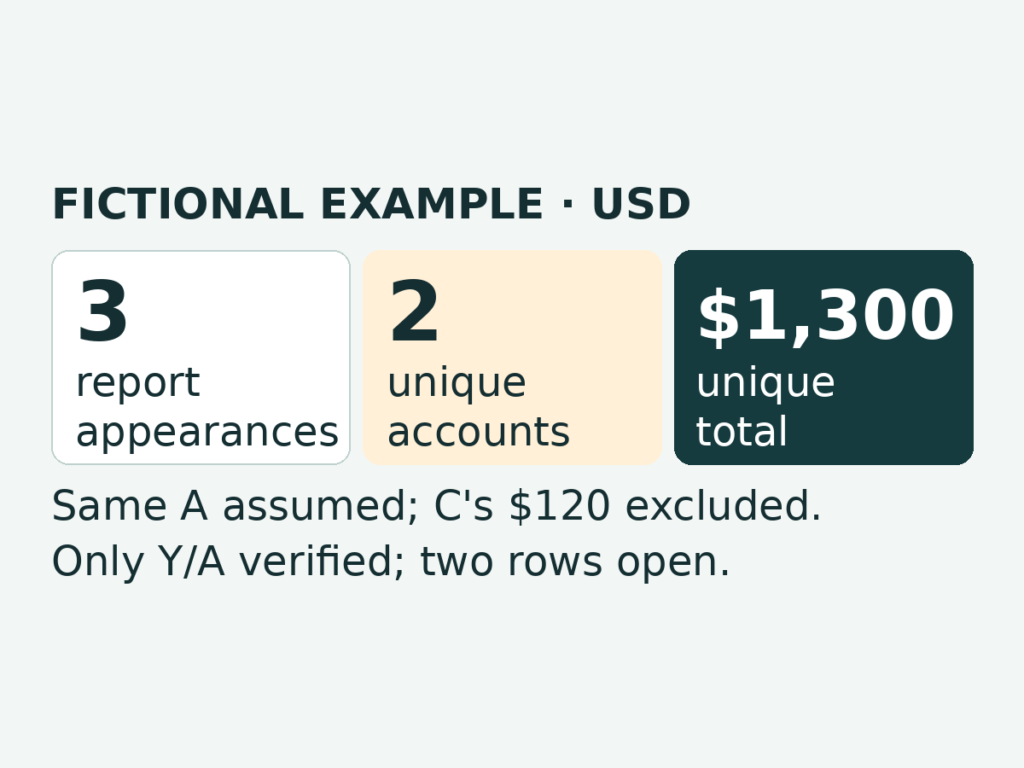
The working list has three targeted appearances: X/A, Y/A and Y/B. It has two underlying alleged accounts, A and B, and two affected recipients, X and Y. The organizer can link both Y rows to the same packet record while retaining a separate outcome for each row.
The unique-account total is $900 + $400 = $1,300. Adding the three appearances instead gives $900 + $900 + $400 = $2,200. That second sum includes A’s $900 twice. Keep C’s $120 outside both totals.
These figures describe the fictional records. They do not estimate money owed, money recovered or a credit-score change. Before combining real entries, reconcile differing report dates, balances and creditor or collector references. If you cannot establish whether two entries concern the same account, mark that link uncertain and postpone a combined total.
Keep the legal reference beside the record
Section 605B requires blocking within four business days after receipt of appropriate identity proof, a copy of an identity-theft report, identified information, and your statement that it does not concern your transactions. Reasonable findings of error, your relevant material factual misrepresentation, or your receipt of goods, services or money from the transaction permit refusal or rescission. Bureaus must promptly notify furnishers of the alleged theft, report, request, and effective block dates, and you of refusal or rescission.
Regulation V permits reasonable, time-bounded requests for additional information to assess an identity-theft report. Identity-proof requirements must match you with the correct file and reflect misidentification risk. Check the recipient’s verified official requirements rather than assuming one document works everywhere.
Use separate fields for packet version, attachment list, submission date, receipt evidence, questions raised and your replies. An upload confirmation and an attachment list answer different recordkeeping questions. Record what each item actually shows. If completeness is uncertain or disputed, write that down. This organizer makes no legal-sufficiency finding and calculates no calendar deadline.
Verify each row at a later checkpoint
For this fictional checkpoint, X’s response about A and Y’s response about A both say the requests were carried out. The reader has checked a later Y report and found A absent, but has not checked a later X report. Y has also asked for more information about B.
| Record | Response held | Later report observation | Organizer status |
|---|---|---|---|
| X/A | Matching result received | Not checked | Verification pending |
| Y/A | Matching result received | Entry absent on checked report | Snapshot verified |
| Y/B | More information requested | Not checked | Response unresolved |
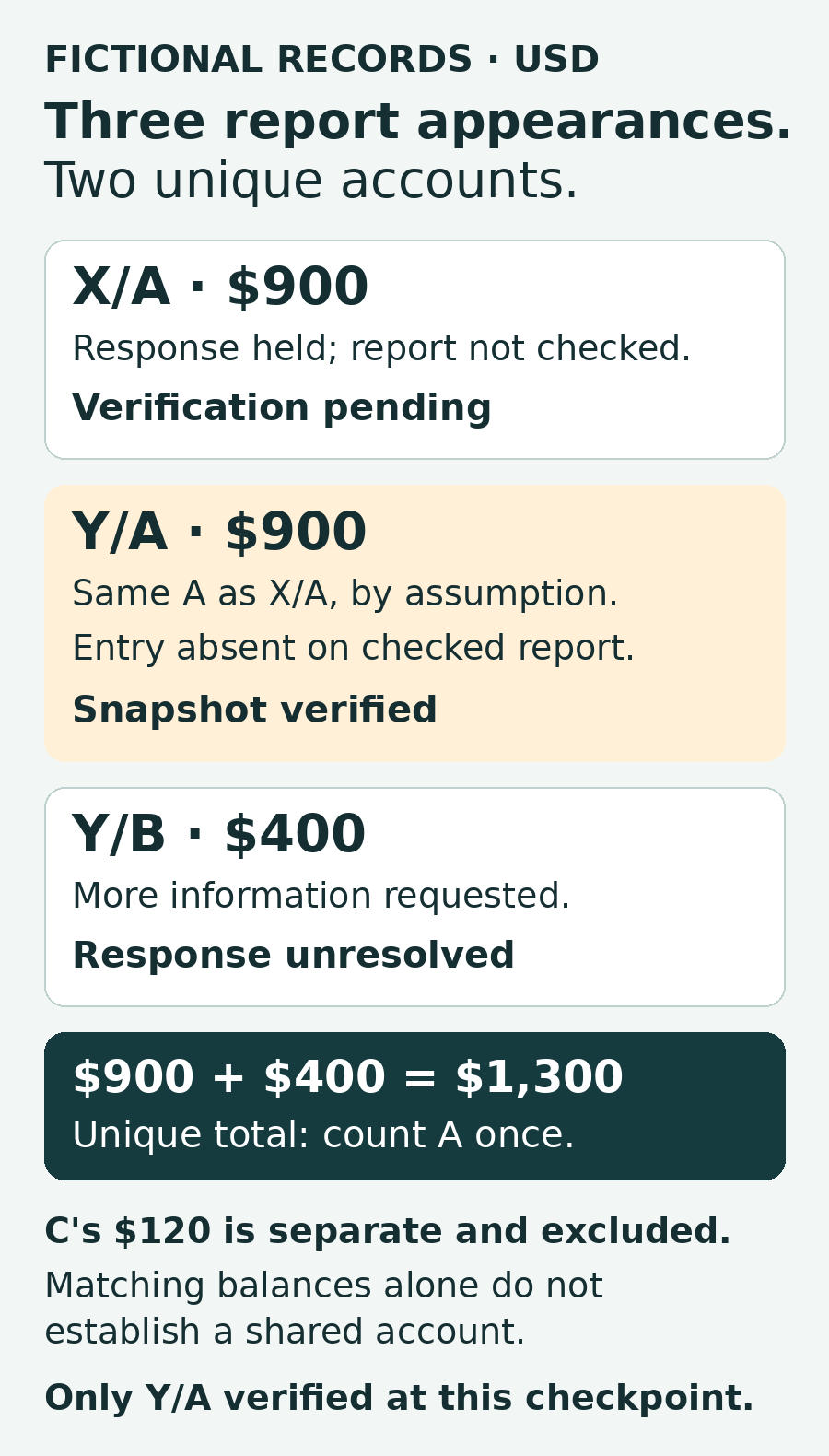
Only Y/A earns the organizer’s “snapshot verified” label. This is a count of completed checks, not a success rate or compliance finding. The label describes that particular observation and makes no promise about later reports. X/A stays open even though a response arrived. Z/C remains in its separate record.
For every check, save the report date, the entry you looked for and what you observed. Keep the recipient’s response alongside that observation. An absent entry records what you saw; the response records what the recipient says happened. Do not copy one row’s status across the whole account.
Make an unresolved response specific
For Y/B, record the exact item requested, the request date and the referenced account. Compare it with the attachment list for the packet version already held. If the request does not identify what is missing, put “clarification needed” in that row instead of inventing an answer or marking it complete.
A useful private note might read: “Y/B: request names B; requested item unclear; compare packet version 2 and seek clarification through Y’s verified channel.” This is a recordkeeping example, not a letter template. When you have a response, append its date and contents, preserve the earlier record, and decide what remains unchecked.
Finish each review with a concrete next step for every open row. In this example: check X/A against a later report; retain the dated Y/A observation; clarify Y/B’s unresolved request. That small list is more useful than treating every appearance as a separate debt or every reply as a finished check.

Credit-Builder Loan vs. Secured Card: A Cash-Access Checklist
Work through three fictional situations and four private questions before deciding whether a new account fits your needs.
Hotel Card Hold: Compare Two Checkout Payment Paths
Compare two fictional hotel checkout choices while keeping the original card’s capacity and the actual payment in separate records.
Overdraft Fee? Look Beyond the Online Bill Label
Compare three fictional document packets behind the same $60 ONLINE BILL entry, then identify what the records still leave unexplained.