SBA Surety Bonds vs. Working-Capital Loans: Four Contractor Scenarios
Follow Riverton Build through four fictional alternatives at one pre-start review. Identify what remains unresolved and prepare a focused next conversation.

A fictional contractor, Riverton Build, is at a pre-start review for a proposed commercial refurbishment contract. In this invented agreement, the customer requires a performance bond called PB-1 before work begins. The contractor also has an upcoming payroll and a supplier order to plan for. At its planning meeting, “sort out the financing” is too vague an instruction: nobody knows which unanswered question that instruction is supposed to resolve.
This guide gives that meeting a more useful agenda. The example is invented, with no prices, approval predictions or recommended products. It addresses only the stated requirement and those two costs; it is not an offer or an underwriting test.
Write down two precise questions
Ask an authorized agent about qualifying SBA-supported contract bonds and a complete written quote. Bonds do not finance job costs. SBA
- Requirement question: Has PB-1 been delivered and accepted by this customer as satisfying this particular requirement?
- Cost question: Has a specified money source actually been confirmed for this payroll and supplier order when they fall due?
Those are the definitions used throughout the exercise. “Someone is looking at it” answers neither question. Keep a brief note of the evidence supporting each answer, its date and any unresolved condition. Do not turn a promising conversation into a confirmed result.
The two questions do not imply independent underwriting.
A limited role map
For this performance-bond example only:
- Contractor (principal): performs the contract.
- Customer (obligee): receives the promised work.
- Surety: backs contractual performance.
Use that map to keep names straight when discussing the actual paperwork. Riverton Build’s owner is not the customer in this story. This illustration covers only the performance example; do not use it to interpret every document in the agreement.
Four alternatives, not four stages
Each version below starts with different stipulated facts. The same contract, PB-1 requirement and pre-start review point apply to all four. There is no implied path from A to D, and no version predicts what an application will produce.
A. The stated costs are covered; the requirement is unresolved
Assume Riverton Build has confirmed existing cash for the two stated costs, with the timing already checked. The customer’s requirement remains unresolved. Its next task is to clarify that requirement and the outstanding response. Opening a loan discussion just because this is a business project would add a question the example has not established a need to answer.
B. The requirement is satisfied; the stated costs are unresolved
Here, instead, assume the customer has accepted the delivered PB-1. Nobody has confirmed the money source for the two costs. Calling the intended solution a working-capital loan does not supply the missing confirmation. Keep the cost question open. The meeting needs an owner for that question and a date for returning with an answer; it should not mark the entire agenda complete because one item has been settled.
C. Both questions remain open
In this version, neither result has been established. Assign a named person to investigate each question and record what information they still need. Work on both, but leave both answers unresolved until there is supporting evidence. Two ongoing conversations are not two successful outcomes.
D. Both stipulated questions are answered
Here, assume both confirmations exist. The exercise has no remaining unanswered question among these two. That narrow result does not authorize bidding, signing, borrowing or beginning work. Staffing, the rest of the budget and other project requirements are outside the exercise.
Make the next conversation specific
For the requirement discussion, bring the actual document containing the requirement and ask: “Which requirement are we addressing, and what remains unresolved in this case?” Write the response beside the question so nobody has to reconstruct it from memory.
If the cost question is still open, show the proposed money provider or business adviser the payroll and supplier amounts with their due dates. Ask: “What would have to be confirmed before I can record this source as available for these costs?” A conditional offer is not the confirmed fact stipulated in this exercise.
If that discussion identifies a borrowing need, continue with business line of credit versus term loan. First establish the question you need that separate guide to answer.
Read the obligations before signing
SBA covers part of the surety’s eligible losses. Program rules require the principal’s written indemnity agreement; collateral and additional indemnitors may be required. A premium does not remove these obligations. 13 CFR Part 115
Ask counsel who must sign, what each signer promises and how the actual document would work in your circumstances. This is general U.S. education, not an assessment of your eligibility, legal position or project’s financial viability.
Sources checked October 21, 2026. The eCFR version consulted displayed currency through October 19, 2026.

Export Payment Documents: A Two-Packet Review
A worked export-packet review follows an unresolved instruction proposal, an incomplete selected inventory and an unknown carrier arrangement, without inventing the missing evidence.
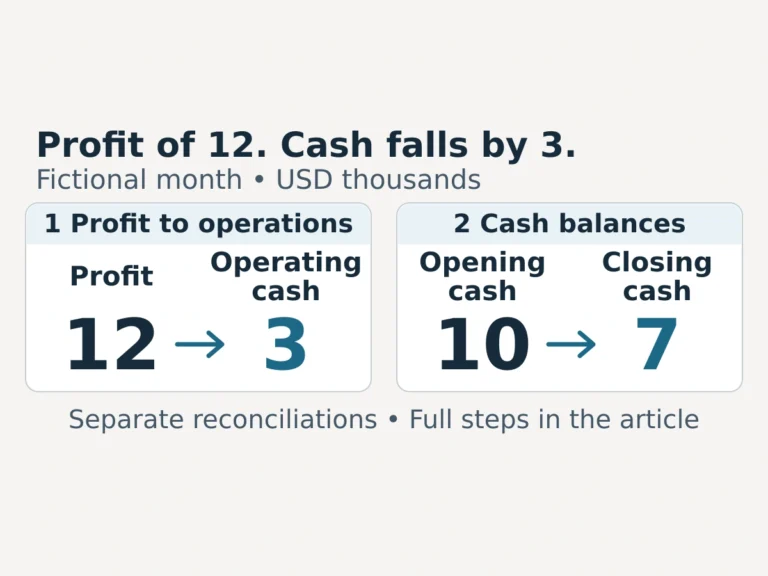
Profitable Business, Falling Cash: Reconcile the Difference
An invented one-month example reconciles net income, customer receipts, supplier payments, equipment, debt and an owner distribution to the closing cash balance.
One Customer Pays Late: Stress-Test Cash and Credit Availability Together
A fictional 13-week test shows how one late customer payment can reduce cash and credit capacity together, leaving a $6,000 gap before added financing…