Texas Pawn Renewal: Can the Later Redemption Fit Your Cash?
An invented two-payment example reveals a ten-dollar gap and separates principal, charges and cash available.
Estimated reading time: 8 minutes
A Texas pawn renewal needs a check of the payment due now and the amount needed later. Keep the redemption budget separate from the cost of extending the agreement.
For Texas borrowers reviewing a pawn renewal quote.
Texas pawn renewal: read the two documents
The OCCC distinguishes renewal, which creates a new contract and must be done in person, from a memorandum extending the due date. Identify which document you’re being offered.
The Texas statute requires the ticket to identify the amount financed, finance charge, total of payments and maturity date. A written extension agreement must specify the new redemption date and additional service charge; you must receive a copy.
Get agreements in writing. Check the ticket and retain your paperwork.
For this exercise, put the old ticket beside the proposed replacement and mark the amounts below. If your documents describe something else, this example doesn’t establish their payment schedule.
A fictional quote with two separate outflows
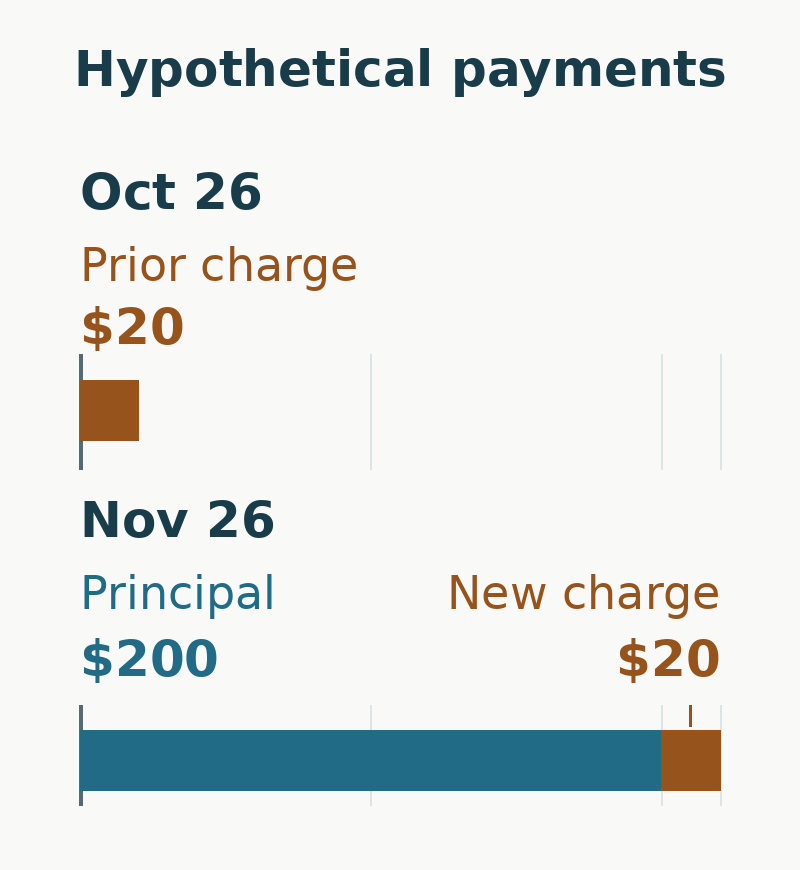
Assume an original transaction on September 26, 2026, with an October 26 maturity. At that maturity, the quoted amount to retrieve the item is $220: $200 principal plus a $20 charge. These are invented quotes, not typical prices or statutory rates.
The fictional renewal offer calls for $20 on October 26, assigned entirely to the old charge. The replacement ticket shows $200 principal and a new $20 charge, with $220 due November 26. No additional cash is advanced. Assume both transactions can be completed on those dates.
The exercise ends at the quoted maturity. It doesn’t model a later redemption, another renewal, an extra charge, or any payment arrangement different from the stated offer.
Check what the first payment changes
Under these stipulated allocations, the $20 first payment clears the old charge; it doesn’t reduce the $200 principal. Subtracting it from the later $220 quote would incorrectly produce a $200 target. The later target remains $220.
Can the later amount actually be funded?
Suppose $75 is available on October 26 after essentials and other commitments. Another $155 of net cash will be available before the November 26 outflow. That $155 is already after all other modeled spending; don’t deduct those expenses again.
- Cash after the first payment: $75 − $20 = $55.
- Cash before the later target: $55 + $155 = $210.
- Unfunded amount: $220 − $210 = $10.
- Required additional net cash after the first payment: $220 − $55 = $165.
The first payment fits, but this particular plan still leaves $10 unfunded. The $165 is the total additional net cash needed, not $165 on top of the already projected $155.
As a separate sensitivity, $170 of additional net cash would leave $225 before the target and $5 afterward. This changes only the stated cash assumption; it isn’t proof of overall affordability.
Keep total cost separate from cash available today
Completing the quoted renewal path requires $20 + $220 = $240 in total outflow: $200 principal and $40 combined charges. Retrieving the item on October 26 would require $220, so the modeled difference is $20. That immediate choice is itself $145 beyond the assumed $75 available.
Neither subtraction creates the missing money. Before choosing, identify which amount is actually available and which is only hoped for. Don’t turn the $10 gap into an assumption that another arrangement will be offered.
Texas pawn renewal: put the cash receipts on actual dates
The original plan leaves $55 after the first $20 payment and projects another $155 before November 26. Its $10 gap exists even though the first payment fits. Break the $155 into dated amounts to test whether it actually precedes redemption.
For a separate fictional schedule, assume five confirmed net receipts of $31, all arriving after October 26 and before the November 26 outflow. They total $155. Starting from $55, the successive balances are $86, $117, $148, $179 and $210.
These receipts are expressly net of all other modeled spending, matching the original example. Don’t subtract those same expenses again. If using gross income instead, build a new complete spending forecast rather than mixing the two definitions.
Now independently move just one $31 receipt to after November 26. Only $124 arrives before the target, leaving $179 available and a $41 gap against $220. The eventual total cash may be unchanged, but the due-date result changes.
A receipt expected after redemption can’t fill an earlier shortfall without another confirmed source. Nor should the later grace period be silently inserted into this model: the original exercise ends at the quoted maturity and supplies no later redemption quote.
For an equal-receipt planning question, the required $165 additional net cash divided among five pre-target receipts is $33 each. That is $2 more per receipt than the stipulated $31, totaling the original $10 gap.
This is a required amount, not a forecast of earnings or a promise that five receipts will occur. Keep each source and date beside the figure. A positive final total based on unsupported income wouldn’t establish a funded plan.
Texas pawn renewal: change the first charge in its own scenario
Use an independent alternative quote, not an extra fee added to the original path. Assume the old charge is $30 instead of $20, so immediate retrieval on October 26 would be $230: $200 principal plus that $30 charge.
Assume the alternative renewal requires that $30 now, entirely assigned to the old charge, and the replacement ticket still shows $200 principal plus a new $20 charge, totaling $220 due November 26. No additional cash is advanced.
From the same $75 available today, the $30 payment leaves $45. Adding the same $155 later gives $200, which is $20 short of the $220 target. Required additional net cash becomes $175.
Total outflow along this alternative renewal path is $250: $30 now plus $220 later. Of that, $200 is principal and $50 is combined charges. Immediate retrieval under this alternative quote would be $230, so the difference remains $20.
The immediate $230 requirement would be $155 beyond the assumed $75 available. This comparison supplies neither that missing cash nor an offer from an actual shop. The amounts are deliberately invented to show how a changed quote affects both totals and timing.
Keep the two scenarios separate. Combining the original $20 first payment with the alternative $30 charge, or subtracting either from the replacement principal without an allocation supporting it, would create a path that neither ticket describes.
Keep principal, charges and redemption value distinct
The principal outstanding in the original replacement is $200 because the stipulated first payment clears only the old charge. The new $20 charge is another part of the later $220 amount. It isn’t another $20 of cash borrowed.
Separately, the item’s resale value or personal importance isn’t supplied. Don’t treat the $200 principal as an appraisal of the item, or the $240 total renewal-path outflow as a prediction of what the item could be sold for.
Those questions may matter to the decision, but they need their own evidence. The worksheet’s narrower role is to show what the specific quote asks you to pay and whether the stated cash plan funds it.
Review the written quote before relying on the arithmetic
Copy the item description, ticket reference, amount financed, charges, first-payment allocation, later redemption amount and date. Identify whether the document is a renewal or a memorandum of extension. Keep the original and proposed records together.
Ask the shop to explain any amount that doesn’t reconcile. For a later date, obtain the applicable quote instead of using the maturity amount unchanged. This article doesn’t calculate additional daily charges or determine a personal deadline.
Record uncertain cash separately from money already available, and keep the payment method and shop access requirements visible. An arithmetic surplus doesn’t establish that the transaction can be completed on the necessary date.
Finally, retain the completed paperwork and receipt if you choose an arrangement. This guide doesn’t select renewal, redemption or forfeiture for you. The useful result is a documented quote and an honest cash check, with any remaining gap still visible.
For a Texas pawn renewal comparison, write the chosen scenario name on every worksheet page. The original quote and the independent $30-charge variation can’t share unlabeled totals. Recheck the written amounts immediately before relying on the plan, and retain any revised quote. A correctly calculated result under yesterday’s different terms wouldn’t answer today’s redemption question.
What the later date means
Use the relevant ticket’s maturity date: Texas provides 30 days afterward to redeem, with an additional daily service charge. Unredeemed goods may then be forfeited. You aren’t obligated to redeem or pay, and the agreement can’t impose personal liability.
If the shop is closed on the last day of grace, OCCC says the period extends through the next day it opens for regular hours.
Keep the document question central: which agreement is proposed, what does the first payment clear, and what amount remains on which date? The numerical example can’t answer those questions for an actual ticket.
Resolve differences with the shop or OCCC before relying on the example.
Educational information, not individualized financial or legal advice.
For separate borrowing alternatives, compare payday alternative loans and secured and unsecured personal loans. Check the collateral and payment terms rather than assuming the products work alike.

Parent Pays Student Loan Interest: Who Deducts?
Separate payment and obligation.

Returned Loan Debit: Two Fees?
Trace the payment and fees.

Rehabilitation Payment Too High?
Check an alternative request.