CPA Financial Statements: What Did the Lender Request?
Clarify the requested accounting assignment before comparing proposals or treating a document package as complete.
Estimated reading time: 5 minutes
Identify the engagement behind a financial statement, not merely its preparer.
Start with the service, not the accountant’s name
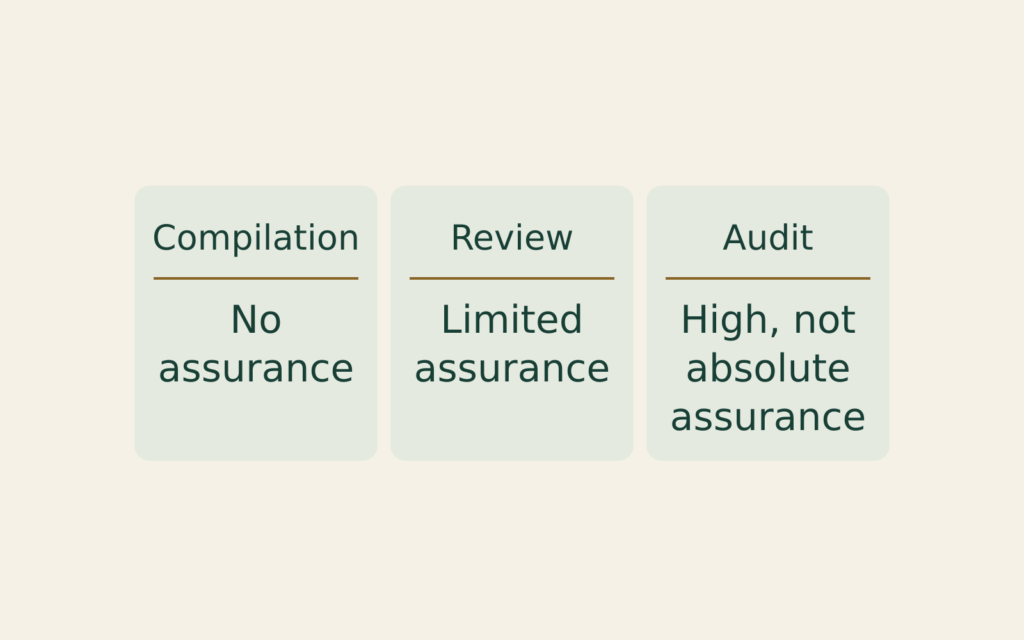
The AICPA’s comparison separates three services:
| Service | Assurance level |
|---|---|
| Compilation | No assurance |
| Review | Limited assurance |
| Audit | High, not absolute assurance |
A review relies on inquiry and analytical procedures. An audit involves additional verification and substantiation and an opinion on the financial statements under the reporting framework. Reviews and audits require independence; a compilation can be performed without independence if that lack is disclosed. None of these labels alone determines a lender’s acceptance.
Agree on what the engagement will deliver
The California Board of Accountancy’s consumer guide recommends an engagement letter explaining the work’s scope, who performs it, client responsibilities, cost and completion timing. Those questions are useful before comparing proposals, not after discovering that the requested deliverable was outside the assignment.
Give the CPA the lender’s actual written request. Ask which statement periods, entities, accompanying reports and additional schedules the proposal includes. Identify work excluded from the quoted fee, who supplies missing information and how a scope change would be handled.
A lower quoted fee isn’t an equal-scope comparison if one proposal leaves an essential deliverable unresolved. Ask for that distinction in writing. This isn’t a recommendation to select a provider or authorize work; it’s a way to compare what the proposed assignment actually covers.
Signing authority and experience are separate checks
Licensing details are jurisdiction-specific. As a concrete example, California’s attest-authority guidance distinguishes an “A” from a “G” in its Experience Completed field. An A permits signing attest reports. A G doesn’t permit that signature, even though the CPA can participate in the work. California treats compilation reports differently from attest reports.
The board also cautions that authority doesn’t by itself establish competence for every assignment. Ask about relevant experience, continuing education and peer review where applicable. A familiar tax preparer may or may not offer the particular service being requested; ask rather than assuming.
Don’t transfer California’s letter codes to another state’s licensing system. Use the appropriate state board’s information and ask the proposed firm to explain who will perform the work and who will sign. This guide checks no individual’s license and makes no finding about any accountant.
Reporting basis is another dimension
Deloitte’s U.S. discussion of special-purpose statements describes cash, modified-cash, tax, regulatory and contractual bases. In its financial-services context, such statements can still undergo independent review or audit procedures using the applicable basis. It also warns that a user may require GAAP or IFRS statements instead. The engagement type and the accounting basis therefore need separate attention.
Fictional request comparison: A lender asks for statements using U.S. GAAP. A proposal expressly offers a different reporting basis. Even if its service sounds more extensive, the basis mismatch remains unresolved. Ask the lender and CPA to clarify the requirement; don’t rename the proposed basis or assume acceptance.
This isn’t a recommendation to adopt a special-purpose framework. The suitable basis depends on the actual users and requirements. Confirm which basis the proposal names, what the lender requests and whether any permitted alternative has actually been confirmed. Don’t infer a waiver from a casual acknowledgement of receipt.
A requested letter isn’t just a signature
The AICPA-endorsed insurance program’s third-party verification guidance explains why requests for CPA letters can raise professional-scope and confidentiality concerns. A request may ask for confirmation the accountant hasn’t been engaged to provide, or use terminology carrying implications beyond the work already performed.
If a financing contact supplies wording for the accountant to sign, forward the exact request for the CPA’s assessment rather than paraphrasing it as routine. Ask what information or deliverable the requester actually needs and what the CPA can appropriately provide. Don’t rewrite or add a certification in the accountant’s name.
Keep permission to disclose information separate from the substance of a professional conclusion. Neither a borrower’s urgency nor a convenient form answers the CPA’s scope questions. Any alternative response needs the appropriate parties’ agreement; this article supplies no letter template or assurance about future repayment.
Confirm the actual lender’s document request
For one program-specific example, SBA’s 7(a) application guidance says applicants work directly with a lender, and application contents vary with loan size and processing method. The lender helps determine the documents needed for the applicant’s circumstances. That isn’t a universal document list for every business loan.
Ask the lender to resolve ambiguous wording before commissioning a package. Keep its requested deliverable distinct from a proposal still awaiting agreement. If information remains incomplete, identify what the lender still needs rather than describing the file as accepted.
These checks improve the question being asked; they don’t decide eligibility or create financing. Keep business records private. This is financial-document education, not an audit procedure or contract interpretation.


