Fertility Financing: Read the Different Commitments
Distinguish the financial terms in fertility funding documents without treating the examples as treatment advice, coverage decisions or recommendations.
Estimated reading time: 5 minutes
Fertility funding documents describe different commitments. The U.S. examples here explain financial terms. They don’t determine treatment choices or coverage, and they aren’t recommendations.
Read the refund program’s boundaries
Shady Grove Fertility’s Shared Risk page describes a refundable deposit for its IVF and donor-egg program, subject to contract exceptions. It excludes medications, diagnostic testing, consultations and other specified expenses. “100% refund” therefore doesn’t mean every fertility-related dollar is returned.
The practice also says a successful first attempt costs more under this program than traditional fee-for-service payment. That comparison isn’t a recommendation for either approach; neither financial format guarantees a clinical outcome.
Ask the financial counselor which program and contract version the quote describes, what payment is refundable, and which outside charges remain excluded. The provider’s eligibility rules and clinical decisions must be assessed separately.
Confirm the employer benefit you actually have
Progyny’s current individual-benefits page says access is through an organization and requires enrollment in an eligible plan. Access to its Progyny Care Advocate support has no charge, but physician visits or treatment can carry plan-specific financial responsibility, including copays and deductibles.
Free benefit support is consequently not the same as free treatment. Ask the benefits team to identify the applicable plan and what the quoted service would require you to pay.
Don’t use another employer’s benefit summary as your coverage evidence. The current page directs individuals to verify which benefits their plan includes. A benefits conversation should establish the actual plan, not simply whether the employer recognizes the vendor’s name.
Separate a pharmacy discount from insurance payment
EMD Serono’s January 2026 savings FAQ describes Fertility Instant Savings for prescribed EMD Serono medications paid out of pocket. The stated terms require U.S. residence, age eighteen or older and a valid prescription. The medication purchase doesn’t use insurance, even when insurance pays for the medical treatment portion.
The FAQ separately describes income-based Compassionate Care, which requires an application and income documentation. An instant discount and approval for income-based assistance are different records.
Have the pharmacy identify the applicable program and current price for the prescribed medication. This isn’t a recommendation to change medication or give up insurance coverage; medical choices remain with the treating clinician.
Check when and where a grant can pay
Baby Quest’s FAQ says awards are paid directly to clinics, laboratories and other approved recipients, not to the applicant. It doesn’t cover expenses already incurred or already scheduled. Awards depend on available funds.
Insurance claims for covered treatment or medication must be submitted first; medication funding may be included only when insurance doesn’t cover that cost. This charity-specific rule isn’t universal.
An application is therefore not cash available to reimburse earlier spending. Ask the charity how its timing restriction applies before counting an award. Don’t postpone necessary care based on an anticipated grant; discuss clinical timing with the care team.
Read the loan’s timing and credit checks
Future Family’s FAQ says provider disbursements must start within forty-five days of signing. When that first disbursement occurs within the window, another 120 days are allowed to use remaining funds. It separately describes a thirty-day window for borrower reimbursements after the first direct disbursement.
The provider distinguishes checking a rate or prequalifying, which it says doesn’t affect the credit score, from proceeding with a loan, which requires a hard inquiry.
Ask the lender to reconcile those windows with the agreement. Its FAQ also makes borrowers and co-borrowers jointly liable.
An annual storage price isn’t a monthly installment
TMRW’s biorepository FAQ says storage is paid in advance, begins when specimens enter its system and renews annually unless a multiyear plan applies. Shipping is separate. It doesn’t prorate storage fees when specimens return to a clinic for treatment.
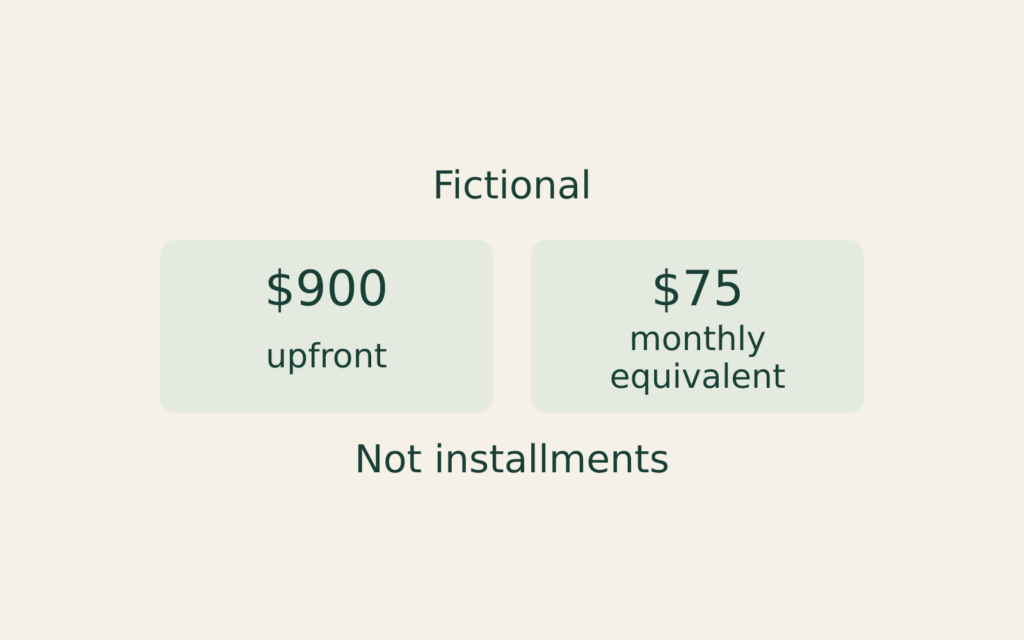
For a fictional arithmetic example, assume a different contract requires exactly $900 upfront for twelve months of storage, with no other charges included. Dividing $900 by twelve produces a $75 monthly equivalent, not twelve authorized installments.
That equivalent can describe the cost over time while leaving the initial $900 payment unchanged. Verify the actual billing interval and shipping charges; this example isn’t TMRW’s price, a funding offer, or advice to move stored specimens.
Keep the tax-year review separate from funding
IRS Publication 502 for 2025 includes certain fertility procedures performed on yourself, your spouse or dependent to overcome an inability to have children. Its examples include IVF and temporary storage of eggs or sperm. That wording isn’t a blanket deduction for every storage or family-building charge.
For those 2025 records, the itemized medical deduction generally concerns qualifying unreimbursed expenses above 7.5% of adjusted gross income. An includible expense isn’t a dollar-for-dollar tax refund.
Take the service descriptions, payment dates and reimbursement records to a qualified tax professional. This paragraph doesn’t calculate a deduction, establish that anyone qualifies, or apply the 2025 publication as a 2026 tax determination.


Roth Conversion and Account Clocks
Separate five-year tests.

ABLE Distributions Across Month-End
Separate retained purposes.