Medical Payment Plans vs Credit Cards: Compare the Written Terms
Compare the creditor, interest clause and actual payoff schedule before financing a medical bill. Check affordability after a smaller payment too.
Estimated reading time: 8 minutes
The billing office offers monthly payments, but you need the agreement to know whether you would owe the hospital or a lender. Compare medical payment plans vs credit cards using that written agreement, a verified bill and a payment your household can sustain. The phrase “payment plan” does not tell you the cost.
Before borrowing, obtain the hospital’s financial-assistance policy and review its eligibility rules and application deadline; CMS also recommends asking what happens to the bill while an application is reviewed. Our hospital financial-assistance guide explains how to track the request. CMS assistance guidance
Medical payment plans vs credit cards: identify the creditor
A provider may offer its own arrangement or financing through another company. With a medical credit card, the issuer pays the provider and you repay the issuer. Interest, fees and credit-check requirements vary across products. CFPB medical-financing guidance
Ask the office to identify the legal creditor and the product type. Before entering application details on a payment website, establish whether it is collecting a hospital bill or opening a new credit account with a separate company. Keep the creditor’s name beside the terms so you know who can answer account and hardship questions later.
Check the balance before financing it. Use the bill, EOB and receipts for the same services. If insurance or assistance remains unresolved, ask how a later correction would reach the financing account.
The CFPB warns that putting a bill on a regular or medical credit card can make obtaining assistance more difficult, although you retain the right to seek it. Financing does not settle whether the original charge was correct. CFPB assistance considerations
Read the interest clause before the monthly amount
A deferred-interest offer can waive accrued interest if you clear the qualifying balance by the specified deadline; leaving a balance can trigger interest reaching back to the purchase date. The CFPB explains that the calculation usually reflects the balances owed over the intervening months. Do not estimate that charge by multiplying the original amount by an APR. CFPB deferred-interest explanation
A true 0% introductory APR works differently. Leaving a balance at the end does not itself create retroactive interest for the zero-rate period; afterward, interest may accrue on the remaining balance at the regular rate. The CFPB’s June 2017 letter explains this distinction. It provides a historical explanation, not a current rate quote.
Use the contract to distinguish these arrangements:
| Written arrangement | Cost question | Deadline question |
|---|---|---|
| Direct provider plan stating no interest or fees | Are there setup, processing or late charges elsewhere in the agreement? | When is each installment due, and what changes after a missed payment? |
| Card with a true introductory 0% APR | Which fees apply, and what APR follows the promotion? | When does that rate change? |
| Deferred-interest card or financing plan | What triggers interest for earlier months, and how is it calculated? | What exact date must the qualifying balance reach zero? |
For an ordinary card without a promotion, compare its actual purchase APR and fees with the other written offer. A medical label does not establish a lower price. The CFPB notes that conventional credit or other financing may cost less than a medical-financing product, depending on the terms. CFPB comparison guidance
Ask what happens to extra payments if the account has other balances. Minimum payments usually do not clear a deferred-interest purchase before expiration, and allocation rules can divert extra money to another balance. The promotional expiration can also differ from the normal due date. CFPB payoff and allocation guidance
Put the same $1,800 through both schedules
These are hypothetical arrangements, not available offers. Assume the balance is correct and no new charges occur.
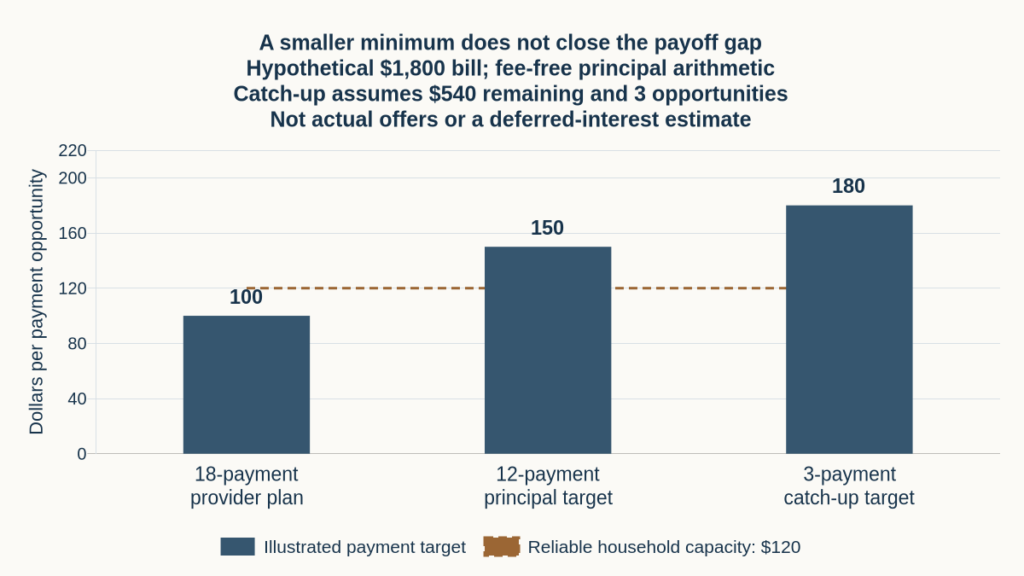
First, suppose a provider’s written plan charges 0% interest and no fees, with 18 equal monthly payments. Dividing $1,800 by 18 gives $100 each month and $1,800 total repayment, assuming timely payments under those terms.
Now suppose a deferred-interest agreement gives you 12 actual payment opportunities before its confirmed payoff deadline. You would need $150 at each opportunity to clear $1,800 of principal, provided every payment reaches this balance and no fees or other interest are added.
At $100 each time, you would pay $1,200 and leave $600 at expiration. Deferred interest could then add to what you owe.
If the household can reliably spare $120 monthly, the $100 provider schedule leaves $20, while the $150 target falls short by $30. A smaller contractual minimum would not supply the missing money. Keep the required minimum and the voluntary payoff target on separate lines.
What one smaller payment does
Consider a separate stress test of the 12-payment schedule. Suppose you made eight payments of $150, then only $60 at the ninth opportunity. For this example, assume $60 satisfies the required minimum, every payment is on time and correctly allocated, and no fees, new charges or other interest apply.
The first eight payments total $1,200. After the ninth, principal remaining is $1,800 − $1,200 − $60 = $540. With three opportunities left, the catch-up target becomes $180 each.
That is $30 above the original $150 target. If current reliable capacity is $120, each remaining payment has a $60 gap. The record below keeps those comparisons visible:
- 18-payment provider arrangement
- $100 per month leaves $20. This assumes the written arrangement charges no interest or fees.
- 12-payment principal target
- $150 at each opportunity leaves a $30 shortfall. This does not estimate deferred interest.
- Three-payment catch-up target
- $180 each on the remaining $540 leaves a $60 shortfall, assuming correct allocation and no additional cost.
Check the minimum separately on a real account. If $60 would not satisfy it, the stress test’s assumptions fail. Later catch-up arithmetic does not undo a missed payment, a fee or a lost promotion.
Use the calculator for principal, not deferred interest
The calculator below can check the explicitly fee-free, zero-interest assumptions. Enter $1,800, 0% annual interest and 18 months: the expected payment is $100, with $1,800 total repayment. Change the term to 12 months and the payment becomes $150.
To check the recovery schedule, enter the remaining $540 at 0% for three months. The result is $180 per month. Starting again with the original $1,800 would count principal already repaid.
This tool does not model promotional expiration, payment allocation or retroactive interest, so entering zero does not convert a deferred-interest agreement into a true zero-rate loan. Save the inputs with the written offer and recalculate if the balance or actual number of payment opportunities changes.
Compare the remaining terms and build a calendar
Request the complete agreement before signing. New York City’s consumer agency recommends clarifying whom you will pay, the schedule and potential fees, then retaining the contract and payment records. These are useful review questions wherever you live; local legal protections can differ. NYC medical-payment guidance
Locate any automatic-debit requirement, early-payment rule and hardship contact. Ask how a provider adjustment or refund would be transferred to the creditor. Beside each important term, record the contract page or written reply supporting it.
Ask about credit inquiries and reporting too. The CFPB warns that reported missed payments on financing can harm credit. CFPB credit considerations
State law may distinguish medical cards from regular cards, as New York’s reporting guidance illustrates. Do not assume every protection for an unpaid provider bill follows it onto a different credit product.
For medical payment plans vs credit cards, the calendar is part of the cost check. Mark required due dates and promotional expiration separately. Count actual payment opportunities; a promotion described in months does not establish how many convenient statement dates remain.
An earlier payoff target needs its own budget check. In the hypothetical $1,800 example, ten payments of $163.64 plus a final $163.60 total $1,800 over 11 opportunities. This assumes no additional cost and correct allocation. The buffer helps only if those payments are affordable, and it does not replace minimum-payment obligations.
After enrollment, compare each statement’s remaining balance with the schedule you saved. Investigate an unexpected difference while there is still time to change the plan.
For the hypothetical household with $120 available, ask for an arrangement that fits before accepting the $150 target. The next question is where the extra $30 would come from every month, not whether a smaller minimum makes the offer appear affordable.