Hearing Aid Costs Before Financing
Review hearing-aid purchase terms, coverage and refund timing before financing; the guide addresses financial documents rather than treatment decisions.
Estimated reading time: 5 minutes
Check purchase terms, coverage and refund timing before financing hearing aids. This guide explains financial documents. It doesn’t advise on treatment choices or suggest delaying care.
Ask about access to the evaluation record
The FDA says you can request your hearing-evaluation records from your hearing health professional and purchase hearing aids elsewhere. The evaluation record and a seller’s order are therefore not the same document.
When requesting a copy, identify the evaluation date and ask for the complete report, rather than only a cropped screen image. Preserve the original file rather than transcribing results into a shopping worksheet. Don’t alter clinical findings to match a seller’s form.
Separate a covered exam from a device purchase
Original Medicare doesn’t cover hearing aids or exams for fitting them. Part B can cover diagnostic hearing and balance exams ordered to determine whether medical treatment is needed. After the deductible, the stated patient share is 20% of the Medicare-approved amount; hospital outpatient copayments can also apply.
Medicare also describes limited access to an audiologist once every twelve months without an order for specified non-acute hearing conditions or diagnostic services associated with surgically implanted hearing devices. That exception doesn’t make every hearing visit covered.
Medicare lists provider charges, acceptance of assignment, facility type, location and other insurance among the factors affecting actual costs. Ask the billing office which of those factors explains its estimate.
Check reimbursement documentation before assuming payment
Jabra Enhance says it’s generally not in-network with insurers and doesn’t guarantee reimbursement. Its documentation process provides an itemized receipt, product code and virtual-service procedure code after a Video Orientation appointment, which must occur within six months of purchase.
If an insurer requires a diagnosis code, Jabra says it needs a diagnostic audiogram completed before purchase, no more than six months old, and signed by an appropriately licensed audiologist or physician. Those are this provider’s document requirements, not permission for a customer to select a diagnosis.
The provider’s two six-month conditions have different reference points: orientation follows purchase, while the qualifying audiogram must precede it. Record both dates separately.
Distinguish VA care from a retail reimbursement assumption
VA describes registration and enrollment followed by an audiology evaluation. The audiologist makes the clinical determination about hearing aids or other assistive devices. When hearing aids are recommended and fitted through that pathway, VA says the aids, repairs and future batteries are provided without charge while VA eligibility for care continues.
Its current audiology overview also identifies audiology as a direct-access service that doesn’t require a primary-care referral. These are VA service arrangements, not a promise that VA will reimburse an independently selected retail purchase.
For a veteran comparing possible funding, ask the VA audiology team to explain the applicable pathway and what is actually authorized. Veteran status alone isn’t a purchase authorization.
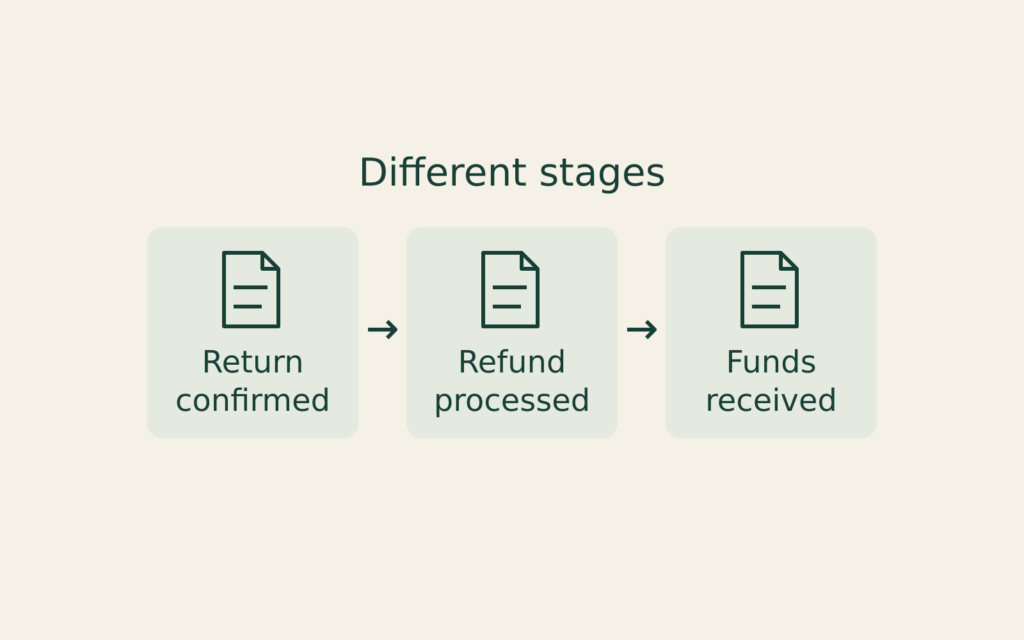
A return and a refund have different stages
Hear.com’s FAQ describes returning devices within its 45-day trial. After it confirms the return, it says it processes refunds within five business days. Card refunds then take another two to three business days to appear; payments made through its financing partner are described as refunded by check within four to five weeks.
These are named-provider processing descriptions, not universal deadlines or a promise that a loan payment is paused. Ask the seller and creditor which confirmation establishes the return, how the financing account is adjusted, and what obligations remain while that adjustment is pending.
Assistance can still leave expenses to check
Help America Hear describes a nationwide, last-resort program that reviews household income, assets, existing insurance benefits and clinical eligibility. Its program page says approved applicants receive two prescription hearing aids, custom earmolds and one year of limited service. It separately lists evaluation, medical clearance, batteries, accessories and extended loss-and-damage warranties as costs applicants must cover.
Its program page describes a refundable deposit, while its FAQ discusses an application fee. Ask whether both charges apply and obtain the current written terms. Don’t assume “assistance” means no cash is needed, or treat the two descriptions as interchangeable. This guide doesn’t determine eligibility.
Keep tax classification separate from immediate funding
For 2025 records, IRS Publication 502 includes the cost of hearing aids and the batteries, repairs and maintenance needed to operate them among medical expenses. That classification doesn’t make the entire purchase a tax refund. The itemized medical-expense deduction generally applies only above 7.5% of adjusted gross income, subject to the applicable rules.
Keep receipts identifying the device and operating expenses, together with payment and reimbursement records. The IRS also requires records supporting the deduction; they aren’t sent with the paper return.
This section concerns the published 2025 rules, not a calculation of anyone’s savings or a claim about a future tax-year revision. Seek qualified tax help for the actual record.
Roth Conversion and Account Clocks
Separate five-year tests.
ABLE Distributions Across Month-End
Separate retained purposes.