Scenario Regret
The largest possible bill and the largest missed saving are different quantities. A fictional offer comparison shows why minimizing them can select…
Estimated reading time: 5 minutes
The largest possible bill and the largest missed saving are different quantities. A fictional offer comparison shows why minimizing them can select different options.
Define the comparison before ranking offers
Here, regret means an offer’s cost minus the lowest cost available among the listed offers in the same scenario. It is a hindsight comparison, not a debt, refund or extra charge. Minimizing maximum regret selects the offer with the smallest largest such difference. Cornell’s Uncertain Prospects course notes describe this decision criterion in terms of the best outcome in each state. Using utility equal to negative cost converts its best-outcome shortfall into cost minus the scenario minimum.
Assume three fictional offers deliver identical service and quality. Exactly one offer must be selected before either scenario L or scenario H occurs. Both scenarios are possible and exhaustive in this model; no probabilities are supplied. Costs are complete outlays in a common monetary unit. Mixing offers, randomizing selections and changing the choice after observing the scenario are excluded.
Build both sets of numbers
Offer A costs 20 in L and 120 in H. Offer B costs 80 in either scenario. Offer C costs 120 in L and 20 in H. All six numbers are stipulated, not actual quotations.
The smallest available cost is 20 in each scenario, supplied by A in L and C in H. Subtract the appropriate scenario minimum from each offer’s cost:
A has regrets 0 and 100; B has regrets 60 and 60; C has regrets 100 and 0.
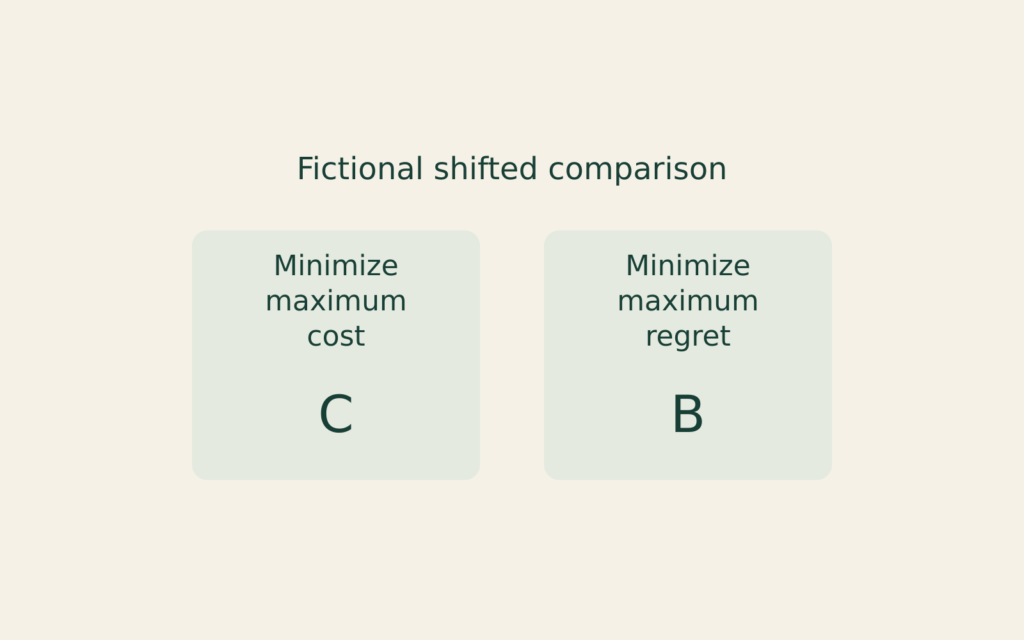
The maximum regrets are therefore 100 for A, 60 for B and 100 for C. B uniquely minimizes maximum regret. The maximum absolute costs are 120, 80 and 120, so B also uniquely minimizes that different criterion in this initial table. Agreement here does not prove that the criteria are interchangeable.
Add the same cost within one scenario
Now add 1,000 to every offer’s H cost, without changing any L cost. The revised costs are A: 20 and 1,120; B: 80 and 1,080; C: 120 and 1,020. This is a common scenario-specific addition, not an offer-specific price increase.
The scenario minima become 20 in L and 1,020 in H. Consequently, A’s H regret remains 1,120 − 1,020 = 100; B’s remains 1,080 − 1,020 = 60; C’s remains zero. The L regrets also remain unchanged. B still uniquely minimizes maximum regret.
However, the maximum absolute costs are now 1,120, 1,080 and 1,020. C uniquely minimizes the largest bill. The disagreement is not a rounding error: the largest bill includes the added 1,000, while the excess over each scenario’s best offer subtracts the corresponding baseline.
Prove exactly what the addition preserves
Write an offer’s cost in scenario s as C(i,s), and the smallest listed cost there as m(s). Add k(s) to every offer in that scenario. The new minimum is m(s) + k(s), because adding the same amount preserves the ordering within that column.
The revised regret is [C(i,s) + k(s)] − [m(s) + k(s)] = C(i,s) − m(s). Every cell’s regret is unchanged, so every offer’s maximum regret is unchanged.
Maximum absolute cost instead becomes max over s of [C(i,s) + k(s)]. Different additions across scenarios need not preserve its ranking, as the example proves.
Check weighted averages separately
Let p be a hypothetical supplied weight on L, with 0 ≤ p ≤ 1, and give H weight 1 − p. This is a parameter, not an estimated probability. For any offer, weighted-average regret equals:
pC(i,L) + (1 − p)C(i,H) − [pm(L) + (1 − p)m(H)].
The bracketed expression is identical for every offer. Subtracting it leaves all pairwise differences unchanged. Thus weighted-average cost and weighted-average regret rank these fixed offers identically when the same weights and candidate set are used. That calculation does not replace a maximum with a weighted average.
For offers i and j, the remaining difference is p[C(i,L) − C(j,L)] + (1 − p)[C(i,H) − C(j,H)]. Each state minimum cancels before the offers are compared. The cancellation holds whether or not the same offer supplies both minima.
Test whether an unspecified weight explains B
In the original table, weighted costs are 120 − 100p for A, 80 for B and 20 + 100p for C. When p ≥ 1/2, A costs at most 70. When p ≤ 1/2, C costs at most 70. At least one of those offers therefore costs less than B’s 80 for every possible p.
B minimizes maximum regret but never minimizes weighted-average cost for any weight in this model. Calling its selection an expected-cost calculation with an unspecified probability would be incorrect.
Keep the actual outlay visible
A regret ranking does not establish affordability or identify a suitable real offer. The shifted example leaves B’s regret unchanged while raising its largest bill from 80 to 1,080. Keep actual outlays, the scenario benchmark and the declared comparison criterion separate; the arithmetic supplies no personal risk preference or financing approval.
Roth Conversion and Account Clocks
Separate five-year tests.
ABLE Distributions Across Month-End
Separate retained purposes.