Cost Distributions
A smaller average cost does not establish a ranking under every nondecreasing cost score. This fictional comparison tests that stronger claim.
Estimated reading time: 2 minutes
A smaller average cost does not establish a ranking under every nondecreasing cost score. This fictional comparison tests that stronger claim.
Use the same possible costs
Assume three arrangements each produce exactly one cost: 0, 50 or 100 monetary units. Their probabilities are stipulated, not estimated. Compare only these costs; ignore timing and all other terms. Choose one arrangement before its cost is known, without switching afterward.
| Cost | A | B | C |
|---|---|---|---|
| 0 | 60% | 30% | 50% |
| 50 | 10% | 30% | 0% |
| 100 | 30% | 40% | 50% |
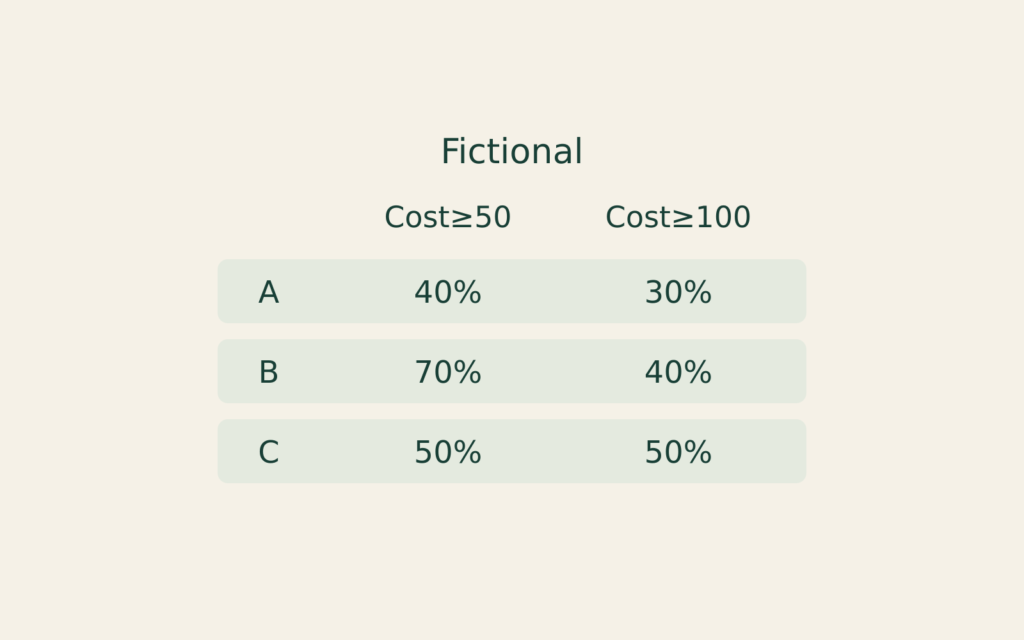
The averages are A: 0×0.6 + 50×0.1 + 100×0.3 = 35; B: 55; C: 50. At-least-50 probabilities are respectively 0.4, 0.7 and 0.5. At-least-100 probabilities are 0.3, 0.4 and 0.5.
Prove the stronger comparison
This finite version applies the ordering method in Jonathan Levin’s October 2006 notes. Scores cannot fall when costs rise. Lower expected scores rank better here. Let a nondecreasing score g have increments d1 = g(50)−g(0) ≥ 0 and d2 = g(100)−g(50) ≥ 0. For each possible cost X:
g(X) = g(0) + d1·1{X≥50} + d2·1{X≥100}.
Here 1{condition} is one when true, otherwise zero. Pr denotes probability. Averaging gives g(0) + d1·Pr(X≥50) + d2·Pr(X≥100). Smaller or equal tails therefore imply no larger expected score. Conversely, a larger tail violates that universal claim: choose its threshold indicator as g. Its expected score equals that tail probability.
For B minus A, substitution gives 0.3d1+0.1d2≥0. With g(X)=X, both increments are 50, giving 20, exactly 55−35. A constant score has both increments zero and ties.
Test the crossed pair
C has the smaller average than B, yet the at-least-100 indicator gives C: 0.5 versus B: 0.4. The at-least-50 indicator instead gives C: 0.5 versus B: 0.7. Both indicators are nondecreasing. More generally, C minus B is −0.2d1+0.1d2: negative when d2<2d1, zero at equality, positive when d2>2d1.
The ordering concerns expected scores, not a guarantee about any realized bill. Expected indicator scores are probabilities, not additional charges.
Roth Conversion and Account Clocks
Separate five-year tests.
ABLE Distributions Across Month-End
Separate retained purposes.