Rental Conversion Basis: Depreciation vs. Sale Gain
Keep conversion-date value and adjusted basis separate. A building-only example shows why the depreciation starting figure is not automatically the later gain basis.
Estimated reading time: 3 minutes
When a personal home becomes a rental, the building’s depreciation starting basis can differ from the basis later used to figure a gain. Keep both the adjusted basis and conversion-date fair market value rather than carrying one number into every calculation.
The distinction matters when a former home’s value has fallen before conversion. The lower value can determine the depreciation starting point without replacing the original adjusted-basis record used for a later gain calculation.
One property, different calculation purposes
IRS Publication 551, revised December 2025, explains this under “Property Changed to Business or Rental Use.” Depreciation starts with the lower of conversion-date fair market value or adjusted basis. For a later gain, the publication instead directs you to adjusted basis when the property is sold. It provides a separate rule for figuring a loss.
Those are different questions. A depreciation schedule is useful evidence, but its starting figure is not automatically the answer to a later gain-basis question.
Worked example: $100,000 adjusted basis and $80,000 value
Consider an individually owned former personal residence converted entirely to rental use. Look only at the building, excluding land. Records establish adjusted basis at conversion of $100,000 and conversion-date fair market value of $80,000.
Assume no subsequent adjustments except $10,000 of independently verified depreciation that was both allowed and allowable. This example assumes that amount; it does not calculate the depreciation deduction.
| Question | Calculation or input | Result |
|---|---|---|
| Adjusted building basis at conversion | Established record | $100,000 |
| Building fair market value at conversion | Established valuation | $80,000 |
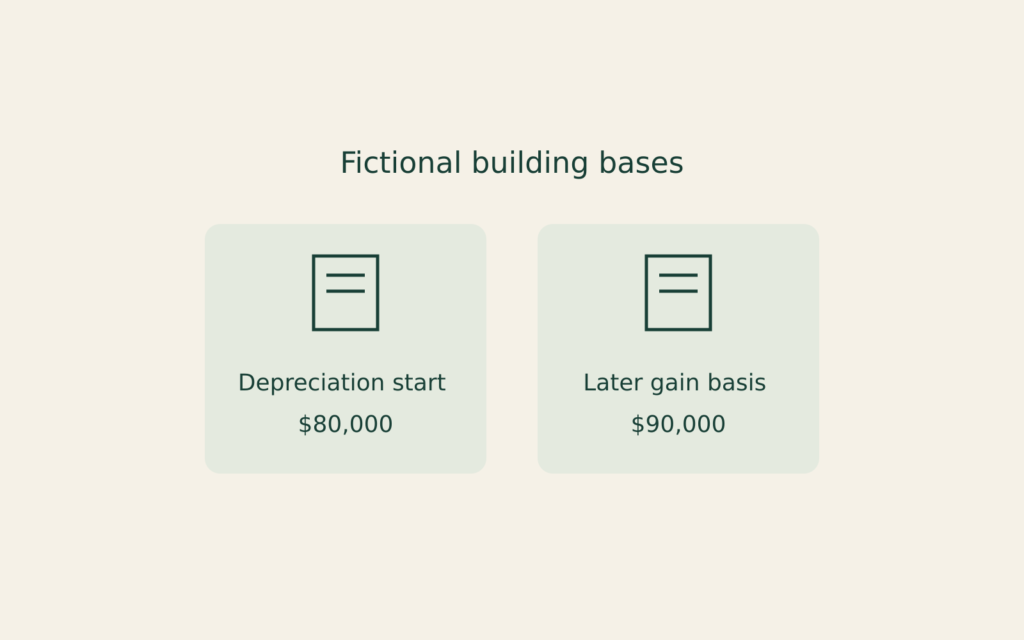
| Starting basis for depreciation | Lower of $100,000 and $80,000 | $80,000 |
| Later adjusted building basis for figuring gain | $100,000 − $10,000 | $90,000 |
Using $80,000 − $10,000 would produce $70,000. That calculation does not supply the gain basis in these facts: it started from the depreciation figure instead of the $100,000 adjusted-basis record.
Do not turn a basis figure into sale proceeds or a tax bill
The $90,000 is a basis for the stated building calculation. It is not the building’s market value, cash available, selling price or taxable gain. No sale proceeds are supplied here, so this example cannot calculate a sale gain or tax owed.
It also does not calculate a deductible loss, a home-sale exclusion or depreciation recapture. Publication 551’s loss rule has a different starting comparison. Do not label the difference between the two conversion figures as an automatic deductible loss.
Keep a two-track record from conversion onward
- Conversion record: the date, adjusted basis and fair market value, with the basis for separating building and land.
- Depreciation record: the starting basis, applicable schedule and amounts that were allowed and allowable.
- Later adjustments: records supporting changes after conversion, rather than an assumption that nothing else occurred.
- Sale question: identify whether the calculation concerns gain or loss before selecting its basis.
If the depreciation claimed on earlier returns differs from the allowable amount, read our missed depreciation and adjusted-basis example. That is a separate check from deciding which conversion value starts the calculation.
The worked amounts are fictional and building-only. Apply the relevant source to the property’s actual history before using a number on a return.


Roth Conversion and Account Clocks
Separate five-year tests.

ABLE Distributions Across Month-End
Separate retained purposes.