Foreclosure Debt and Tax Components
Compare recourse and nonrecourse foreclosure examples. Separate property disposition gain from canceled debt, with assumptions and IRS Publication 4681.
Estimated reading time: 1 minute
A foreclosure can involve both a property disposition and a separate canceled-debt amount.
Keep the debt character explicit
2025 IRS Publication 4681 distinguishes recourse debt, for which the borrower is personally liable, from nonrecourse debt.
Compare alternative completed 2025 foreclosures of individually owned investment land. Each has verified $100,000 outstanding principal, $80,000 fair market value and $70,000 adjusted basis. Assume no accrued interest, fees, other liens, cash or property received, or other adjustments.
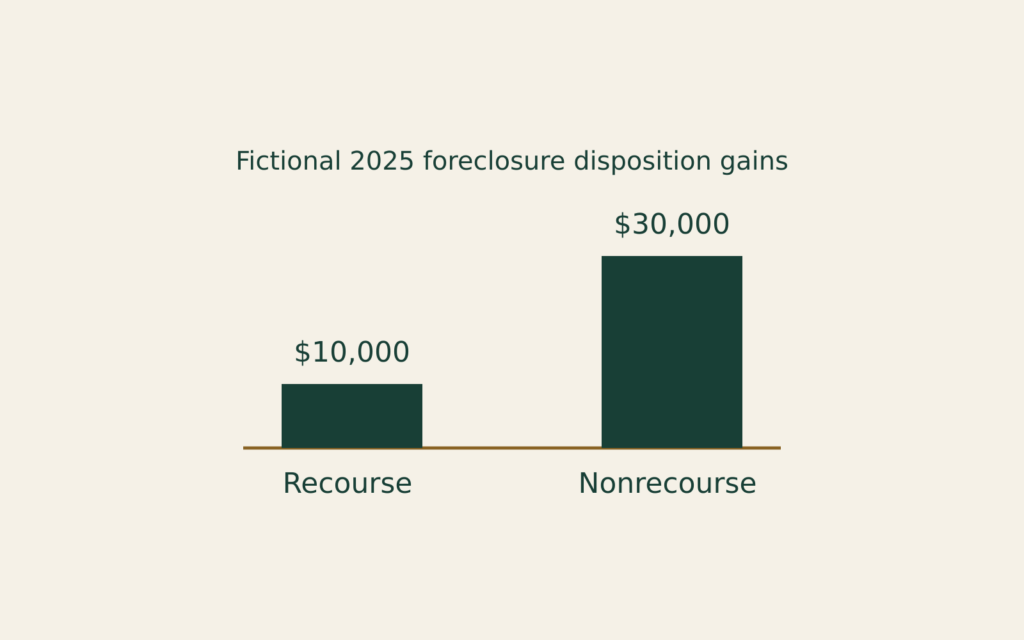
- Recourse: the creditor expressly cancels the entire $20,000 deficiency at transfer; no liability remains. Amount realized is $80,000, producing $10,000 disposition gain. Separately, canceled debt is $20,000 before applicable exceptions or exclusions.
- Nonrecourse: amount realized includes the full $100,000 debt, producing $30,000 disposition gain and no separate cancellation-of-debt income.
The same property value therefore does not determine the same tax components. These are alternatives, not amounts to combine. The example determines neither gain character, exclusion eligibility nor tax owed; foreclosure alone does not establish that a recourse deficiency was canceled.


