Wages and Self-Employment Tax Bases
Allocate two different tax bases.
Estimated reading time: 1 minute
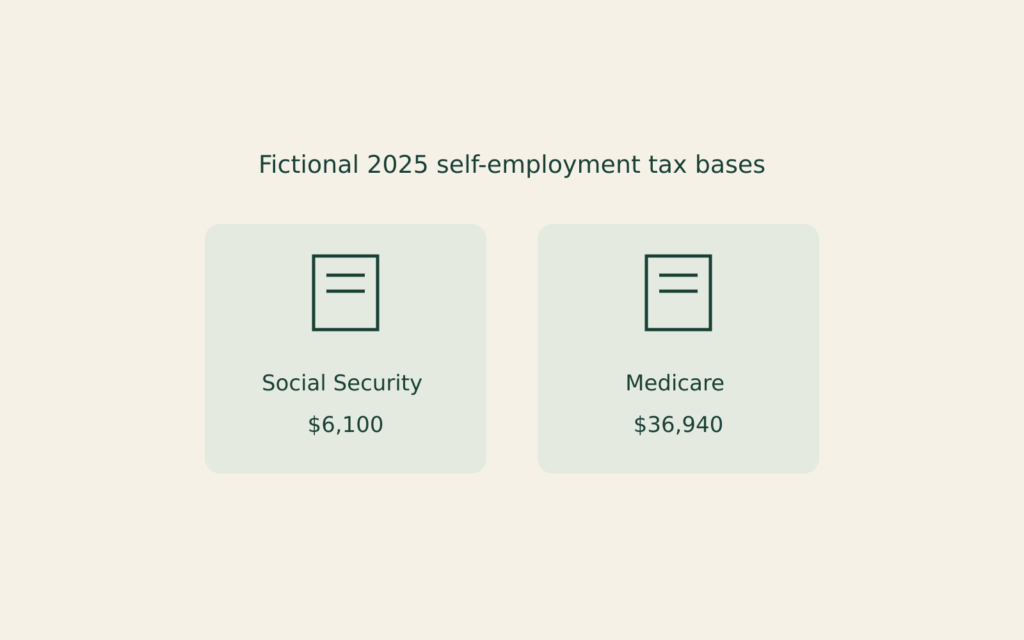
Wages can consume Social Security capacity without reducing the Medicare base for self-employment tax.
Fictional 2025 case: a U.S.-resident married couple files jointly. One spouse has $170,000 of ordinary W-2 wages, all subject to Social Security and Medicare, plus $40,000 verified Schedule C profit from their sole nonfarm business. The other spouse has no earnings. Neither has tips, railroad or church income, exemptions, other businesses or special adjustments; the regular method applies.
On 2025 Schedule SE, adjusted self-employment earnings are $40,000×92.35%=$36,940. Wages leave $176,100−$170,000=$6,100 of Social Security capacity. The smaller base, $6,100, produces $756.40 at 12.4%.
Medicare instead uses all $36,940: at 2.9%, that component is $1,071.26. Regular self-employment tax totals $1,827.66, not 15.3% of all adjusted earnings. The separate half-tax deduction is $913.83, not a reduction of that tax.
Combined wages and adjusted earnings are $206,940, below the $250,000 joint Additional Medicare threshold. Figures retain cents before return rounding; final income tax and payments remain separate.
Mid-Quarter Depreciation Across Purchases
Check the entire acquisition pool.
Alternative Minimum Tax Reconciliation
Separate tentative and additional tax.
Self-Employed Health Insurance Limits
Check coverage eligibility before enrollment.