Two Production Constraints
Compare feasible output mixes.
Estimated reading time: 1 minute
ACCA explains production planning with multiple resource constraints.
Fictional weekly model: A contributes $60 per unit after variable costs and uses two machine hours plus one labor hour. B contributes $40 and uses one machine hour plus two labor hours.
Available capacity is 100 machine hours and 80 labor hours. Assume sufficient demand, constant unit economics, unchanged fixed costs, whole units and no other constraints or setup costs.
For quantities a and b, both must hold: 2a + b ≤ 100 and a + 2b ≤ 80.
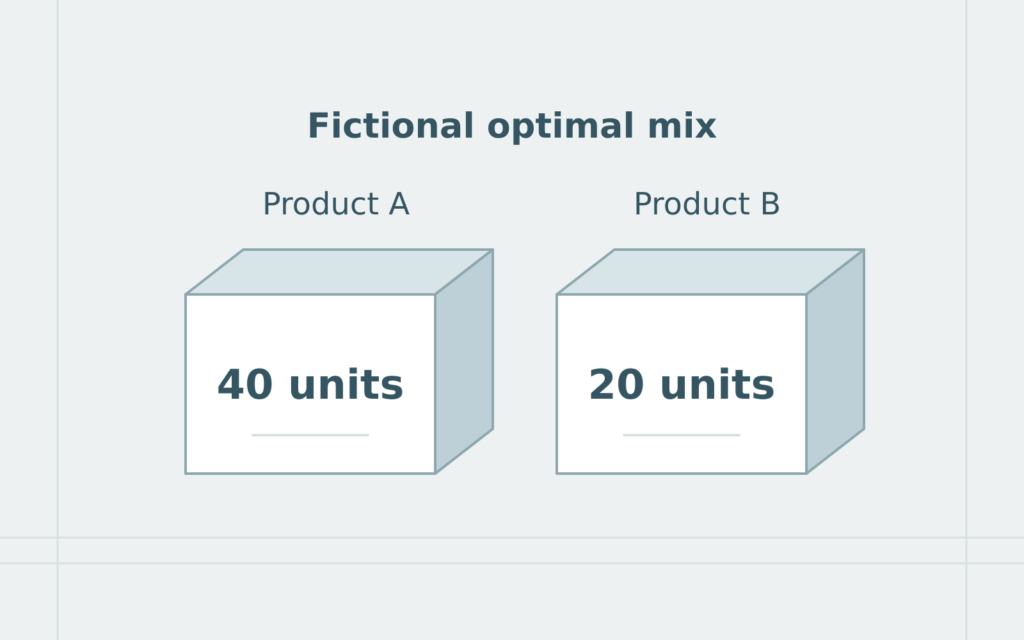
Making 50 A yields $3,000; making 40 B yields $1,600. The joint-limit mix, 40 A and 20 B, uses all 100 machine hours and 80 labor hours, yielding $3,200.
These are the nonzero corners of the feasible region; zero production yields zero. The mixed corner therefore maximizes contribution here.
Rankings using only one resource miss the joint constraint. Recheck demand, costs and both capacities before borrowing; contribution is not cash available for loan payments.
Enterprise Value and Funding
Reconcile acquisition funding.