Payroll Mix and Premiums
Check each classification.
Estimated reading time: 1 minute
The Texas Department of Insurance explains that workers’ compensation basic premium adds classification premiums, each using its payroll and rate per $100. Unchanged total payroll does not guarantee unchanged premium.
Fictional annual inputs, with insurer-confirmed classifications and unchanged rates: Class A has $100,000 payroll at $2 per $100; Class B has $200,000 at $0.50.
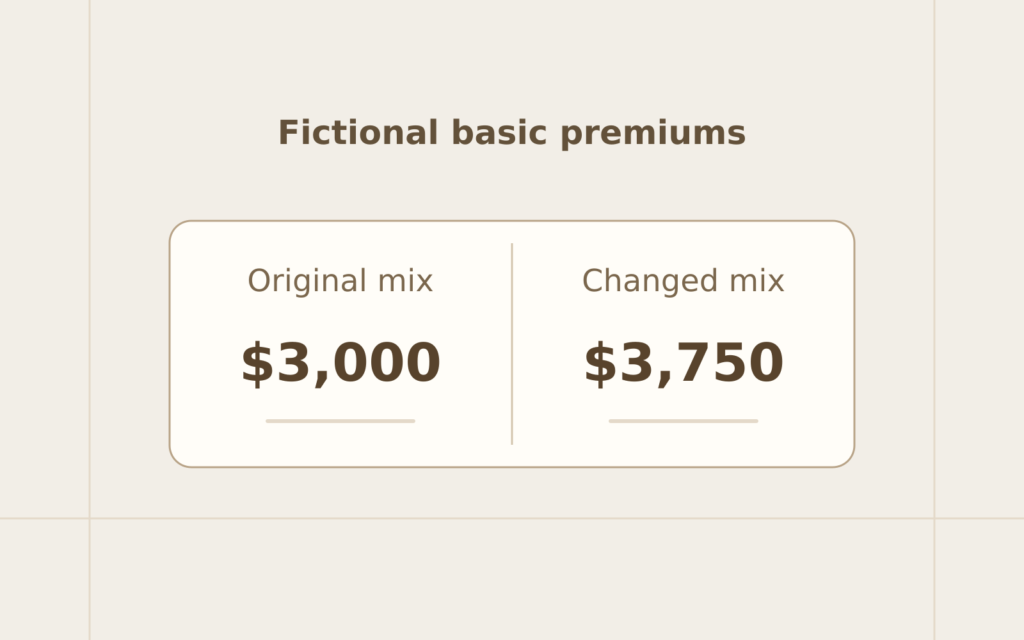
Basic premium is ($100,000 ÷ 100 × $2) + ($200,000 ÷ 100 × $0.50) = $3,000.
Now A has $150,000 payroll and B has $150,000. Total payroll remains $300,000, but basic premium becomes $3,000 + $750 = $3,750: $750 more.
The old blended rate was $1 per $100. Reusing it on unchanged total payroll predicts $3,000 and misses the increase. The new blend is $1.25.
This models a changed payroll mix, not permission to reclassify workers. No experience modifier, schedule adjustment or other premium component is modeled. Basic premium is not necessarily the final bill.
Before budgeting a renewal, ask the insurer to confirm each classification, payroll amount, applicable rate and remaining adjustments.