Build a Tax Planning System That Works All Year
For a self-employed person, tax planning works best when it happens throughout the year rather than during the few weeks before a tax return is due. Income can change, expenses can appear unexpectedly, clients can pay at different times, and business decisions made in one month can affect the tax picture much later. Waiting until filing season means many of those decisions have already happened, leaving little room to respond.
A year-round system does not mean calculating your exact tax liability every week. It means keeping enough information current that you can recognize when your tax position has changed and respond while there is still time to do something about it. The IRS emphasizes that good records help businesses identify income, track deductible expenses, monitor the business, prepare returns, and support the items reported on those returns.
The Goal Is Fewer Surprises
A useful tax-planning system should answer practical questions throughout the year. How much has the business earned? What expenses have actually occurred? How much has already been paid toward estimated taxes? Has expected annual income changed? Are there major purchases or business changes that could affect the tax calculation?
You do not need perfect forecasts to answer those questions. You need current records and a routine for reviewing them. The system becomes valuable precisely because self-employed income is uncertain. Instead of pretending that January’s estimate will remain accurate all year, you create a process for adjusting it when reality changes.
Start With One Reliable Financial Picture
Tax planning becomes difficult when the numbers are spread across a bank account, payment platforms, invoices, receipts, spreadsheets, and memory. Before building complicated tax calculations, create one reliable picture of the business’s financial activity. That means keeping business income and expenses organized enough that you can see what has happened without reconstructing every transaction from scratch.
The IRS does not require most small businesses to use one particular bookkeeping format. You can choose a recordkeeping system suited to the business as long as it clearly shows income and expenses. Electronic systems can be used as well, provided they maintain complete and accurate records.
Keep Business Money Distinguishable
Separating business and personal activity makes this process much easier. A dedicated business account is not a substitute for proper tax analysis, but it can reduce the number of transactions that have to be examined later. When personal purchases, business expenses, transfers, and client payments are mixed together, even a simple business can become difficult to interpret.
This separation also helps with monthly reviews. Instead of asking whether every transaction on a personal account might somehow relate to the business, you can focus your bookkeeping attention on the accounts and payment channels actually used for business activity. The fewer unnecessary transactions in the system, the easier it is to maintain.
Create a Monthly Tax Dashboard
You do not need a complicated financial dashboard. A simple monthly summary can provide most of the information needed for an ongoing tax review. At minimum, track year-to-date business income, deductible business expenses, estimated taxable income, estimated tax payments already made, and significant changes expected before the end of the year.
The purpose is not to produce a final tax return every month. It is to identify movement. If revenue is substantially above the original forecast, that should be visible. If expenses have increased, that should be visible too. If a major purchase or new income source changes the business, the dashboard gives you a place to record the change before it disappears into the year’s paperwork.
Use Trends Instead of One-Month Numbers
One unusually strong month should not automatically become your new annual forecast. Likewise, one weak month should not convince you that the entire year will be poor. Look at several months together and ask why the numbers changed.
For example, a freelancer might receive three large payments in June because several projects finished at once. That does not necessarily mean July, August, and September will produce the same revenue. A better forecast considers recurring contracts, outstanding invoices, confirmed projects, normal seasonal patterns, and the actual history of the business.
Make Estimated Taxes Part of the Routine
For many self-employed individuals, estimated taxes are one of the most important parts of year-round planning. The IRS generally requires individuals who expect to owe at least $1,000 when filing their return to make estimated tax payments, subject to the applicable rules and exceptions. Estimated tax can cover both income tax and self-employment tax.
Form 1040-ES is used to figure estimated tax. The IRS recommends considering expected adjusted gross income, taxable income, taxes, deductions, and credits for the year, with the previous year’s return often serving as a useful starting point.
Your First Estimate Is Only a Starting Point
A January estimate should not be treated as a permanent number. If your expected earnings rise or fall substantially, the IRS allows you to refigure estimated tax for later payment periods. This is particularly important for freelancers whose income changes significantly during the year.
Suppose your original forecast was based on $70,000 of annual income, but by the middle of the year you have already earned more than expected and have several additional contracts lined up. Continuing to use the original estimate without reviewing the numbers could leave the tax reserve and estimated payments out of step with reality.
Build a Tax Reserve Alongside the Calculation
An estimated tax calculation tells you what you may need to pay. A tax reserve makes it possible to pay it without disrupting the business. These two parts of tax planning should work together but should not be confused.
When client money arrives, some of it may eventually be needed for taxes. Treating the entire payment as available spending money can create a false sense of financial capacity. A separate reserve allows you to distinguish money that is available for operating or personal purposes from money that has effectively been committed to a future tax obligation.
Avoid the Fixed-Percentage Trap
A simple percentage can be useful as a budgeting habit, but it should not be mistaken for a complete tax calculation. The actual tax position depends on the taxpayer’s circumstances, including income, deductible expenses, deductions, credits, filing situation, and applicable tax rules.
A freelancer whose income changes dramatically should therefore review the actual tax estimate periodically instead of assuming that the same percentage will always produce the correct result. The reserve can be adjusted when the forecast changes.
Keep Records While the Details Are Fresh
Recordkeeping is one of the foundations of year-round tax planning. The IRS says supporting documents can include invoices, receipts, paid bills, deposit slips, canceled checks, and other documents that support entries in the business books and tax return.
The practical advantage of recording transactions promptly is not simply compliance. It preserves context. A purchase that is obvious today may be difficult to identify six months later. If the receipt, business purpose, and transaction details are captured when the expense occurs, the same item becomes much easier to evaluate during tax preparation.
Give Unusual Transactions Extra Attention
Routine expenses usually fit into established categories. Unusual transactions deserve more documentation. A large equipment purchase, mixed personal-and-business expense, asset sale, new business activity, or significant change in how an asset is used may require information that is not obvious from a bank statement.
Do not force an uncertain transaction into a category simply to make the bookkeeping look complete. Flag it for review. A short note explaining what you are unsure about can be more useful later than a confident but incorrect classification.
Review Expenses Before Year-End
Tax planning is not about buying things simply because they might produce deductions. However, legitimate business expenses and larger purchases can have tax consequences, so understanding them before year-end is better than discovering them while preparing the return.
If the business already expects to need equipment, software, professional services, or another legitimate business expense, the timing may deserve consideration. The relevant tax treatment can depend on the type of expense, when it was placed in service, business use, and other rules. A deduction should therefore be the result of a sound business decision rather than the reason for making a purchase.
Separate Ordinary Expenses From Assets
A recurring operating expense and a significant business asset may not be treated the same way for tax purposes. Property may involve depreciation or other rules, while certain provisions can allow qualifying property to receive different treatment. The correct treatment depends on the specific facts and current tax law.
This is where keeping an asset record becomes important. Record the purchase date, cost, description, business use, and supporting documentation rather than assuming the receipt alone will answer every question later. Good records also help establish basis when the property is eventually sold or otherwise disposed of.
Use the Calendar to Prevent Tax Planning From Disappearing
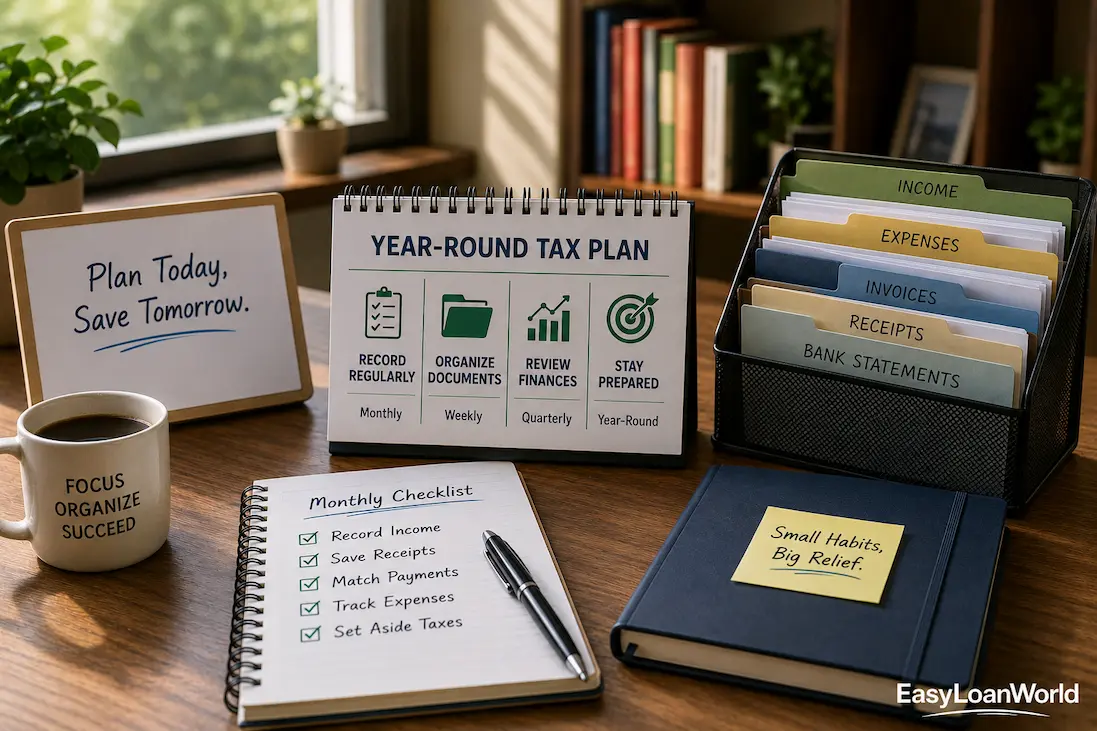
A year-round system works better when specific reviews have a place on the calendar. Otherwise, “I’ll check the numbers later” can easily turn into November, followed by December, followed by tax season.
The review does not need to happen every week. A short monthly bookkeeping review combined with a more deliberate tax forecast at useful points during the year can be enough for many small businesses. The appropriate frequency depends on transaction volume and how quickly the business changes.
A Simple Four-Stage Rhythm
Beginning of the year: Start with the prior year’s return and create a reasonable forecast for current-year income, expenses, deductions, credits, and estimated tax.
During the year: Keep records current, review business income and expenses, maintain the tax reserve, and compare actual results with the forecast.
After major changes: Recalculate when income changes significantly, a major expense occurs, the business changes structure, or another event materially affects the expected tax position.
Before filing season: Reconcile the year’s records, resolve questionable transactions, confirm supporting documents, and identify missing information before the return is prepared.
This rhythm prevents tax planning from becoming a single annual event. It turns it into a repeating process with clear points for adjustment.
Pay Attention to Changes That Can Alter the Forecast
Not every change in the business requires a complete tax analysis, but some deserve attention. A substantial increase in income, a sharp decline in revenue, a new business activity, significant equipment purchases, changes in filing circumstances, or new income from another source can all affect the broader calculation.
The IRS’s 2026 Publication 505 emphasizes that estimated-tax calculations should be adjusted for changes in the taxpayer’s situation and relevant changes in tax law.
Keep a “Changes” List
One practical approach is to maintain a short list throughout the year. Instead of trying to remember every unusual event in December, write down significant changes when they occur.
For example: “Started second business in May,” “bought business equipment in July,” “client contract increased monthly income,” or “began receiving income from another source.” The list does not determine the tax treatment. It simply makes sure important events are not forgotten when the tax forecast is reviewed.
Plan for Uneven Income, Not Just Total Income
Some businesses earn approximately the same amount each month. Others have highly seasonal revenue. A freelancer might have several quiet months followed by a large project, while a consultant may receive most annual revenue from a few contracts.
The distinction matters because the timing of income can affect estimated-tax planning. The IRS provides an annualized income installment method for taxpayers whose income is not received evenly during the year. This method can allow estimated installments to reflect the actual timing of income rather than assuming it arrived evenly.
Do Not Use Annualization Just to Make Payments Smaller
Annualization is not a method for reducing the final tax bill. It is a way of calculating required installments when income is uneven. The calculations are more involved than a basic quarterly estimate and may require additional forms or schedules.
For a freelancer with dramatically seasonal income, it can be worth investigating. For someone whose income simply fluctuates modestly from month to month, a regular estimated-tax calculation that is updated as circumstances change may be sufficient.
Connect Tax Planning With Cash-Flow Planning
Tax planning should never be separated completely from business cash flow. A tax obligation may be accurate on paper while the business still struggles to meet it because cash is tied up in unpaid invoices or future operating expenses.
This is why the tax reserve should sit alongside an operating cash reserve rather than replacing it. A freelancer needs to know not only what may be owed to the IRS but also what money is available to keep the business functioning.
Watch Outstanding Invoices
An invoice that has been issued but not collected is not the same thing as cash sitting in the bank. Track outstanding invoices separately so that your cash-flow forecast does not assume that every completed project has already produced usable money.
At the same time, do not automatically assume that an unpaid invoice has no tax relevance. The tax treatment of income depends on the accounting method and applicable rules. Your bookkeeping and tax planning should therefore use a consistent accounting approach rather than relying only on bank deposits.
Use the Slow Months for Tax Maintenance
A slower business period can be an opportunity to strengthen the system. Reconcile accounts, organize receipts, review unpaid invoices, update the income forecast, check the tax reserve, and resolve transactions that have been sitting in an uncertain category.
This work has a second benefit: it improves the next forecast. You may discover that certain software costs are higher than expected, that a client regularly pays late, or that a particular type of project generates more profit than another. Tax planning becomes more useful when it reflects how the business actually operates.
Fix Repeated Problems at the Source
If the same missing receipt appears every year, change how receipts are captured. If payment-platform income is consistently difficult to reconcile, create a specific procedure for those deposits. If personal and business expenses repeatedly become mixed, improve the separation between accounts.
The objective is not to create more paperwork. It is to eliminate recurring sources of uncertainty. A good tax system should become easier to operate over time, not more complicated.
Keep the Records Long Enough to Support the Return
Year-round planning does not end when the tax return is filed. The records behind the return still matter afterward. The IRS says the appropriate retention period depends on the action, expense, or event documented, and records generally need to be kept as long as necessary to substantiate the income or deductions reported.
Property records can require special attention because information about basis may be needed when property is sold or otherwise disposed of. Employment tax records also have separate retention requirements.
Archive the Return With Its Evidence
Keep the filed return together with the records used to prepare it. That creates a useful historical package for the following year and makes it easier to answer questions about prior calculations.
It also gives next year’s planning process a better starting point. The previous return can provide actual income, deductions, credits, and tax information that can be adjusted for the new year rather than recreated from memory.
Know When the System Has Outgrown You
A year-round system is supposed to reduce complexity, but there is a point where trying to handle everything alone can become inefficient. A growing business may have multiple accounts, employees or contractors, several income streams, significant assets, inventory, complicated deductions, or major changes during the year.
Professional help can be particularly useful when you cannot confidently determine how a major transaction affects the tax forecast or when estimated-tax calculations become difficult to maintain. The purpose is not to hand over every routine bookkeeping task. It is to get qualified help where the consequences of an incorrect decision justify it.
Simple Does Not Mean Incomplete
A solo freelancer with relatively few transactions may need little more than organized records, a reliable bookkeeping method, an updated tax forecast, and a tax reserve. A larger operation may need formal accounting software and professional review.
The system should grow with the business. Adding complexity merely because a business owner believes a “serious” tax system must be complicated can make the process harder to maintain. The better test is whether the system produces accurate, accessible information when decisions need to be made.
A Year-Round Tax Planning Checklist
A useful system can be reduced to a handful of recurring actions. Keep business income and expenses current, preserve supporting documents, reconcile accounts, maintain a tax reserve, update estimated-tax calculations when circumstances change, and review significant purchases before making them. At year-end, make sure the records are complete rather than beginning the cleanup after the tax deadline approaches.
The IRS specifically says that a business may choose the recordkeeping system suited to its operations, provided it clearly shows income and expenses. The best system is therefore not the one with the most categories or software features. It is the one that consistently produces information you can understand and support.
Final Takeaway
A year-round tax planning system does not require constant tax calculations. It requires current information, regular reviews, and enough flexibility to change the plan when the business changes. Start the year with a reasonable estimate, record transactions as they happen, protect money for estimated taxes, review the numbers regularly, and revisit the forecast after significant changes. The IRS itself treats estimated tax as a calculation that can be revised when expected earnings change.
The biggest advantage of planning throughout the year is not simply avoiding a large surprise at filing time. It is having enough information to make better decisions while those decisions can still be changed. When tax planning becomes part of the normal business routine, filing season becomes the final step in an ongoing process rather than the moment when the entire financial year has to be reconstructed.
Official resources: IRS Estimated Taxes · IRS Publication 505 — Tax Withholding and Estimated Tax · IRS Recordkeeping · IRS Form 1040-ES