
How to Estimate Taxes When Your Income Changes Every Month
Self-employed income rarely arrives in a perfectly predictable pattern. One month may bring several large client payments, while the next may produce only a few small invoices. A freelancer might earn $3,000 in January, $7,500 in February, $1,800 in March, and then have another strong month in April. That unevenness makes tax planning harder because the money arriving in the bank account does not follow the same pattern as a traditional paycheck.
For U.S. self-employed individuals, estimated tax is generally based on expected income, deductions, credits, and taxes for the year rather than simply applying a fixed tax percentage to whatever arrived during the current month. Form 1040-ES is the IRS’s main worksheet for figuring estimated tax. If your original estimate turns out to be too high or too low, the IRS allows you to refigure the estimate for later payment periods.
The Real Problem Is Usually the Forecast
The difficult part is not multiplying this month’s income by a percentage. It is estimating what the entire year may look like when the future is uncertain. A freelancer cannot know exactly which clients will sign, which invoices will be delayed, or whether a major project will appear unexpectedly. A useful tax estimate therefore needs to be treated as a working forecast, not a prediction carved in stone.
That distinction changes how you respond to a strong or weak month. A large payment should not automatically cause you to panic about taxes, and a weak month should not automatically convince you that no tax will be due. Instead, each significant change should trigger a review of the year-to-date numbers and the remaining months.
Start With What Has Already Happened
When estimating taxes partway through the year, begin with actual information rather than guessing the full year from scratch. Gather your business income recorded so far, deductible business expenses, estimated tax payments already made, withholding from other sources if applicable, and any major changes that could affect your tax situation.
Use the Previous Return as a Starting Point
The IRS specifically suggests using the previous year’s federal return as a starting point when estimating current-year tax. That does not mean simply copying last year’s numbers. Your expected income, deductions, credits, filing situation, and applicable tax rules may all be different. The previous return is useful because it provides a structured baseline from which those changes can be made.
For example, a freelancer who earned $60,000 last year but expects $85,000 this year should not simply repeat last year’s estimated payments. At the same time, assuming the entire $85,000 will be taxable income would also be too simplistic. Business expenses, adjustments, deductions, self-employment tax, credits, and other factors affect the actual calculation.
Separate Revenue From the Number That Drives the Tax Estimate
One of the most common mistakes in self-employed tax planning is treating gross client payments as though they were automatically taxable income. Business revenue is an important starting point, but the tax calculation is more involved.
A freelancer who receives $10,000 in client payments during a month might also have legitimate business expenses associated with earning that income. The eventual tax calculation can also involve adjustments, deductions, credits, and self-employment tax. Form 1040-ES therefore asks taxpayers to estimate items such as adjusted gross income, taxable income, taxes, deductions, and credits rather than simply entering monthly revenue.
Keep a Running Business Picture
Your monthly bookkeeping should make it possible to answer three different questions: How much money came in? How much did the business spend? And what does the current information suggest about the full-year result? Those questions are related, but they are not interchangeable.
This is why a freelancer can have a $12,000 revenue month without necessarily having $12,000 of taxable income. It is also why a month with very little revenue does not automatically mean the annual tax liability has fallen by the same proportion. The tax estimate should follow the broader year-to-date picture.
Reforecast Instead of Starting Over Every Month
A practical approach is to update the forecast periodically rather than rebuilding the entire tax plan whenever a payment arrives. Suppose you have six months of actual results and six months remaining. Use the actual first six months as your foundation, then make a reasonable estimate for the remaining six months.
The future estimate does not need to be perfect. It needs to be reasonable and based on information you actually have. Existing contracts, recurring clients, scheduled projects, typical seasonal patterns, known expenses, and current sales activity can all provide better evidence than simply assuming the next six months will look exactly like the previous six.
Use Scenarios When the Future Is Uncertain
If your income is especially unpredictable, consider creating a conservative, expected, and strong-income scenario. For example, you might estimate that the remaining months could produce $25,000, $35,000, or $45,000 of additional revenue. You can then see how each scenario affects your expected annual tax position.
This is not a substitute for the IRS worksheets or professional tax advice. It is a planning technique that helps prevent one optimistic forecast from becoming the only version of the future you consider. It also makes it easier to decide how much cash should remain available for taxes.
Your Estimated Payment Does Not Have to Stay the Same
A major point for self-employed taxpayers with changing income is that estimated tax calculations can be revised during the year. The IRS says that if you estimated your earnings too high, you can complete another Form 1040-ES worksheet to refigure your estimated tax for the next quarter. The same applies if you underestimated your earnings.
A Strong Month Can Change the Later Payments
Imagine a freelancer originally expected to earn $60,000 for the year. By July, several new contracts have pushed the expected annual income substantially higher. Continuing to make payments based on the old forecast without reviewing the numbers may leave the freelancer underestimating the eventual tax obligation.
The appropriate response is not simply to multiply the unexpected payment by a guessed percentage and send that amount to the IRS. Instead, update the annual estimate using the relevant income, deductions, credits, and tax calculations. The revised result can then be used to determine what remains to be paid during later periods.
Uneven Income Requires a Different Way of Thinking
There is an important difference between changing annual income and unevenly distributed annual income. A freelancer may ultimately earn $80,000 for the year but receive most of it during the summer. Another freelancer might earn approximately $80,000 spread fairly evenly across all twelve months.
Using four equal estimated payments can be less representative when income arrives unevenly. The IRS provides an annualized income installment method for taxpayers whose income is not received evenly during the year. This method calculates estimated tax using income and other relevant amounts accumulated through each payment period rather than assuming the year’s income arrived at an even pace.
Annualizing Is Not a Way to Pay Less Tax
The annualized method can change when estimated payments are required, but it does not magically reduce the final tax liability. Its purpose is to better match estimated payments with the timing of income.
For example, a seasonal business might earn very little during the first part of the year and substantially more later. Requiring identical installments as though income had been earned evenly could create a mismatch between cash generation and estimated payments. Annualization can account for the actual pattern, subject to the applicable IRS rules and calculations.
When Annualization May Be Worth Looking At
The annualized income installment method can be particularly relevant when a business has strong seasonal swings, a major project creates a large income spike, or income arrives in a few concentrated periods. The IRS’s 2026 Publication 505 specifically describes this method for taxpayers whose income is not received evenly during the year.
However, it is more involved than simply dividing an annual estimate by four. The taxpayer uses the annualized estimated tax worksheet and, when using the method, generally files Form 2210 with the tax return with the applicable annualized-income schedule.
Do Not Annualize Just Because Income Is Messy
Not every freelancer needs the annualized method. If income changes somewhat from month to month but remains reasonably consistent across the year, regularly updating the standard estimated-tax calculation may be enough. Annualization becomes more interesting when the timing of income is substantially uneven, not merely because one month was better than another.
If you are unsure whether the method applies to your circumstances, this is one of the situations where professional tax guidance can be useful. The calculations can become complicated when business income interacts with other income, deductions, credits, or major financial changes.
Keep a Running Tax Reserve Alongside the Estimate
The estimated tax calculation tells you what may need to be paid. A tax reserve helps you actually have the money available when payment time arrives. These are two different systems and should not be confused.
Suppose your latest forecast indicates that another $8,000 may be required for federal taxes over the remaining payment periods. That number is useful, but it does not help much if the entire amount has already been spent on business expansion or personal expenses. Keeping a separate reserve gives the estimate a practical purpose.
The Reserve Should Follow the Forecast
The reserve does not have to be based on a permanent percentage of every payment. When income changes substantially, review the expected annual tax and compare it with the amount already reserved and the payments already made.
If the forecast increases, the reserve may need to increase as well. If expected income falls materially, the updated calculation may show a different requirement. The important point is to keep the cash reserve and tax estimate connected without assuming that either one is perfectly accurate months in advance.
Watch the Difference Between Cash and Tax Timing
Money received in a particular month and income recognized for tax purposes are not always concepts that should be treated as identical without considering the taxpayer’s accounting method. This is another reason that a bank statement alone is not a sufficient tax-planning system.
For many small self-employed businesses using the cash method, the timing of actual or constructive receipt can be important. Other taxpayers may use different accounting methods. Your recordkeeping system should therefore follow the method that applies to your business rather than assuming that every tax calculation can be made simply by looking at monthly bank deposits.
Unpaid Invoices Still Matter to the Forecast
Outstanding invoices are useful for cash-flow forecasting even when they have not yet produced a bank deposit. If a client owes $7,000 and has promised to pay next month, that information can affect the expected cash position even though the money is not currently available.
This distinction becomes especially important when estimating the remaining months of the year. A freelancer with $20,000 of completed but unpaid work may have a different near-term cash situation from a freelancer with no outstanding invoices, even if their current bank balances are identical.
Know When the Standard Quarterly Approach Applies
For estimated-tax purposes, the IRS divides the year into four payment periods. For 2026, the general individual payment dates are April 15, June 15, September 15, and January 15 of the following year, subject to weekend and holiday adjustments.
That does not mean a freelancer must literally move money to the IRS only four times. The IRS says estimated taxes can be paid weekly, biweekly, monthly, or on another schedule as long as enough has been paid by the applicable quarterly deadlines. This can be useful for freelancers who prefer to move a smaller amount into a tax account whenever client payments arrive.
Smaller Transfers Can Make Cash Flow Easier
For someone whose income arrives several times a month, setting aside tax money whenever a client payment clears can feel more manageable than trying to assemble a large quarterly payment at the last minute. The important distinction is that your personal cash-management schedule and the IRS’s required payment schedule are not necessarily the same.
You can therefore use frequent transfers as a budgeting habit while still checking that the total amount paid to the IRS meets the applicable requirement by each due date. This creates a bridge between irregular business income and regular tax obligations.
Check Whether You Are at Risk of an Underpayment Penalty
Estimated-tax planning is not only about predicting the final tax bill. It also involves considering whether enough tax has been paid during the year. The IRS generally says many taxpayers can avoid the underpayment penalty if they owe less than $1,000 after withholding and credits, or if they paid at least 90% of the current year’s tax or 100% of the prior year’s tax, whichever is smaller, with special rules applying in certain circumstances.
These rules are more nuanced for some taxpayers, particularly those with higher incomes or special circumstances. Therefore, a freelancer should not assume that having a refund or a small final balance automatically means estimated payments were handled correctly. The timing of payments can matter.
Uneven Income Can Affect the Penalty Analysis
This is another reason the annualized method can be important for highly seasonal businesses. The IRS explains that taxpayers whose income is received unevenly during the year may be able to annualize income and make unequal estimated payments to avoid or reduce an underpayment penalty.
The method is not something to apply casually after the year is over simply because the payment pattern looked unusual. If you expect your income to be heavily concentrated in particular periods, it is better to understand the rules while the year is still in progress.
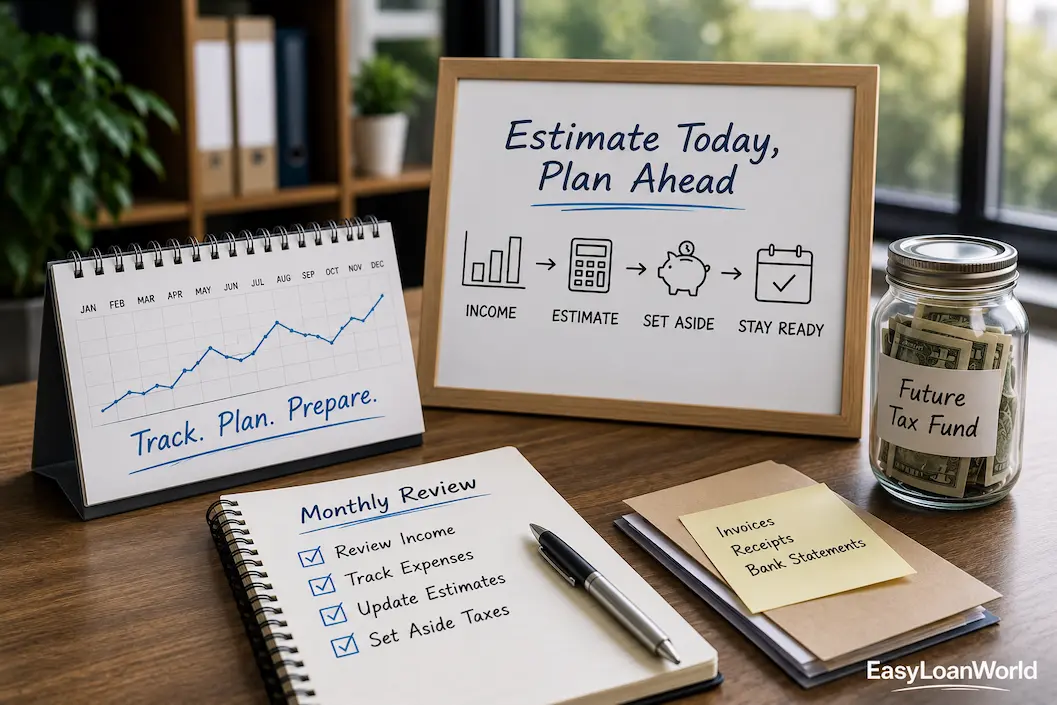
A Practical Monthly Tax Review
You do not need to recalculate your entire tax situation every time a client pays an invoice. A better routine is to establish specific points when you will revisit the estimate. A monthly bookkeeping review can update the basic numbers, while a more detailed tax forecast can be performed after a major change in income or expenses.
At each review, look at year-to-date business income, business expenses, expected remaining revenue, estimated tax payments already made, withholding if applicable, and major changes that could affect deductions or credits. The purpose is to identify whether your original annual forecast still makes sense.
Ask Four Questions
First, is my year-to-date income close to what I expected? Second, have my business expenses changed significantly? Third, has anything changed that affects my tax situation? Fourth, does the amount already paid or reserved still make sense compared with my updated annual estimate?
These questions are simple, but they prevent a common problem: making estimated payments based on a forecast created many months ago even though the underlying business has changed completely. A forecast is useful only while it resembles reality.
Do Not Turn One Exceptional Month Into a Twelve-Month Forecast
A single unusually large project can distort your expectations in either direction. If a freelancer receives $15,000 in one month after several quiet months, assuming every future month will produce $15,000 could create an unrealistic annual forecast. The opposite mistake can happen after a very weak month.
A better approach is to identify why the month was unusual. Was it a one-time project? A delayed payment? A seasonal event? A new recurring client? A temporary expense reduction? Understanding the cause is more useful than simply carrying the number forward.
Look for the Pattern Behind the Number
If a strong month came from a recurring contract that is likely to continue, it may deserve significant weight in the forecast. If it came from a one-off project, it should not automatically become the new monthly baseline. Similarly, a weak month caused by a temporary client delay may tell you little about annual earning capacity.
Tax estimates become more reliable when they are based on the business’s underlying pattern rather than whichever monthly number happens to be most recent.
When a Tax Professional Becomes Worthwhile
Self-employed tax calculations can become complicated when income changes significantly, multiple businesses or income sources are involved, major asset purchases occur, or the taxpayer has substantial deductions and credits. The annualized-income method adds another layer of calculation that may not be worth attempting casually.
Professional assistance can be particularly useful when a large income change occurs close to an estimated-tax deadline or when you are uncertain whether your current payments satisfy a safe-harbor or annualized-income rule. The goal is not to outsource every simple calculation. It is to recognize when the consequences of getting the calculation wrong justify expert review.
Conclusion
Estimating taxes with changing monthly income works better when you treat the calculation as a rolling forecast rather than a once-a-year guess. Start with your prior return, replace assumptions with actual year-to-date numbers, estimate the remaining months realistically, and refigure your estimated tax when your circumstances change. The IRS specifically allows taxpayers to revise estimated-tax calculations during the year, while taxpayers with genuinely uneven income may be able to use the annualized income installment method.
The most important habit is not finding one perfect percentage to save from every payment. It is checking whether your current estimate still matches the business you are actually running. When income changes, update the forecast, review what has already been paid, protect the cash needed for taxes, and pay attention to the timing of estimated-tax requirements.
Official resources: IRS Estimated Taxes · IRS Publication 505 — Tax Withholding and Estimated Tax · IRS Form 1040-ES