Auto Lease Capitalized Cost: Trace the Vehicle Value and Extras
Trace a fictional lease from vehicle value through extras and a reduction, without mistaking the result for a payment.
Estimated reading time: 5 minutes
This guide examines a U.S. personal-use auto lease covered by Regulation M, not a business equipment lease or a loan. The regulation’s consumer-lease definition generally concerns personal, family or household use for a term exceeding four months, subject to exclusions and an applicable dollar threshold. Don’t assume every vehicle arrangement qualifies. Check the coverage definition when the transaction falls outside that ordinary setting.
Separate the vehicle from the total being capitalized
Gross capitalized cost includes the agreed vehicle value plus other amounts paid over the lease term. Under the motor-vehicle disclosure rule, service contracts and prior credit balances aren’t part of the agreed vehicle value itself. Capitalized accessories and destination charges are included in that vehicle value; certain capitalized taxes and registration-related fees may be included there too.
The rule provides for a separate written itemization of gross capitalized cost by type and amount, available before consummation when requested. That breakdown answers a different question from simply finding the vehicle’s negotiated value.
Follow the two-stage calculation
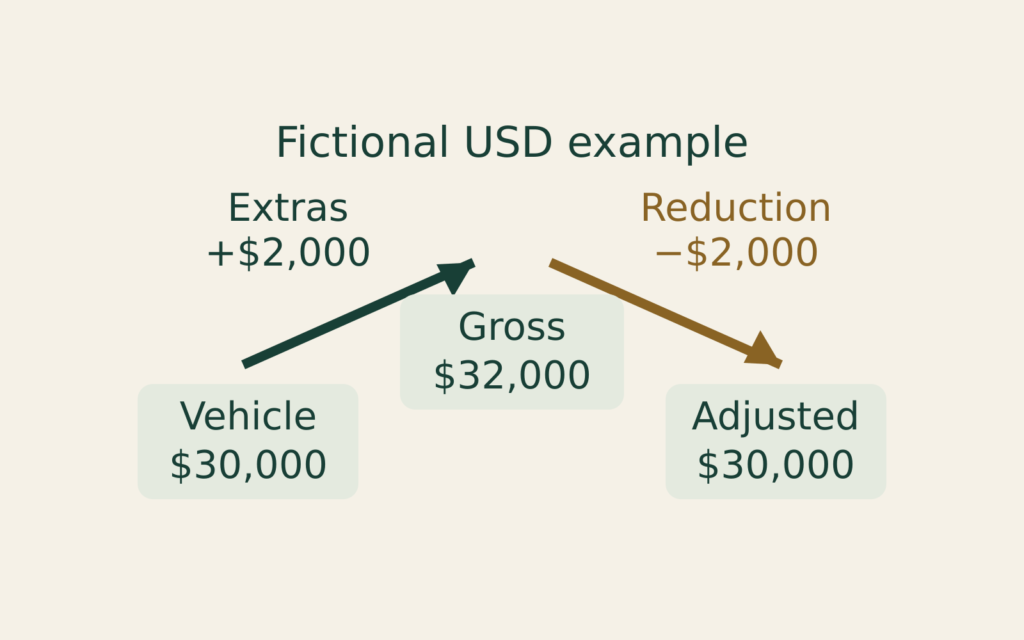
Mercedes-Benz Financial Services’ glossary describes adjusted capitalized cost as gross capitalized cost less the capitalized cost reduction. The following invented terms assume every listed extra is capitalized and the reduction is confirmed. They aren’t a provider quote or a recommendation to include these items.
| Component | Amount |
|---|---|
| Agreed vehicle value | $30,000 |
| Capitalized acquisition fee | $700 |
| Capitalized service contract | $800 |
| Capitalized prior balance | $500 |
| Gross capitalized cost | $32,000 |
| Confirmed cost reduction | −$2,000 |
| Adjusted capitalized cost | $30,000 |
The three extras total $2,000. Adding them produces $32,000; subtracting the reduction produces $30,000. The final figure happens to equal the vehicle value because two separate adjustments offset. The extras haven’t disappeared or become free.
Don’t turn that result into a monthly payment
The CFPB’s leasing-versus-buying explanation distinguishes paying for vehicle use from buying it. Lease payments account for depreciation, a rent charge, taxes and fees; the lessor estimates the end-of-lease residual value.
Treat the payment explanation as a separate review step. Identify which line represents the rent charge and where taxes and fees enter the quoted payment. If a presentation only describes depreciation, ask for the remaining payment components rather than estimating them yourself. A label such as “monthly” doesn’t explain which components have been included. Keep any assumptions supplied with the explanation alongside it, especially when comparing presentations that use different labels.
For each unresolved payment question, write down the provider’s response and the document it identifies. Distinguish an explanation you received from an assumption you made; leave unanswered questions visibly open.
Keep the versions together
Under Regulation M’s general disclosure requirements, required disclosures must be clear, written and retainable, and provided before consummation. The disclosure statement is dated and identifies the parties. It can be separate from the contract; related information may appear across the permitted documents. A separate page isn’t automatically evidence that something is missing.
For review, keep the statement and its accompanying pages under the same version date. If a revised page arrives, preserve the earlier copy rather than silently replacing it. Mark which version the explanation addresses. Ask the provider to identify the matching pages when a packet contains different dates or inconsistent references.
The regulation allows properly identified estimates under specified conditions when information remains unavailable after reasonable efforts. An estimate label deserves attention, but it doesn’t by itself establish wrongdoing. Record exactly which field is estimated and ask what information remains unresolved; don’t convert that field into a confirmed amount in your own comparison.
An advertisement isn’t the itemization
The advertising provisions distinguish an advertised total due at signing from a transaction-specific breakdown: the advertisement need not itemize that total’s components. Advertised payments or signing totals may also exclude varying third-party taxes, license or registration fees if that exclusion is disclosed, or use a stated locality with a warning that fees vary.
Consequently, an attractive advertised figure isn’t enough to reconstruct your own documents. Save the relevant offer’s conditions and identify whether its geographic assumptions match the proposed transaction. If the documents differ, ask which assumption changed rather than treating every difference as an added charge.
This is a document-comparison exercise, not a finding that an advertisement complies with every rule or that a dealer must extend an offer to a particular applicant.
Resolve the unexplained line, not just the bottom number
A useful review question names the exact page, row and version: “Please identify the document supporting this line and explain what changed from the earlier copy.” Keep the reply alongside that page. If an explanation refers to another document, obtain the relevant reference before marking the question resolved.
Distinguish three outcomes in your notes: a transcription error, a documented change, or an unanswered question. Don’t invent an answer merely because the arithmetic balances. This guide doesn’t recommend signing, paying, selecting an add-on or changing an existing arrangement.
Roth Conversion and Account Clocks
Separate five-year tests.
ABLE Distributions Across Month-End
Separate retained purposes.