Auto-Loan Add-Ons: Isolate the Financed Cost
Compare fictional product costs with two matched payment schedules.

A small increase in a car payment can hide several separate purchases. Compare two otherwise identical schedules. The calculation answers the borrowing question; it cannot establish the value of the products.
Extended warranties, Guaranteed Asset Protection (GAP) and credit insurance are generally optional. Ask for the contract basis if called mandatory. See CFPB guidance. This does not describe all vehicle insurance.
Separate the shopping list from the loan
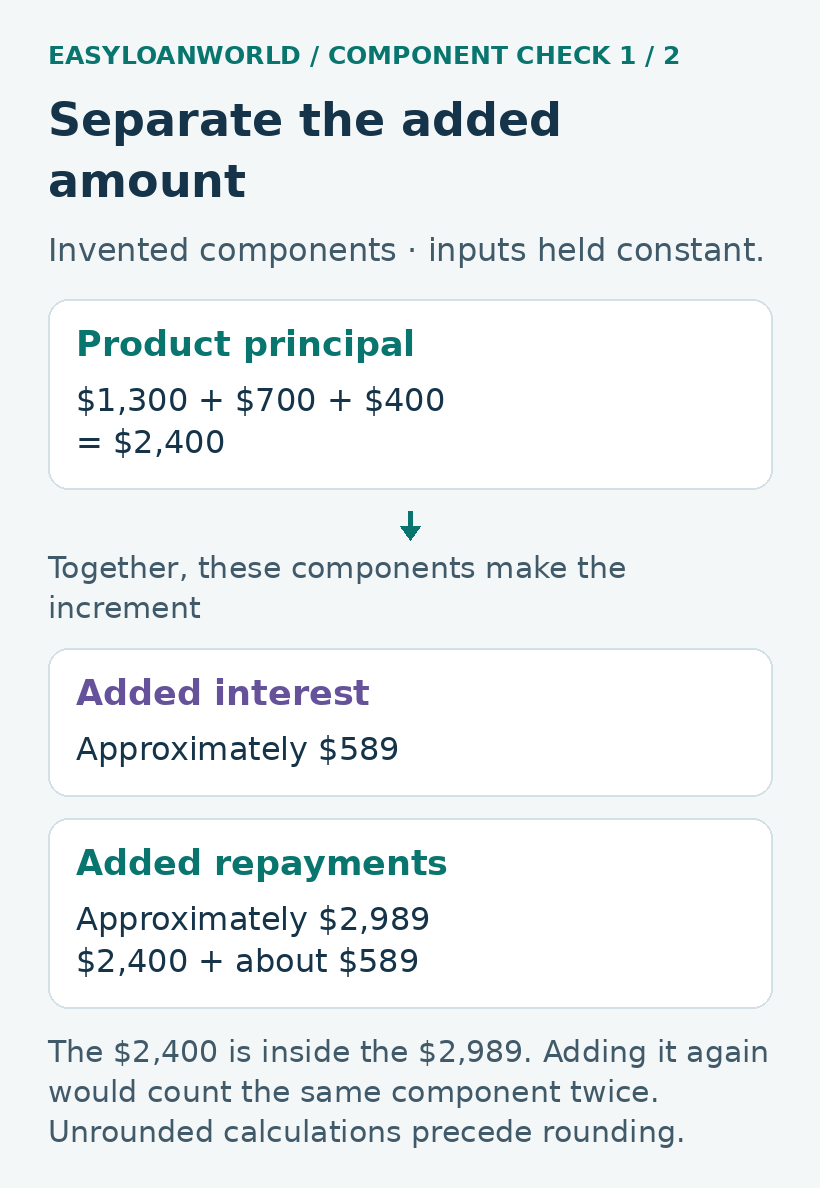
For this invented example, a service contract costs $1,300, a GAP product costs $700 and credit insurance costs $400. Together they cost $2,400. These are fictional prices and availability, with no assumed coverage or benefits.
The CFPB’s credit-insurance guidance explains that financing its cost adds interest and that eligibility restrictions matter. Review the actual policy before deciding.
Hold the other inputs still
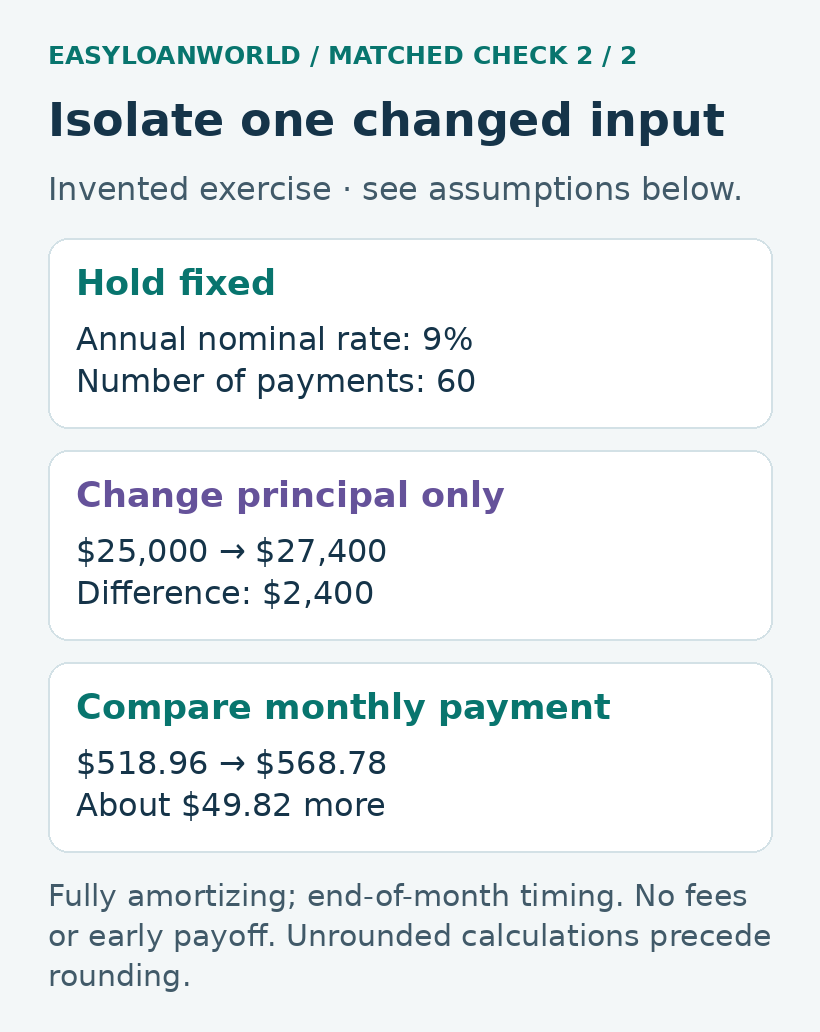
Start with $25,000 borrowed before products, a 9% annual nominal rate and 60 end-of-month payments. Adding the entire package raises principal to $27,400. Both fictional loans fully amortize, with no other fees, irregular first period or early payoff. In this fee-free model, the annual rate equals APR. The rate is an invented input, not a current offer.
| Measure | Without package | With package |
|---|---|---|
| Principal | $25,000 | $27,400 |
| Monthly payment | $518.96 | $568.78 |
| Scheduled repayments | $31,137.53 | $34,126.74 |
| Interest within repayments | $6,137.53 | $6,726.74 |
The package adds about $49.82 per month. Across the full modeled schedule, it adds approximately $2,989 in repayments: $2,400 of product principal plus approximately $589 of interest. Do not add the $2,400 again to the $2,989; the principal is already included.
Calculation method: monthly payment equals principal × monthly rate ÷ [1 − (1 + monthly rate) raised to the negative number of payments]. Here the monthly rate is 0.09 ÷ 12. Totals use unrounded payments before rounding to cents, so multiplying a displayed payment by 60 or subtracting rounded totals can differ slightly. Actual payment dates, daily-interest methods, fees, rounding and early payoff can change results.
If a second quote also changes the rate or term, its payment difference no longer isolates the package. Request a version with matching financing inputs, or label the comparison “multiple changes” rather than attributing the whole difference to products.
Make one private decision card per product
Use these questions to organize what you still need to learn. Do not fill gaps with assumptions about standard coverage.
- Product name, separate price and provider?
- Where are duration, eligibility and exclusions documented?
- Where is the claim procedure?
- Cancellation/refund contact and written response?
- My decision: keep, decline or unresolved. What missing answer would change it?
The card is for your own files. It does not require publishing medical, employment or other private information. A cheaper loan calculation alone cannot answer whether you want a particular product.
Keep three after-purchase records separate
Ask about cancellation; credit-insurance refunds after sale, refinance or prepayment are not guaranteed.
Record the cancellation request, any quoted refund and any credit actually posted as three distinct events. Ask the provider and lender about the amount, destination and effect on the payment schedule. Do not build a new budget on an assumed cash refund, lower payment or reversal of past interest. Keep written responses with the original contract.
Educational comparison only. The fictional products are not recommendations, and the illustration makes no claim about coverage adequacy, approval or future savings.
Featured photo: A car interior, shown for illustration. Photo: NAM CZ / Unsplash. Used under the Unsplash license.

College Withdrawal Bill: Reconcile the School Account
Use three school records and a fictional $1,340 example to trace each adjustment, check a changed balance and organize questions for the right office.

Student Aid Credit Balance: Separate the School Ledger From Spendable Cash
Use two fictional aid snapshots and a private payment record to organize the amounts, permissions and dates behind a college-account credit.

Solar Loan Quotes: Compare the Cash Price Before the Low Rate
Match the installation scope, reconcile a fictional $6,000 financed-price uplift, and test the later payment if a planned savings payment never arrives.