Dealer Financing Changed? Compare Both Versions
Track a fictional callback with a version-by-version comparison worksheet.

Estimated reading time: 8 minutes
When dealer financing changes, compare the complete transaction before judging the new monthly payment. Separate cash already paid from newly requested cash, and keep the financing status in writing.
Use two questions to organize a financing callback: what changed, and what remains unresolved? A new payment amount alone can’t explain a changed transaction or determine your legal position.
Check whether financing is final before leaving. Review proposed changes before deciding. See car-financing guidance.
Dealer financing: keep a register of both versions
Date and label complete existing documents “A” and revised documents “B.” Keep attachments with their own version. Avoid combining a price page from A with a payment page from B, even if the vehicle identification is unchanged.
On a separate call log, record the caller, date, explanation and requested next step in neutral language. “Dealer says approval was not completed” records what you were told. It doesn’t establish that a contract was invalid or that anyone broke the law.
Dealer financing: read the change across all columns
This original exercise compares two proposals before repayment begins. It isn’t an actual rescission case. The fully itemized vehicle transaction is $26,000 in both versions, with no trade-in, add-ons, rebate, separate finance charge or fees beyond that total. There are no prior repayments or other debts.
| Input or result | A: first proposal | B: changed proposal |
|---|---|---|
| Total cash contribution | $2,000 | $3,000 |
| Principal | $24,000 | $23,000 |
| Annual nominal rate | 7% | 10% |
| Monthly payments | 60 | 72 |
| Payment amount | $475.23 | $426.09 |
| Scheduled repayments | $28,513.73 | $30,678.79 |
| Cash plus repayments | $30,513.73 | $33,678.79 |
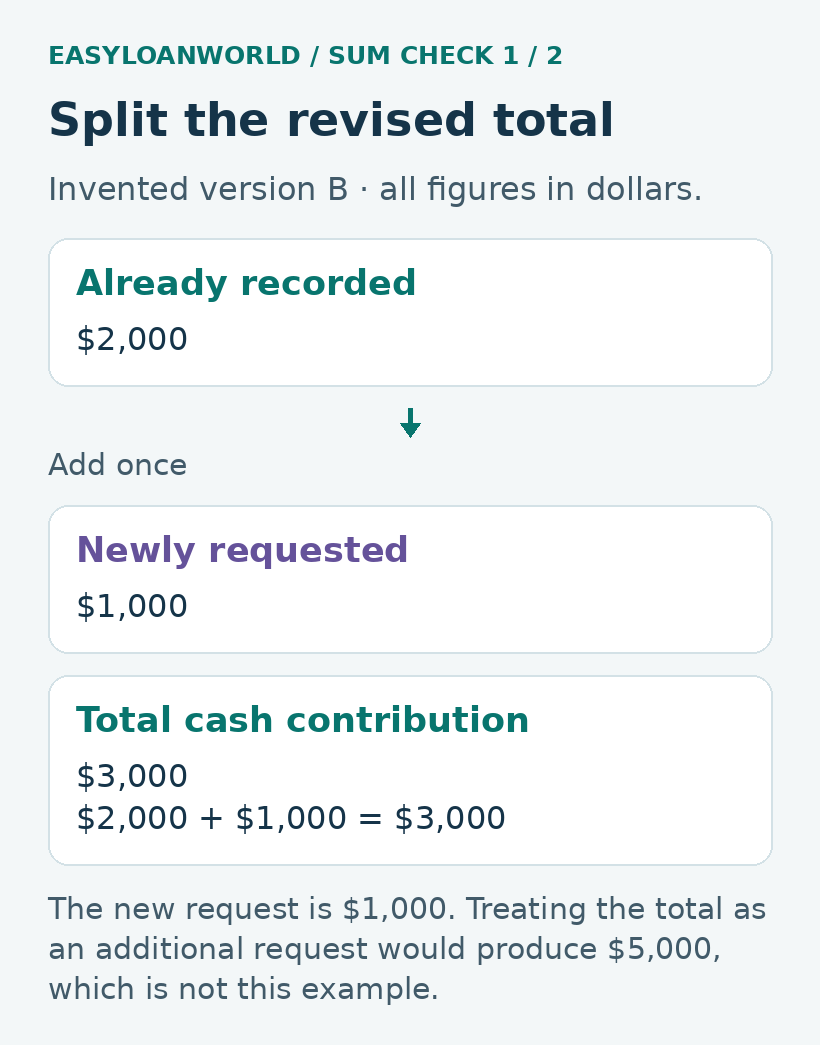
For B, the $3,000 cash total consists of $2,000 already on record plus $1,000 newly requested. Count the existing contribution once. The new request is $1,000, not another $3,000.
B lowers the monthly payment by about $49, but requires that extra $1,000 now and 12 additional monthly payments. Its modeled cash-plus-repayments total is $3,165.06 higher. Don’t add the $26,000 vehicle transaction to either final total: purchase principal is already represented in cash and repayments.
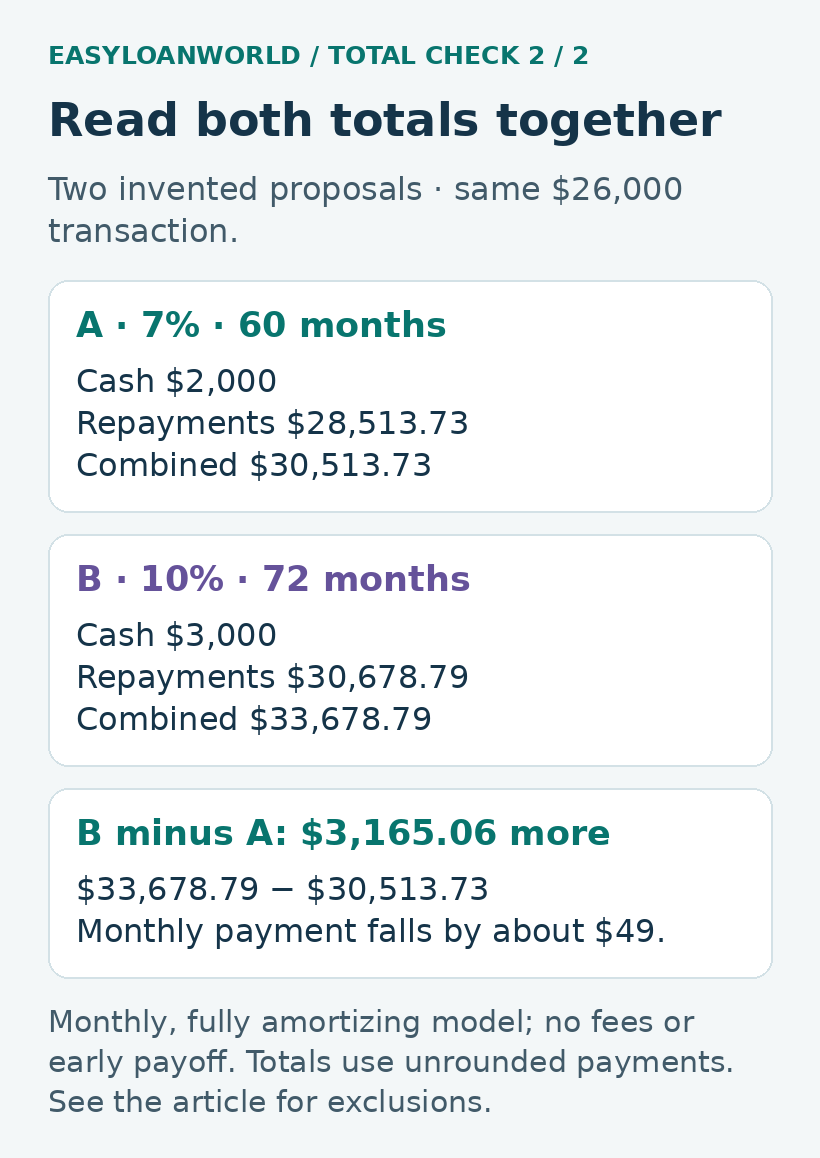
Both schedules assume fully amortizing monthly loans with end-of-month payments, no irregular first period and no early payoff. Rates are invented and equal APR in this fee-free model. The calculation uses monthly rate = annual rate ÷ 12 and payment = principal × monthly rate ÷ [1 − (1 + monthly rate) raised to the negative payment count]. Totals use unrounded payments; displayed cents can create small subtraction differences. Real schedules can differ. This model excludes maintenance, insurance, depreciation and the value of cash used today.
Dealer financing: reproduce both complete repayment schedules
Use the embedded calculator with the fictional contractual interest rates and whole-month terms. Proposal A uses $24,000 principal, 7% annual interest and 60 months. Expected monthly principal and interest is $475.23, total interest $4,513.73 and scheduled repayments $28,513.73.
For proposal B, enter $23,000 principal, 10% and 72 months. Expected payment is $426.09, interest $7,678.79 and scheduled repayments $30,678.79. These runs retain the original fully amortizing, fee-free monthly assumptions.
Keep cash contributions outside the loan calculator. Add A’s $2,000 once to its repayment total, and B’s $3,000 once to its total. That reproduces $30,513.73 and $33,678.79 of modeled cash plus repayments.
Don’t enter the full $26,000 vehicle transaction as loan principal and then add the down payment again. Each proposal funds that price with its stated cash contribution and borrowing. Changing principal would model a different transaction.
Dealer financing: isolate B’s longer term as an independent comparison
For a new teaching variation, keep B’s $23,000 principal, 10% rate and $3,000 total cash contribution, but shorten the term to 60 months. This isn’t a claim that the dealer offers that alternative.
The calculator should show $488.68 monthly principal and interest, $6,320.92 interest and $29,320.92 scheduled repayments. Including the unchanged $3,000 cash contribution gives $32,320.92.
Compared with B’s 72-month schedule, the 60-month variation requires about $62.59 more monthly cash but costs $1,357.87 less scheduled interest. Only the term changed in this comparison, so it isolates that timing trade-off.
By contrast, A versus B changes principal, cash contribution, rate and term together. Their payment difference can’t be attributed solely to a higher rate or a larger down payment. Keep the full original comparison beside the separate term-only sensitivity.
All totals use unrounded calculated payments before display. Multiplying displayed cents by the number of months can create small differences. Actual daily-interest methods, first-payment dates and lender schedules may require a different model.
Dealer financing: test the cash request and installment independently
Suppose a separate fictional household review leaves $450 monthly for this installment after all other planned uses. A’s $475.23 exceeds that amount by $25.23. B’s $426.09 leaves $23.91, while the independent 60-month B variation exceeds it by $38.68.
Those comparisons describe a narrow recurring budget. They don’t include maintenance, insurance or unexpected costs, and the $23.91 remainder isn’t a recommendation or a finding that B is affordable.
The newly requested $1,000 also needs its own source and availability date. A lower installment doesn’t supply that upfront money. If the only available $1,000 is already earmarked for essential bills, record the competing use rather than treating it as free cash.
Keep A’s existing $2,000 receipt connected to B’s $3,000 total. A revised page that fails to acknowledge the earlier cash needs clarification before the worksheet can assume it was credited.
Dealer financing: distinguish a revised proposal from a completed resolution
A new payment schedule is evidence of proposed terms, not proof of acceptance or financing finality. Preserve the complete documents and the actual explanation of what remains unresolved. Don’t fill a missing finality statement with a favorable assumption.
If a response supplies a corrected cash entry, update that entry and check whether principal and repayments still reconcile. If a separate fee appears, the original fee-free model no longer describes the whole transaction and needs a new complete comparison.
A contact log should identify the question asked, answer, date and supporting version. Keep a request about cancellation or return arrangements separate from the payment calculation and obtain appropriate help for disputed obligations.
The useful result is a coherent transaction record and a clear understanding of both upfront and recurring cash. It doesn’t decide enforceability, guarantee that an earlier proposal remains available or authorize ignoring an actual notice.
For an independent upfront-cash check, suppose only $800 is usable after essential commitments when B requests the additional $1,000. The immediate gap is $200, even though B’s monthly installment fits the separate $450 budget. Future monthly headroom can’t be treated as cash already available for that request. Record the proposed source and date for the missing amount rather than adjusting the documented down payment to make the worksheet work.
Make each unresolved change visible
Create a row for price, total cash, cash already received, newly requested cash, principal, rate, term, scheduled repayments and stated financing status. Give every row these five fields:
- Value in A and its document/page.
- Value in B and its document/page.
- Dollar, percentage-point or date difference.
- Your unanswered question.
- The response, date and supporting document.
For the example’s cash row, a useful question is: “Does the revised $3,000 include my recorded $2,000?” For an unchanged price with changed principal, ask which cash or itemization entry explains the difference. Mark a missing page as missing rather than assuming it matches A.
Record the decision and the response
If rejecting the new proposal, ask about cancellation and return of your down payment or trade-in. Ask the dealer and finance company for written confirmation of any agreed cancellation. These requests aren’t a universal right to unwind every contract or a guaranteed return. Take disputed obligations or return arrangements to a state consumer-protection agency or qualified legal adviser.
Use USA.gov’s state consumer-protection office directory to select your state or territory and find its official contact route for a business complaint.
For this callback, ask which office handles dealer-financing complaints and what to do about the specific return demand or payment deadline you received. Have both document versions and the dealer’s request available.
If considering B, resolve its unexplained entries and keep the complete version you actually accept. Don’t assume A remains available or enforceable. Avoid treating silence, vehicle abandonment or stopped payments as a resolution; address obligations and any notice promptly. This worksheet organizes evidence and questions, not legal advice or a finding of wrongdoing.
If the revised quote includes products, check the financed cost of auto-loan add-ons separately from changes in the loan rate or term.
Featured photo: A showroom scene, shown for illustration. Photo: Patrick Langwallner / Unsplash. Used under the Unsplash license.

Parent Pays Student Loan Interest: Who Deducts?
Separate payment and obligation.

Returned Loan Debit: Two Fees?
Trace the payment and fees.

Rehabilitation Payment Too High?
Check an alternative request.