Bankruptcy Records: Discharged, Dismissed or Closed?
Distinguish bankruptcy discharge, dismissal, and case closure by reading the actual orders and docket records, then prepare the specific question your documents leave unresolved.
Estimated reading time: 5 minutes
A bankruptcy folder can contain several official-looking records without one page answering every question. Start by identifying what each document actually calls itself. This U.S. educational guide compares record labels, not filing strategies. It doesn’t recommend paying, withholding payment, reopening a case or taking action against anyone.
Read the discharge order, not a shortcut
A discharge releases personal liability for certain debts and prohibits collection of discharged debts. It isn’t a promise that every obligation disappeared. The U.S. Courts explains that a discharge notice doesn’t specifically identify the debts determined to be nondischargeable. A valid lien that wasn’t avoided can remain enforceable against property.
A creditor list isn’t an itemized discharge determination.
Closed and dismissed answer different questions
The Central District of California bankruptcy court explains that dismissal ordinarily stops the main case and related proceedings without a discharge. Closing means the main case activity and trustee’s duties are complete; closing alone doesn’t establish that a discharge occurred. A case can be closed without one. Closing also doesn’t necessarily end every related adversary proceeding.
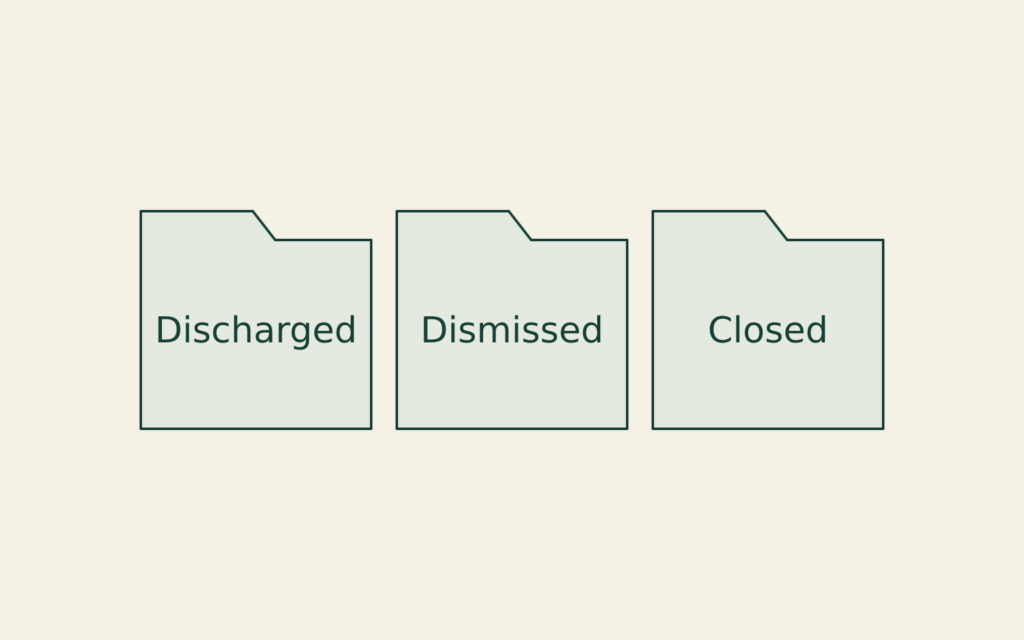
Conversion is another distinct label: it changes the bankruptcy chapter, rather than simply describing a completed case. These terms aren’t interchangeable stages on a progress bar. In a document folder, keep the exact label instead of replacing several different entries with “finished.” The table is a reading prompt, not a determination of anyone’s case status.
| Label | Reading question |
|---|---|
| Discharged | What does the order cover? |
| Dismissed | What does the dismissal order say? |
| Closed | Is there a separate discharge order? |
Separate the debtor-wide issue from one debt
The Oregon bankruptcy court distinguishes denial of a discharge from a determination that a particular debt is nondischargeable. Those headings describe different questions. A document about one obligation shouldn’t silently become a conclusion about every creditor, and a general heading shouldn’t replace the detailed question a separate decision addresses.
The court also explains that discharge isn’t a determination of how much the trustee will pay creditors. Therefore, a distribution record and a personal-liability ruling aren’t substitutes. When a packet contains both, identify the subject of each before comparing amounts or assuming one contradicts the other. Ask for legal interpretation when the relationship between the documents is uncertain; this distinction doesn’t classify any particular debt.
Court records and credit reports are separate evidence
The U.S. Courts says bankruptcy filings are generally public records, with limited exceptions. Bankruptcy courts don’t report or provide information to consumer reporting agencies and aren’t responsible for validating credit-report information. Case records can be viewed through a bankruptcy clerk’s office or through PACER, which requires an account for online searches and viewing.
Accordingly, identify which record you’re questioning. The judiciary directs readers to CFPB and FTC resources for information about disputing credit data. Obtaining a court record isn’t, by itself, a credit-report correction.
Don’t equate a legal event with immediate deletion
The CFPB says bankruptcy information can remain on a credit report for up to ten years, and some situations permit reporting beyond that period. That statement isn’t an individualized removal date, a guarantee about a score or a prediction about a lender’s decision.
A reader checking a report shouldn’t infer that the mere passage of a court milestone requires immediate disappearance of the entry. This article doesn’t calculate a reporting deadline. The practical distinction is between understanding the event described and deciding whether the report accurately reflects it.
Choose help for the question you actually have
The U.S. Courts strongly recommends qualified legal advice because bankruptcy has long-term legal and financial consequences. Court employees and bankruptcy judges can’t provide legal advice. The judiciary identifies interpreting dischargeability, property consequences and whether to continue paying creditors as matters an attorney can address.
A request for a document copy therefore shouldn’t be treated as a request for permission to stop paying or take action against a creditor. Explain the legal uncertainty to a qualified bankruptcy attorney rather than expecting a clerk to resolve it. People unable to afford counsel may qualify for free legal services; the judiciary’s help page links to resources. Eligibility and availability require separate checking.
Keep uncertainty visible
For a private reading exercise, place three blank cards beside the documents: “Exact wording,” “Page reference” and “Question still unanswered.” Copy only the short heading needed to identify the issue, not sensitive account details. Leave the answer blank when the document doesn’t supply it. A question mark is more honest than an invented resolution. If you later receive an explanation, record who supplied it and which page they discussed, without overwriting the original question. For example, “page two, paragraph three” lets a later reviewer locate the passage; “everything settled” replaces evidence with your own conclusion. Keep those two kinds of notes visibly separate.


