Credit Report Errors: Build and Track a Dispute
Build a precise dispute for credit report errors. Keep evidence and recipient receipt dates together, understand investigation periods and verify the actual field after the result.
Estimated reading time: 8 minutes
To dispute credit report errors, identify the specific entry you question and state how your records conflict with it. Send supporting copies through the appropriate dispute channels, then keep the response with a later check of the report. USAGov’s overview identifies both the reporting agency and the information supplier as recipients.
This guide covers U.S. consumer reports. It helps you prepare a precise request and track what actually happens, without assuming that a submitted dispute will produce a deletion or score change. If you still need the underlying file, start with our free credit reports guide.
Identify the field before calling it an error
Start with the bureau and the report copy you’re reading. Find the account or personal-information entry, then write down the particular field that appears inaccurate. A balance, payment-status marker and account-ownership label raise different questions and call for different supporting records.
The CFPB’s common-error checklist includes incorrect identifying information, closed accounts shown as open, inaccurate payment dates and wrong balances. It also flags duplicate debts and cases where an authorized user appears as the account owner.
Compare the entry’s dates with your documents before describing the discrepancy. An older reported balance and a current app balance can describe different moments. Our credit-utilization record check illustrates that distinction for cards.
Also separate inaccurate information from accurate history you would prefer to remove. The FTC distinguishes errors from correct negative information. For credit report errors, specify what is wrong with the entry and which evidence supports a correction.
Build an evidence packet for credit report errors
The CFPB’s dispute instructions describe the information to include and provide sample letters. For a mailed bureau dispute, the essentials include:
- Your contact information and the report confirmation number, if available.
- The disputed account or entry, with a clear explanation of the error.
- The correction or removal you are requesting.
- A marked copy of the relevant report section and copies of supporting documents.
Keep the originals. Give each supporting copy a plain attachment label, then check that every document mentioned in your explanation is actually in the packet. A short evidence list also helps you locate the same record when a company asks a follow-up question.
A payment confirmation may help with a payment-date question; it won’t necessarily resolve whether a different account belongs to you. Choose documents that address the disputed field, and describe how each supports the requested change instead of sending an unrelated stack of financial paperwork.
A hypothetical balance discrepancy
The following records are invented for illustration. They concern the same installment account, and no real borrower or outcome is represented.
| Record | Relevant date | Information shown |
|---|---|---|
| Payment confirmation | September 18 | Final payment recorded for the example account. |
| Lender’s paid-in-full letter | September 20 | A $0 balance effective September 18. |
| Credit-report entry | September 30 account update | A $420 current balance. |
The letter’s effective date comes before the report’s account-update date. That gives the consumer a concrete discrepancy to ask the companies to investigate, after checking that all documents identify the same account.
The requested correction concerns the current balance: investigate the $420 entry against the lender’s written $0 confirmation. It doesn’t require asking to erase the entire account or making an unsupported statement about its payment history. Keep the request tied to the field the documents address.
An explanation for this hypothetical packet could read:
I dispute the $420 current balance for the installment account in this example. The attached letter dated September 20 confirms a $0 balance effective September 18, which predates the September 30 account update shown on the report, and the payment confirmation concerns the same account. Please investigate the discrepancy and correct the current balance if your investigation confirms that record.
This excerpt illustrates the connection between a disputed field and its evidence. For a real submission, include the identifying details required by the recipient and use only facts your own records support.
Keep separate records for each recipient
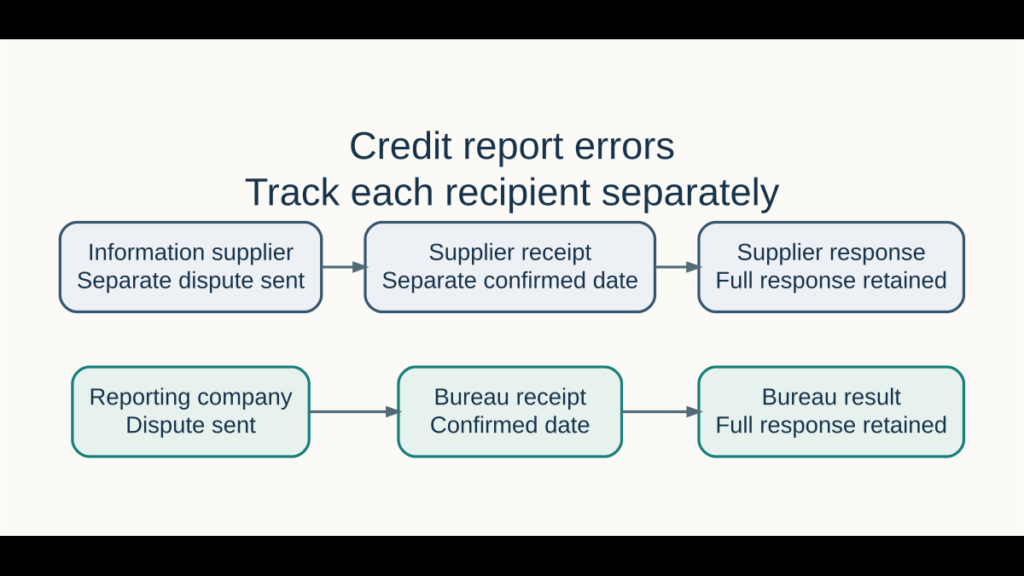
The FTC says to dispute with each bureau that has the mistake and the business that supplied it. This correction process is free. Use the official dispute instructions rather than treating a credit-repair subscription as a required first step.
For current bureau links and mailing guidance, use the CFPB’s dispute page. A business supplying information is often called a furnisher. Follow its designated dispute address or the applicable instructions instead of assuming its ordinary payment address is the right destination.
While investigating credit report errors, save a copy of what you submitted to each recipient. A bureau confirmation and a supplier confirmation are separate pieces of evidence, even when the packets concern the same account. If you use mail, the CFPB explains that certified mail with a return receipt can provide a record of receipt.
- Sent
- Save the exact packet, recipient and submission date.
- Receipt confirmed
- Keep the confirmation and the recipient’s actual receipt date.
- Result received
- Retain the complete response and the date it arrived.
- Field verified
- Record the report checked and what the disputed entry now shows.
Use this log privately. It has no upload fields, and you don’t need to send a report or identity documents to EasyLoanWorld. Keep an unknown receipt date marked unknown until you have evidence for it.
Use the right starting point for the investigation period
The CFPB’s timing guidance says a reporting company generally must investigate within 30 days of receiving a dispute. The starting event is receipt, rather than the day you prepared the letter or put it in the mail.
The same guidance describes situations where an investigation can take up to 45 days. These include a dispute after receiving a free annual report, or relevant additional information submitted during the initial 30-day period, which can extend that period by 15 days.
After completing the investigation, the reporting company has five business days to notify you of the results. Keep the investigation period separate from that results-notice period. Neither one establishes that the disputed field will change in your favor.
For a direct dispute with the information supplier, CFPB guidance also describes a general 30-day period from receipt for investigation and response. Save that recipient’s receipt date even if the bureau received its own packet earlier.
If you add documents, record what you sent and when. Save any acknowledgement beside the original packet so a later question about timing can be checked against the actual correspondence, rather than a date reconstructed from memory.
Read the result and check the actual entry
A case marked closed doesn’t tell you which field changed. Read the full response and compare it with the correction you requested. The FTC explains that a change resulting from a dispute brings a free copy of the report, and recommends checking that the inaccurate information was removed.
For the hypothetical account above, a useful verification note would record the displayed current balance and account-update date on the report checked after the result. If it still shows $420, identify what the response says about that balance before describing the case as corrected.
One recipient’s reply doesn’t establish that another recipient has responded or that every bureau’s entry matches. Record which report you inspected and the field you verified, with a link to the relevant response in your own records.
When the response leaves credit report errors unresolved
Compare the answer with the evidence you supplied. Check for an account mismatch, an attachment the company says it didn’t receive or a response addressing a different field. A useful follow-up explains the unresolved point and identifies the supporting document.
The CFPB describes disputes considered frivolous or irrelevant, including those without enough information to investigate. Read the stated reason and address the actual gap. If a furnisher maintains that its information is accurate, the CFPB also explains how to ask for a statement of the dispute in your credit file.
For a complaint against a reporting agency about inaccurate or incomplete information, read the CFPB’s current complaint notice first. It requires a prior direct dispute with the agency and an attestation concerning a dispute submitted more than 45 days ago or one that is no longer pending. The notice also warns against submitting while a dispute remains active.
Check the current instructions and your actual case status before making that attestation. A reminder on a calendar is insufficient to establish that every condition in the complaint process is met.
If you suspect identity misuse, the CFPB’s dispute guidance directs you to IdentityTheft.gov for reporting and recovery. Preserve the relevant records rather than treating an unfamiliar account as only a balance correction.
When a response arrives, put it beside the original request and open the relevant report. Record the actual value in the disputed field before changing your own tracker from unresolved to verified.
Sources
Sources checked November 3, 2026. The balance-record example and record-keeping visuals are original hypothetical editorial aids.