Business Borrowing Base: When an Unused Limit Is Unavailable
Follow a fictional $15,000 borrowing-base contraction with unchanged debt.

A fictional wholesaler has a $100,000 revolving commitment and owes $65,000. Subtracting the debt from the commitment gives $35,000. Yet its worked formula initially leaves only $7,000. At the next snapshot, the same debt exceeds the calculated ceiling by $8,000.
This is an invented U.S. teaching case for a collateral-supported facility. Every dollar amount and percentage below is stipulated for the exercise. The percentages are not market benchmarks, recommended terms or a lender offer.
The two snapshots start with one rule
For this exercise, the ceiling is the smaller of commitment or borrowing base; signed headroom equals that ceiling minus utilization.
The invented agreement assigns a 75% advance rate to eligible accounts receivable and a 40% rate to eligible inventory. Its inventory valuation input is $30,000 on the assumed contractual valuation basis; no retail-value or liquidation-value conversion is being made. Initial eligible receivables are $80,000. Outstanding principal is $65,000 and is the only utilization.
Assume no reserves, blocks, inventory sublimits, letters of credit, other utilization, capitalized charges, holds or additional restrictions. Rates stay unchanged. These are simplifying exclusions, not typical terms.
Snapshot one: $72,000 supports $65,000
- Receivables contribution: $80,000 × 75% = $60,000.
- Inventory contribution: $30,000 × 40% = $12,000.
- Borrowing base: $60,000 + $12,000 = $72,000.
- Formula ceiling: smaller of $100,000 and $72,000 = $72,000.
- Signed formula headroom: $72,000 − $65,000 = $7,000.
Lender-confirmed draw availability is a separate question.
The $35,000 commitment-only subtraction overstates this exercise’s positive headroom by $28,000: $35,000 − $7,000 = $28,000. Writing both subtraction results next to their labels makes the mismatch visible.
Snapshot two: one $20,000 input changes
Nothing is borrowed, collected or repaid between these snapshots. Inventory does not change. A stipulated eligibility rule now excludes $20,000 of the receivables, leaving $60,000 eligible. No particular aging cutoff is assumed. The invoices have not been declared worthless, and no accounting write-off is assumed.
- Receivables contribution: $60,000 × 75% = $45,000.
- Inventory contribution: $30,000 × 40% = $12,000.
- Borrowing base: $45,000 + $12,000 = $57,000.
- Formula ceiling: smaller of $100,000 and $57,000 = $57,000.
- Signed formula headroom: $57,000 − $65,000 = −$8,000.
Additional formula capacity: $0. Separately, the $8,000 overadvance is $65,000 used − $57,000 supported. Both numbers matter.
Why the change is $15,000, not $20,000
Before checking the answer, predict the loss of support. Does excluding $20,000 reduce headroom by the full $20,000, or by $15,000?
In this case, each eligible dollar contributed 75 cents. The removed $20,000 therefore contributed $20,000 × 75% = $15,000. Starting with $7,000 and subtracting $15,000 produces −$8,000. This bridge reconciles the two snapshots without inventing a new draw or changing the commitment.
A second check works backward: $72,000 − $15,000 = $57,000. Both paths reach the same later base. If they did not, at least one input or arithmetic step would need correction.
Applying the lesson carefully
Consequences depend on the agreement; some overadvances are permitted. Resolve uncertain draw figures with the lender and a qualified adviser. See the OCC’s Asset-Based Lending handbook.
Ask: “Which documented changes explain the $15,000 difference?” This exercise is not a borrowing-base certificate.
If the disputed input is the amount already used, the separate business credit-line draw, interest and fee ledger exercise addresses that different reconciliation.
Source dates and page references
Asset-Based Lending is version 1.1, January 27, 2017. Its March 20, 2025 notice removes reputation-risk references; it is not a new 2025 edition.
Formula reference: printed page 73; zero-based PDF index 74; one-based viewer page 75.
Accounts Receivable and Inventory Financing (March 2000): printed pages 22–23; zero-based PDF indexes 24–25; one-based viewer pages 25–26.

Export Payment Documents: A Two-Packet Review
A worked export-packet review follows an unresolved instruction proposal, an incomplete selected inventory and an unknown carrier arrangement, without inventing the missing evidence.
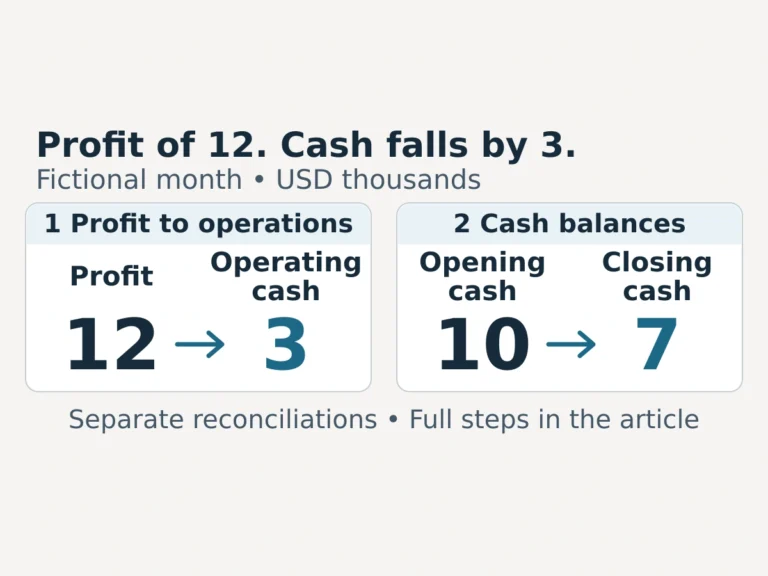
Profitable Business, Falling Cash: Reconcile the Difference
An invented one-month example reconciles net income, customer receipts, supplier payments, equipment, debt and an owner distribution to the closing cash balance.
One Customer Pays Late: Stress-Test Cash and Credit Availability Together
A fictional 13-week test shows how one late customer payment can reduce cash and credit capacity together, leaving a $6,000 gap before added financing…