SBA Disaster Loans: Evidence Brief
Build a focused SBA disaster-loan evidence file: match the declaration, damage records, business cash needs, and other recoveries without counting a loss twice.
Estimated reading time: 8 minutes
Questions about SBA disaster loans start with the applicable declaration and the evidence of loss. Use the repair-shop example to organize dates, physical damage and business impacts before discussing an amount or program route.
After a disaster, a repair-shop owner may have a damaged machine, a rent bill and a quieter appointment book. Put the event and the evidence on one page before trying to choose a borrowing amount.
SBA disaster loans: start with the declaration
Check the exact location’s program designation and amendments; proximity isn’t confirmation. Record incident dates, declaration date and each filing deadline separately.
Use this blank cover sheet alongside the relevant official notice. A Federal Register declaration example illustrates the distinctions; its dates and locations aren’t instructions for your business.
- Incident name/identifier: ____
- Business location: ____
- Incident period: ____
- Declaration date: ____
- Source and checked date: ____
- Exact program designation at this location: ____
- Physical filing deadline: ____
- EIDL filing deadline: ____
- Amendments checked: ____
- Unresolved question: ____
Separate the two questions
Physical disaster loans cover property damage; businesses of any size and most private nonprofits may apply. Economic Injury Disaster Loans (EIDL) address disaster-caused inability to pay necessary operating obligations; property damage is unnecessary. Applicants: small businesses, small agricultural cooperatives, small aquaculture businesses and most private nonprofits. SBA must find credit unavailable elsewhere. EIDL excludes physical repairs, expansion and fixed-asset purchases. SBA guidance.
SBA disaster loans: build four evidence cards
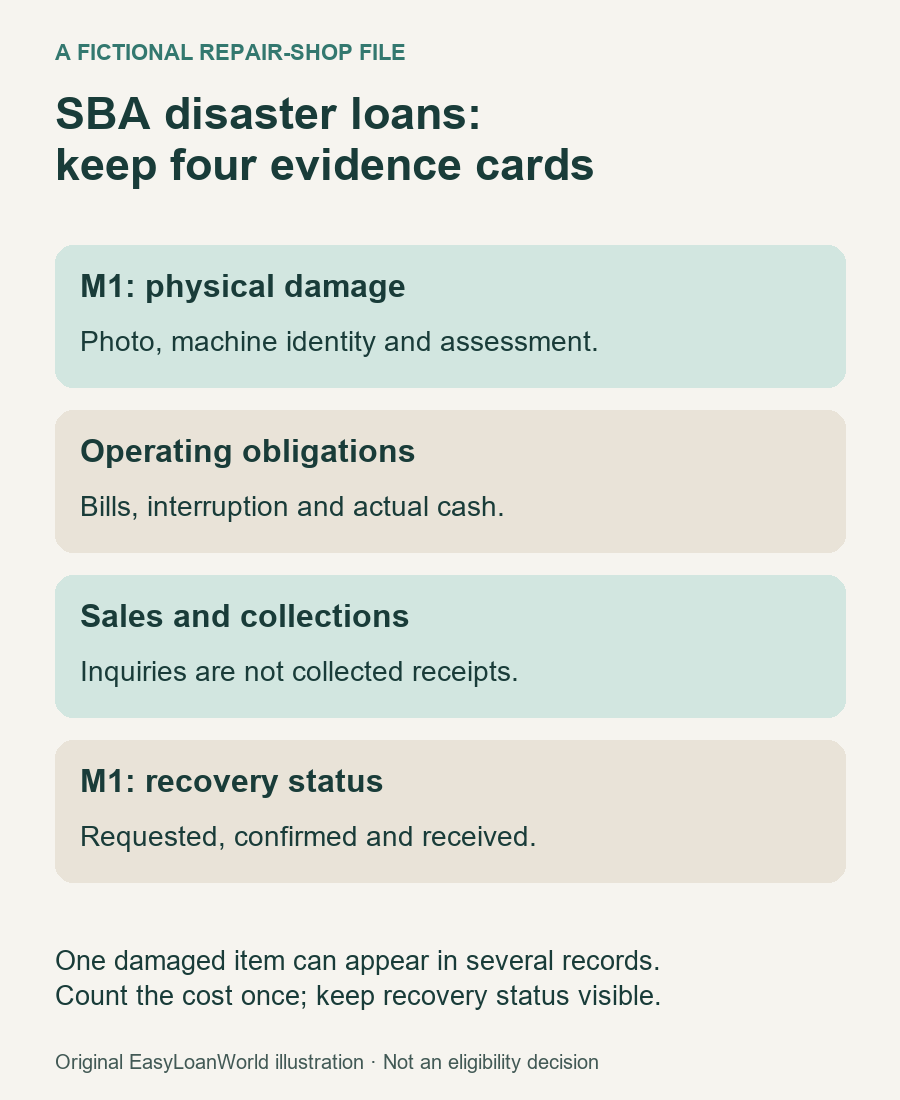
This fictional repair shop is an organizing exercise, not an eligibility finding. These suggested records are neither an official checklist nor proof that SBA will accept a claim.
1. The water-damaged machine
Label this a physical-damage question.
Give the machine a reference such as M1. Attach a dated photo, its identifier and a repair assessment. Write down what the assessment actually establishes, and flag anything still uncertain.
2. Rent during disrupted operations
Annotate the bill with the disaster interruption and supporting records, such as cancellations and receipts. Explain the resulting payment difficulty.
3. Fewer inquiries, with existing bills paid
Sales decline alone doesn’t establish economic injury. Keep eligibility unresolved.
Keep inquiries separate from booked work and completed jobs. Note which dates the records cover, and label any gaps.
4. The machine’s insurance claim
Insurance and other recovery affect uncovered losses. Link M1; distinguish requested, estimated and received recovery. Count each repair once.
Record the claim identifier, status and date of the latest update. If two records disagree, preserve both and write the question that needs resolving.
SBA disaster loans: keep the declaration dates distinct
The incident period describes when the event occurred. The declaration date records a separate official action. Filing deadlines are further dates, potentially different for physical damage and economic injury. Copy each from the applicable notice and amendments.
A nearby business’s notice may not establish the designation for your exact location. Keep the business address and program designation connected to the source you checked. Don’t use a familiar disaster name as a substitute for that verification.
If an amendment changes a deadline or covered location, retain the earlier notice and the amendment with their dates. Update the cover sheet while preserving why it changed. A screenshot without its source and checked date may become difficult to interpret later.
The Federal Register link above illustrates notice structure. Its dates aren’t a calendar for the fictional repair shop or an instruction about an actual applicant’s deadline.
Use the machine reference across related records
The M1 identifier connects the damaged machine’s photograph, assessment, invoice and insurance claim. It doesn’t merge those records into one conclusion. A photograph shows visible conditions; a repair assessment describes its own findings and limitations.
For a separate fictional cost exercise, assume a qualified assessment and quote identify $12,000 of proposed machine repairs. The shop has requested $7,000 from insurance, but the insurer hasn’t confirmed that amount or paid it.
The $7,000 requested recovery is not received cash. Entering $12,000 − $7,000 = $5,000 as a confirmed uncovered amount would assume the request’s outcome. Keep the quote, requested recovery and current status separate.
If a later confirmed $3,000 insurance payment applies to those same modeled repairs, the cost less that receipt is $9,000. That arithmetic isn’t an SBA-approved loss, eligible loan amount or determination of insurance benefits.
If total confirmed recovery later reaches $7,000, the remaining cost difference becomes $5,000. Don’t add a $7,000 total recovery to the earlier $3,000 receipt as though the total were an additional payment.
SBA disaster loans: separate an operating-cash example
Use an independent simplified snapshot for operating obligations. Assume $3,000 rent, $4,000 payroll and $500 utilities are due before the next confirmed receipts. The listed obligations total $7,500.
Assume $5,000 of actual available cash is dedicated to those obligations, with no other inflows or outflows in this isolated example. The immediate gap is $2,500.
This doesn’t establish economic-injury eligibility or an EIDL amount. It organizes the specific obligations, timing and cash facts for the disaster-related explanation. SBA’s review requires the applicable program criteria and actual financial circumstances.
Don’t add the machine’s repair quote to this operating-cash example and label the combined figure EIDL borrowing. Physical repairs and operating obligations are different program questions, as the guidance above explains.
Also distinguish an ordinary cash shortage from a supported account of disaster-caused inability to meet obligations. The explanation needs the actual disruption and records, not merely a negative result from a worksheet.
Don’t substitute sales decline for payment evidence
Fewer inquiries can be an early business concern, but inquiries, bookings, completed work, invoices and collected cash are different stages. Keep each series labeled rather than describing them all as sales received.
For a fictional example, suppose $15,000 has been invoiced and only $8,000 collected at the checkpoint. The $7,000 difference is an unpaid receivable in the example, not another $7,000 already available in the bank.
If a customer is expected to pay after the rent date, that expectation doesn’t fund rent before it arrives. Keep promised and confirmed receipt dates separate, and preserve any uncertainty in the forecast.
Likewise, a fall in revenue doesn’t on its own calculate the operating gap. Costs, actual available funds and payment timing matter. The original guide keeps SBA’s economic-injury conclusion unresolved until the relevant facts are assessed.
Keep each cost and recovery counted once
A damaged machine can appear on a repair quote, an insurance claim and an assistance discussion. Use the same M1 reference so reviewers can see that these records concern one underlying item.
Don’t add three copies of the repair amount to the loss list. The documents describe the cost and possible ways to address it; they don’t create three damaged machines.
The same principle applies to a total insurance award described in several updates. Distinguish the total confirmed amount from individual payments already included in it. Reconcile amounts before using them as additional funding.
Keep any other assistance or recovery visible with its purpose, amount and status. This worksheet doesn’t decide how a particular source affects eligibility or assistance; it makes the overlap available for SBA to review.
Turn a missing record into a precise request
If the machine assessment is incomplete, identify the unanswered condition or scope question. If a rent bill’s connection to the interruption is unclear, retain the bill and the records explaining the affected period.
If insurance remains pending, ask for its current status and preserve the response. Don’t create a final recovery amount merely to make the evidence cards look finished.
Use a simple index linking each question to the relevant card and source. A reviewer should be able to distinguish a supported event, an estimate, a requested payment and money actually received without guessing.
A missing document isn’t automatically proof of ineligibility. It’s an identified gap to discuss through the appropriate official process. Keep its status honest rather than marking it accepted or rejected without an answer.
Prepare the brief for an official discussion
The completed SBA disaster loans brief should identify the declaration, location, dates, damage items, business interruption, obligations and recovery status. It should also identify which amounts are examples and which come from actual records.
Keep private business, customer and account information within the genuine application or assistance channels. No sensitive records need to be posted in a public comment to use the organizing method.
Ask SBA which program route and supporting information apply to the actual circumstances. The brief improves the question; it doesn’t establish an approval, replace the official application or determine an appropriate borrowing decision.
Before discussing a figure, identify whether it’s a quoted repair cost, a due operating bill, a requested recovery or received cash. Those labels determine what the number can support; combining unlike fields can conceal both an eligibility question and an immediate cash shortage.
Take unresolved questions about SBA disaster loans to SBA
Both loans may apply; approval isn’t automatic. Their combined limit is shared. Ask SBA about related assistance or apply through its Loan Portal.
Bring the cover sheet and linked cards. Your useful next step is a precise question: “What is missing from this account of the incident?” Keep unanswered questions visible instead of filling them with assumptions.
Keep disaster-specific evidence separate from the ordinary borrowing comparisons in SBA loan program uses and business credit-line draws and fees.