Compare annual income available for debt service with required debt payments and a target ratio.
The interactive form requires JavaScript. The worked example, formulas and source links below remain available.
Read the DSCR calculator result
A debt service coverage ratio, or DSCR, compares a defined income measure with debt payments for the same period. This calculator shows the ratio for existing annual debt service and for a scenario with additional annual debt service. It also translates a target ratio you choose into a conditional annual payment capacity.
The most important input is often the definition of income, not the division itself. The DSCR calculator doesn’t audit net operating income, identify permitted adjustments, or apply a lender’s underwriting policy. Use it to organize a business or property-financing discussion with consistent figures. A favorable ratio isn’t an approval, and a chosen target isn’t a universal lending threshold.
DSCR: define the numerator before entering the amount
The annual income input is the numerator appropriate to the analysis. For an income-producing property, a common measure is net operating income under the relevant definition. Business lending can use a specified cash-flow measure or adjusted earnings definition. Gross sales or gross rent aren’t automatically interchangeable with the income available for debt service.
The OCC’s Commercial Real Estate Lending handbook describes DSCR using net operating income and annual debt service, and explains that underwriting and covenant definitions can differ. Obtain the actual definition when reviewing an application or a loan covenant rather than assuming the same adjustments apply everywhere.
Keep the supporting calculation with the input. Identify revenue, operating costs, vacancy assumptions, reserves, and any adjustments relevant to the chosen measure. An unsupported add-back can improve the ratio on paper without creating cash to make payments. The DSCR calculator can’t determine whether a proposed adjustment is justified.
How the DSCR calculator works
Annual debt service is the payment obligation included in the analysis over a year. It isn’t the principal balance still owed. Use the principal-and-interest payments and other obligations required by the actual definition. Entering only interest can understate the denominator when principal repayment is also required.
Match the period on both sides. Dividing annual income by one month’s payment would overstate coverage by a factor of 12 for a level monthly schedule. Convert the relevant payments to the same annual period, and account for irregular or changing payments when they matter.
The additional-debt-service input represents a proposed addition to the annual obligation. For replacement financing, don’t leave the old payment fully included and then add the entire replacement payment as though both debts continue. Prepare a complete before-and-after schedule or enter a supported net increase when that accurately represents the transaction.
DSCR: read the ratio as a multiple
Current DSCR equals annual income divided by existing annual debt service. Proposed DSCR equals the same income divided by existing plus additional annual debt service. A ratio of 1.50 means the entered income is 1.5 times the entered debt-service amount. It doesn’t mean the business earns a 50% profit margin.
A ratio of 1.00 means the numerator equals the denominator. Below 1.00, the entered income is less than the entered debt service. Those are arithmetic descriptions, not complete judgments about a borrower. Cash reserves, timing, other obligations, and the quality of the income measure still matter.
The target input is a ratio, such as 1.25, rather than a percentage such as 125. Choose a value appropriate to the scenario you want to test and clearly label its source. The DSCR calculator doesn’t decide that a lender, investor, or loan agreement requires that target.
Translate a chosen target into annual payment room
Debt service supported at the target equals annual income divided by the target ratio, with a floor of zero for this capacity measure. Additional annual room equals that supported amount minus existing annual debt service, also floored at zero. This room is measured before subtracting the additional payment you’re testing.
Remaining room after the proposal subtracts both existing and proposed annual service from the supported amount, with a floor of zero. Income needed at the target equals total proposed annual debt service multiplied by the target. The income gap is any positive difference between that requirement and the entered income.
These capacity figures are annual payment dollars. They aren’t a loan principal amount. Converting payment capacity to a possible principal requires a rate, amortization term, fees, and other terms, along with actual underwriting. The loan payment calculator can illustrate a specified loan structure, but it doesn’t turn this ratio into an approval.
DSCR calculator example: $120,000 of income and $80,000 of existing debt service
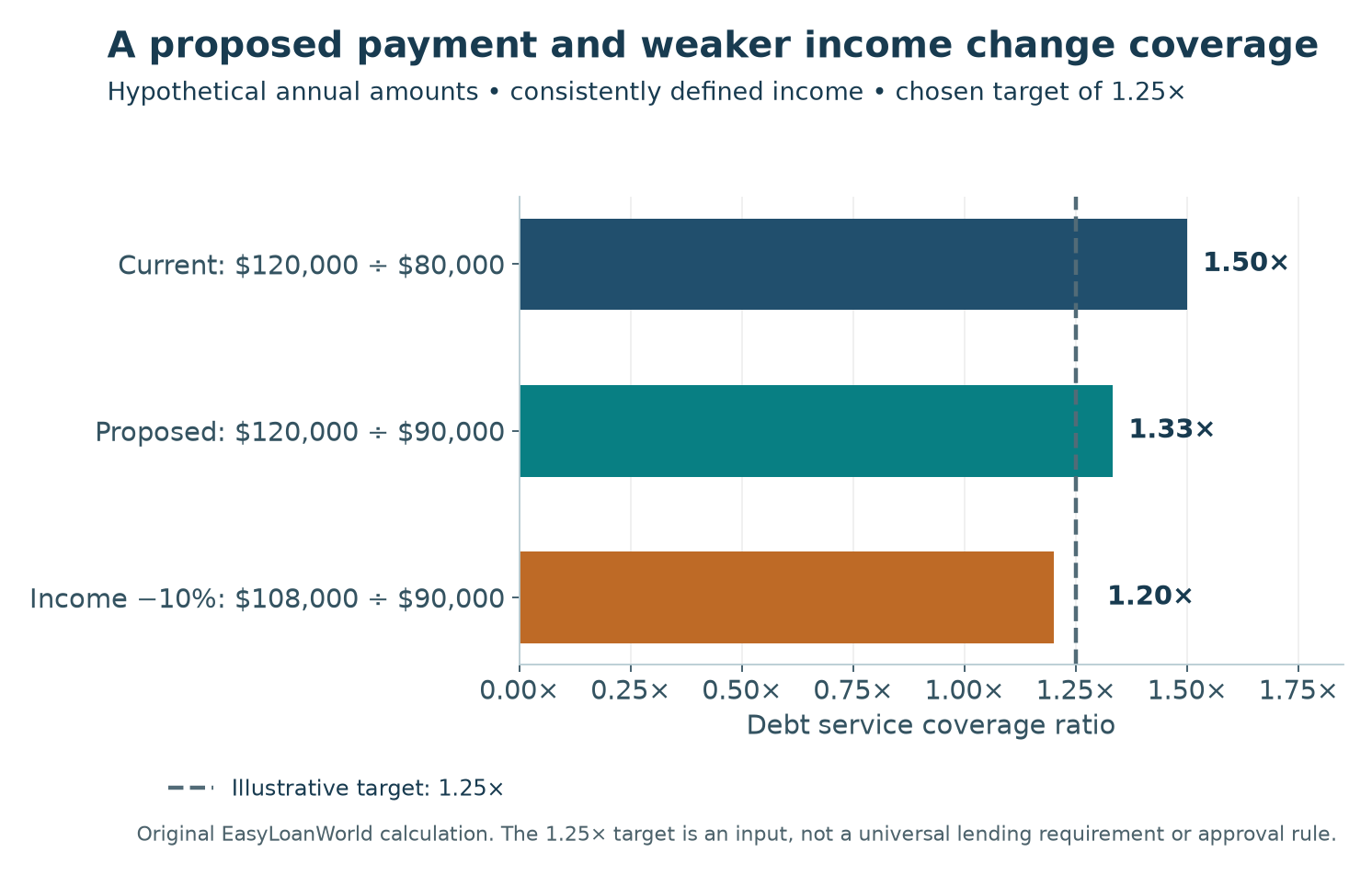
Assume a consistently defined annual income numerator of $120,000, existing annual debt service of $80,000, and an additional $10,000 payment obligation. Choose an illustrative target of 1.25. The example doesn’t establish that this target is appropriate for a particular lender or property.
| Measure | Result |
|---|---|
| Current DSCR: $120,000 ÷ $80,000 | 1.50× |
| Total proposed annual debt service | $90,000.00 |
| Proposed DSCR: $120,000 ÷ $90,000 | 1.33× |
| Annual service supported at 1.25× | $96,000.00 |
| Additional room before the proposed payment | $16,000.00 |
| Room remaining after the $10,000 proposal | $6,000.00 |
| Income needed for proposed service at 1.25× | $112,500.00 |
| Income gap at the selected target | $0.00 |
The $16,000 figure is the difference between $96,000 of supported annual service and $80,000 already committed. The proposed $10,000 uses part of that room, leaving $6,000. Reading the initial room as still available after the proposal would overstate the remaining capacity.
Test income pressure before adding the payment
Reduce the example’s income by 10%, from $120,000 to $108,000, while keeping proposed annual debt service at $90,000. The proposed DSCR falls to 1.20. The income required at the selected 1.25 target remains $112,500, leaving a $4,500 gap.
That scenario doesn’t forecast a decline. It shows how much the decision depends on the income assumption. In the original proposed case, income could fall by only $7,500 before reaching the chosen target, which is 6.25% of the original $120,000. A ratio above the target can therefore still leave limited room for weaker performance.
Test the drivers relevant to the activity: vacancy, lower sales, higher operating costs, delayed collections, or a payment increase after an interest-only period. Keep the changes connected to a realistic operating scenario. A single ratio calculated from an optimistic year is less informative than a comparison that shows where coverage becomes strained.
Annual coverage doesn’t eliminate cash-timing problems
A business can report enough annual income while receiving cash after payments are due. Seasonal sales, slow customer payments, inventory purchases, and large periodic expenses can create a funding gap within the year. The DSCR input aggregates a period and doesn’t produce a monthly cash-flow calendar.
The SEC’s financial-statement guide distinguishes income statements from cash-flow information. Review both when evaluating repayment capacity. The invoice delay cost calculator can illustrate one financing consequence of delayed collection, but it doesn’t replace a complete cash forecast.
Likewise, a positive ratio doesn’t prove that all other needs are funded. Owner distributions, major capital expenditures, taxes, and obligations outside the chosen definition may affect available cash. State the scope of the numerator and denominator so the ratio isn’t asked to answer questions it excludes.
Keep DSCR distinct from margin, DTI, and collateral ratios
Profit margin compares profit with revenue. DSCR compares a defined income measure with debt service. A company can have an attractive margin but too little absolute income to support a large payment. The profit margin calculator addresses pricing and gross-profit questions under its own cost definition.
Debt-to-income ratios used in household borrowing commonly put debt payments in the numerator and income in the denominator. DSCR reverses that relationship and often uses a different income definition. The debt-to-income calculator should therefore not be treated as the same measure with a different name.
A collateral ratio answers another question: how debt relates to asset value. Strong collateral doesn’t automatically create operating cash to make a payment, and strong coverage doesn’t establish a property’s value. A complete lending assessment can consider multiple measures rather than relying on one favorable output.
Interpret zero and negative inputs honestly
If the debt-service denominator is zero, the corresponding ratio is undefined rather than infinite. If proposed debt service becomes positive, that proposed ratio can be calculated even when the current ratio can’t. If income is zero with positive debt service, the ratio is zero.
Negative income produces a negative ratio when debt service is positive. The DSCR calculator preserves that result while flooring modeled supported payment capacity at zero. A zero capacity figure doesn’t erase the operating loss; it simply avoids presenting negative borrowing room as a usable payment amount.
DSCR calculator questions
Is 1.25 the required DSCR for every loan?
No. It’s an illustrative target. Actual requirements and definitions depend on the lender, agreement, product, and analysis.
Can I enter gross revenue as income?
Only if it’s the defined numerator for the specific analysis, which should be verified. Gross revenue isn’t automatically cash available for debt service after operating costs.
Does $16,000 of room mean I can borrow $16,000?
No. It’s additional annual debt-service capacity under the assumptions, not principal. Rate, term, costs, and underwriting are separate considerations.
Why is room shown before and after the proposal?
The proposal consumes part of the initial capacity. Showing both prevents the same payment room from being counted twice.
Questions or corrections?
Send a question or report an issue with a published page.