Changing Scales
A fictional comparison shows how adding an inferior proposal can reverse two unchanged proposals’ scores when the worksheet rescales its inputs.
Estimated reading time: 5 minutes
A fictional comparison shows how adding an inferior proposal can reverse two unchanged proposals’ scores when the worksheet rescales its inputs.
Hold the proposals and weights fixed
Consider invented financing proposals for the same amount. Score only an upfront fee and waiting time; all unscored terms are assumed identical. A charges $100 and supplies funds after ten days. B charges $200 and supplies funds after five. These are stipulated attributes, not actual lender quotes or promises about disbursement.
The worksheet treats a smaller fee and shorter wait as better. For each attribute, calculate:
attribute score = (largest included value − proposal’s value) ÷ (largest included value − smallest included value).
This assigns one to the smallest included value and zero to the largest. All ranges in this exercise are positive. The combined score gives the fee score a weight of 0.60 and the time score a weight of 0.40. A larger combined score ranks higher.
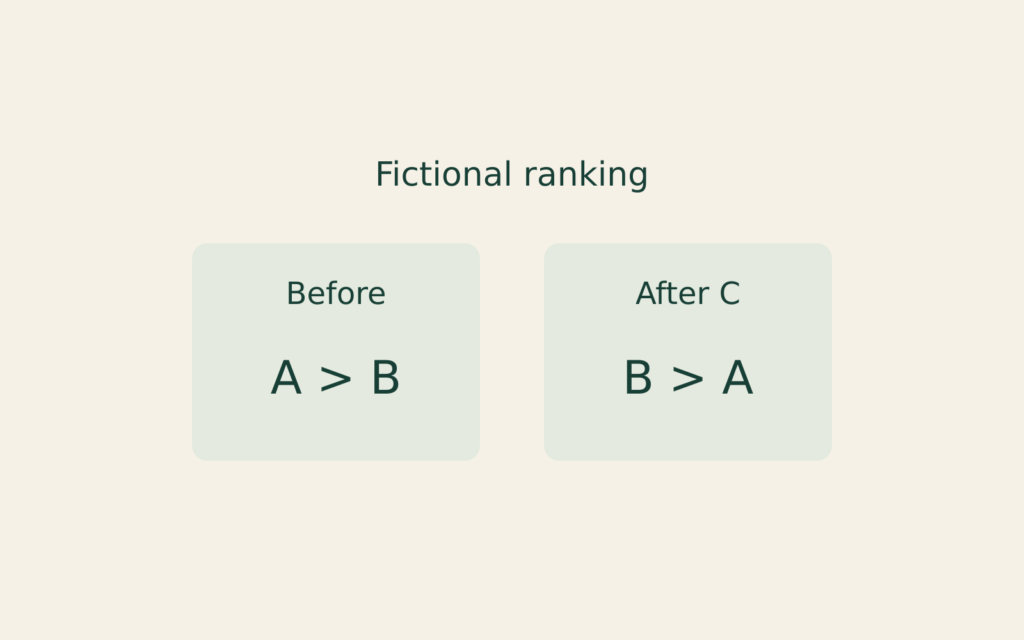
With only A and B included, A has fee score one and time score zero. B has fee score zero and time score one. Their totals are therefore 0.60 and 0.40: A ranks above B.
Add an option that loses on both attributes
Now include C, charging $1,000 with an eleven-day wait. C is worse than both existing proposals on both scored attributes. A and B retain exactly their previous fees and waiting times, and the worksheet still uses the same 0.60/0.40 weights.
But the fee range expands from $100 to $900, while the time range expands from five to six days. A’s fee score remains one; B’s becomes ($1,000 − $200)/$900 = 8/9. A’s time score becomes (11 − 10)/6 = 1/6; B’s remains one. C receives zero on both.
| Proposal | Without C | With C |
|---|---|---|
| A | 0.60 | 2/3 ≈ 0.6667 |
| B | 0.40 | 14/15 ≈ 0.9333 |
| C | Not included | 0 |
A’s new total is 0.60 + 0.40/6 = 2/3. B’s is 0.60 × 8/9 + 0.40 = 14/15. B now ranks above A. C still finishes last; it does not need to become competitive to change the comparison between the other two.
Find what changed beneath the percentages
Writing the combined score in raw units exposes the mechanism: constant − (0.60/fee range) × fee − (0.40/time range) × days. The constant is common to every proposal in that comparison and therefore cancels when subtracting B’s score from A’s.
In the original two-proposal calculation, an additional dollar of fee reduces the score by 0.60/100 = 0.006. An additional waiting day reduces it by 0.40/5 = 0.08. Moving from A to B adds $100 but removes five waiting days, changing the score by −0.60 + 0.40 = −0.20.
After C enters, the corresponding reductions are 0.60/900 = 1/1,500 per dollar and 0.40/6 = 1/15 per day. The identical move from A to B now changes the score by −100/1,500 + 5/15 = 4/15, a positive amount.
The nominal weights did not change; their coefficients on the original dollars and days did. Initially, one day’s score effect equals approximately $13.33 of fee effect: 0.08/0.006. Afterward, it equals $100: (1/15)/(1/1,500). These are implications of the invented formula, not recommended dollar values for anyone’s time.
Prove which weights produce the reversal
Replace 0.60 with a fee weight w and give time weight 1 − w, with w between zero and one. Before C is included, A’s score minus B’s equals w − (1 − w) = 2w − 1. A ranks higher exactly when w > 1/2.
After C enters, A’s fee advantage is 1/9 and its time disadvantage is 5/6. The score difference is:
w/9 − 5(1 − w)/6 = (17w − 15)/18.
A now ranks higher only when w > 15/17, approximately 0.8824. Consequently, every fee weight strictly between 1/2 and 15/17 produces the reversal: A first, then B. At either endpoint one comparison ties, so the strict interval matters. The chosen 0.60 lies inside it.
Keep the original anchors as a control
For a separate calculation, retain fee anchors $100/$200 and time anchors five/ten days after adding C. Do not replace them with the new observed extremes. A and B then keep their original scores, 0.60 and 0.40, because neither their inputs nor their denominators changed.
Under this explicitly unclipped formula, C receives a fee score of −8 and time score of −0.2, giving −4.88 overall. Values below zero are allowed in this control; silently clipping them would define another calculation.
Read a scoring method, not a preference verdict
The European Commission’s normalisation guide discusses rescaling by the observed range and sensitivity to extreme values. Its 2020 weighting guidance describes weights as value judgments and calls for transparent methods. This exercise does not establish a suitable loan-selection rule or describe a real comparison platform. It shows why unchanged displayed weights alone do not guarantee unchanged pairwise rankings.

Deferred Compensation
A deferred-compensation statement and payroll form can describe different rights and events.
Loan Horizons
A smaller cumulative missed-payment count can reflect a shorter observation window. This fictional record exercise compares equal payment ages instead.
Rate Transmission
A rate announcement, a market yield and a contract reset describe different links between monetary policy and borrowing costs.