Business Loan Quotes: Check the Day Count Before Ranking Rates
Work through a fictional loan comparison, calculate an equal-interest rate, and see how an upfront fee changes the result.
Estimated reading time: 8 minutes
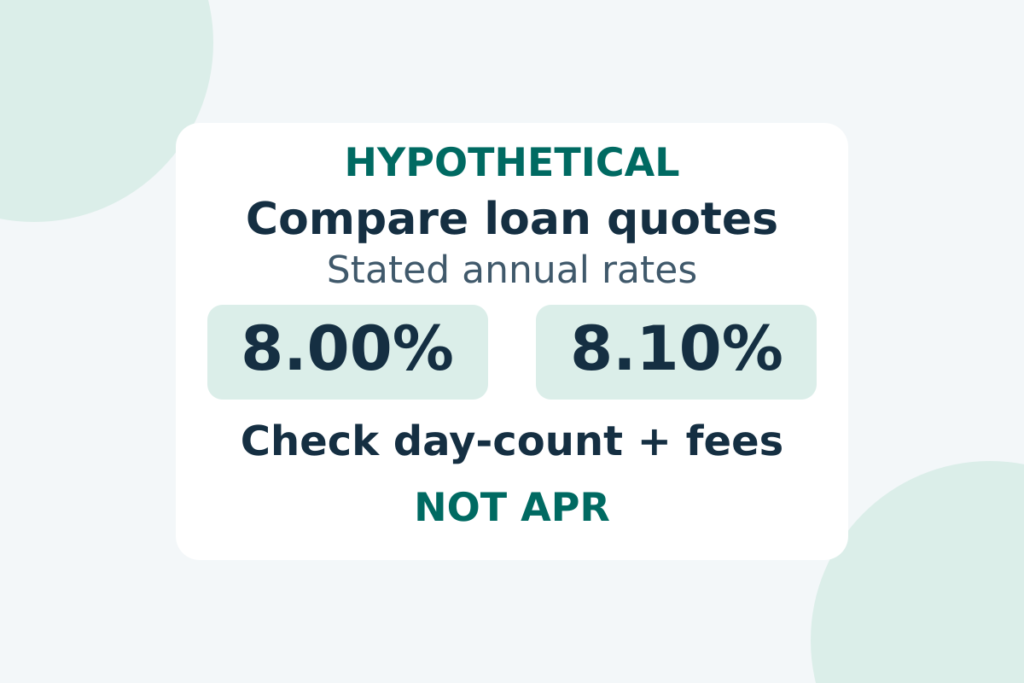
Business loan quotes need a common time basis before their rates can be ranked. Compare interest dollars and fees for the same borrowing period and balance.
Use this fictional business loan worksheet to compare interest dollars, find an equal-interest rate, and test one fee.
The CBRE agreement, Section 5.1(c), illustrates actual elapsed days with 365/366-day years for Base Rate Loans and a 360-day basis for other interest. The linked Gold.com collateral filing concerns collateral terms; check the actual interest clause in the applicable loan agreement when reviewing a quote.
These citations are illustrations only. The invented worksheet below establishes neither available offers nor market prevalence. It provides no borrowing recommendation.
Business loan quotes: the invented offers
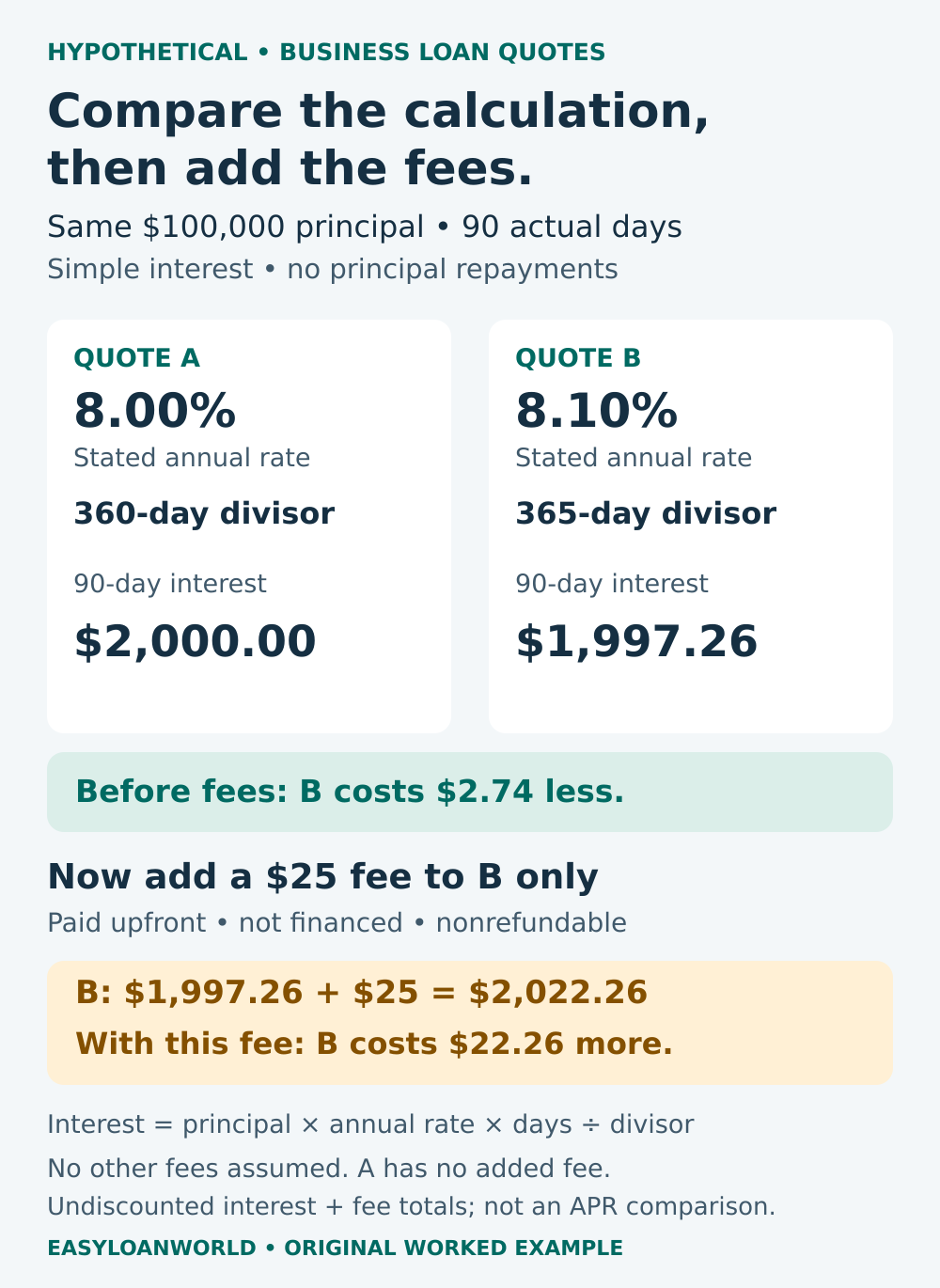
Invent both quotes with $100,000 outstanding for 90 actual days, unchanged balances and annual rates: A at 8%, divisor 360; B at 8.10%, divisor 365.
Assume identical funding and final repayment dates, no interim repayments, compounding, fees or rate resets; the chosen divisors are hypothetical inputs, not calendar determinations.
Business loan quotes: compare interest dollars
For this worksheet only, interest = principal × annual rate as a decimal × days ÷ divisor.
| A | $100,000 × 0.08 × 90 ÷ 360 = $2,000 exactly. |
|---|---|
| B | $100,000 × 0.081 × 90 ÷ 365 = $145,800/73, or $1,997.26 after rounding only the final result. |
Despite its higher annual rate, B produces $2.74 less interest in this example: the exact difference is $200/73.
To match A, solve 100,000 × r × 90 ÷ 365 = 2,000: r = 0.08 × 365/360 = 73/900, equivalent to 8.111…% annually.
Add the fee
Now add a nonrefundable $25 cash fee paid by the borrower at funding for B only, not financed; A’s fee stays zero, with no discounting.
Interest plus fee is now $2,000 for A versus $2,022.26 for B; these undiscounted cash sums reverse the interest-only ranking by $22.26.
This limited comparison is neither APR nor a full financing evaluation. Its arithmetic alone can’t establish which loan suits your business.
Business loan quotes: reproduce the two conventions
The calculator below checks one constant-principal, simple-interest case at a time. It doesn’t read a lender’s agreement or establish which convention applies. Enter the contractual or explicitly assumed denominator rather than leaving an unrelated default in place.
For the original Quote A, enter $100,000 principal, 8% annual interest and 90 elapsed days. Select Actual days / 360. The displayed interest should be $2,000.00 and principal plus interest $102,000.00. The displayed daily interest is $22.22.
For Quote B, keep $100,000 and 90 days, change the annual rate to 8.10% and select Actual days / 365. Interest should display $1,997.26, principal plus interest $101,997.26 and daily interest $22.19. Reset both rate and denominator when switching cases.
The tool excludes the separately stipulated $25 fee. Add that once outside the tool for the interest-plus-fee comparison. Don’t put the fee into principal, because the original example expressly says it’s paid separately and isn’t financed.
Keep the day fraction separate from the nominal rate
Quote A multiplies its annual rate by 90/360, or one quarter. Quote B multiplies a different annual rate by 90/365. The fractions differ even though both examples cover the same 90 actual days and identical assumed funding and repayment dates.
For a separate control, apply 8% to both $100,000 cases. With divisor 360, interest is $2,000. With divisor 365, it is $1,972.60 after final rounding. The $27.40 displayed difference comes from the denominator alone in that controlled comparison.
This control isn’t a third available offer. It changes one mathematical input to show why ranking only the annual rate can miss a difference in the interest calculation. Actual contracts can contain other features the simple model excludes.
The equal-interest nominal rate already derived above is approximately 8.111…% on the 365 basis. It matches A’s 8% on the 360 basis under these identical principal and elapsed-day assumptions. It isn’t a universal APR conversion or an offer a lender must provide.
Business loan quotes: check the fixed-fee threshold
For the original $100,000 and 90-day comparison, B’s exact interest advantage is $200/73, approximately $2.739726. A fee greater than that advantage reverses the undiscounted interest-plus-fee ranking, assuming A remains fee-free and all other inputs remain fixed.
The stipulated $25 fee exceeds that advantage. B’s extra total cash cost relative to A is $25 minus $200/73, approximately $22.260274, displayed as $22.26. The fee is small relative to principal but material relative to this narrow interest difference.
Don’t describe the $2.74 displayed interest difference as an exact fee threshold. It’s a rounded display. A comparison close to the boundary should retain full precision rather than subtracting rounded outputs and claiming an exact tie.
The threshold concerns only this restricted cash-sum comparison. A fee at funding and interest at final repayment occur on different dates. The example deliberately doesn’t discount them, calculate a yield or establish a complete financing cost measure.
Change the principal while holding the fee fixed
For an independent scale test, increase each principal to $1,000,000. Keep the same rates, 90 days, divisors, exclusions and B-only fixed $25 fee. This is a mathematical alternative, not a recommendation to borrow a larger amount.
A’s interest becomes $20,000. B’s interest becomes $19,972.60 after final rounding, and its interest plus fee is $19,997.60. B is now $2.40 lower on the displayed cash-sum comparison. Interest scales with principal while this particular fee remains fixed.
To check the tool, run $1,000,000 at 8% for 90 days on Actual days / 360: interest $20,000.00 and total $1,020,000.00. Then use 8.10% and Actual days / 365: interest $19,972.60 and total $1,019,972.60. Add B’s fee separately.
The exact principal boundary is $912,500 for these fixed inputs. A’s interest there is $18,250, while B’s is $18,225 plus the $25 fee. This equality follows from the stated formulas; it establishes neither an available borrowing amount nor affordability.
Test duration without changing the balance history
For another independent comparison, return to $100,000 and extend both assumed constant-balance periods to 180 actual days. Keep the same rates, divisors and one fixed $25 fee for B, with no interim payments or other changes.
A’s interest is $4,000. B’s is $3,994.52 after final rounding; with the fee, B totals $4,019.52. Doubling the time doubles the unrounded interest amounts but doesn’t double the single fixed fee under this alternative’s explicit assumptions.
Neither actual lender is assumed to offer this extension. If a real quote has an interim principal reduction, rate reset, additional fee or compounding, the constant-principal multiplication no longer describes the whole transaction. Recalculate the relevant intervals from the actual terms.
Don’t count 180 days merely because a description says six months. Elapsed calendar days and a loan’s contractual counting convention require their own verification. The examples supply day counts directly instead of deriving a calendar rule.
Business loan quotes: don’t rebuild interest from a rounded daily display
The daily outputs are rounded for display. Multiplying A’s displayed $22.22 by 90 gives $1,999.80, which is $0.20 below the full formula’s exact $2,000. That multiplication uses an already-rounded input and therefore doesn’t reproduce the stated calculation method.
For B, $22.19 times 90 gives $1,997.10, compared with $1,997.26 after rounding the full-precision period calculation. The $0.16 displayed difference again comes from premature rounding, not a new fee or principal change.
Use principal times annual rate times elapsed days divided by the chosen denominator to reproduce this model. A real agreement may specify a different rounding convention; obtain that actual instruction before treating either displayed result as the contractual charge. Keep the method with the amount so the discrepancy can be explained.
Keep outputs and payment records in their own columns
Interest, principal plus interest and a separate fee are different quantities. Comparing A’s interest-only output with B’s principal-plus-interest output would create a meaningless gap. Compare matching labels and include the stipulated fee in the appropriate cash row once.
For actual quotes, retain principal, dates, balance changes, rates, denominators, fees and fee timing together. Ask the lender for a reproducible calculation when one element is unclear. An unexplained result should remain unresolved rather than being forced to fit the smaller headline rate.
The cited company filings illustrate contractual provisions rather than consumer offers or typical pricing. The calculator reproduces only the invented inputs. A business loan quotes review also needs actual covenants, collateral, prepayment terms and other relevant costs before an adviser can assess a concrete financing proposal.
Questions for your lender
Ask your lender: Which written terms specify the divisor, counted dates, balance changes and fees? Can you show the calculation and fee payment dates?
If a swap also covers the borrowing, review business loan paydowns and swap mismatches. For a revolving facility, use the credit-line draws, interest and fees guide to track the balance on which interest is calculated.
Customer Overlaps
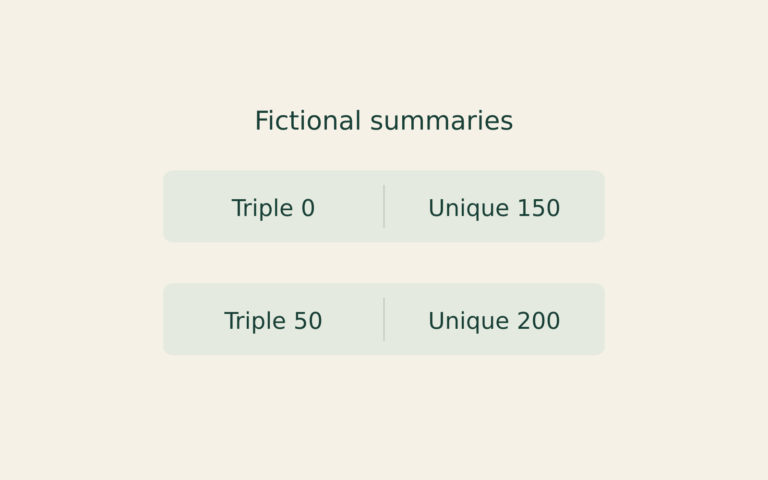
A business worksheet can contain every pairwise channel overlap yet still leave its unique-customer total unresolved.
Equity Returns
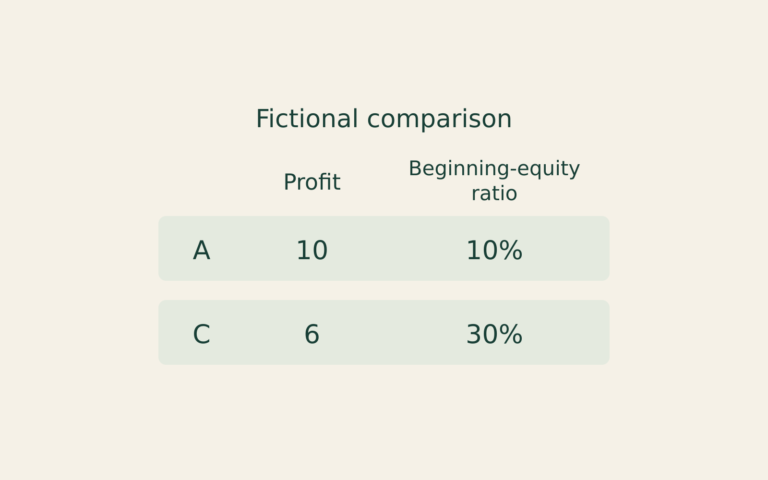
A higher profit-to-equity percentage need not mean more profit. This fictional comparison holds operations constant and then reverses the calculation.
Hedge Funding Peaks
A matched terminal receipt does not specify the largest borrowing balance along the way. This fictional example connects both calculations using one price…