Credit Card Billing Errors: Build and Track Your Dispute Record
Organize one questioned card entry, supporting documents, notice delivery evidence and the issuer response with a fictional duplicate-entry example.

Estimated reading time: 8 minutes
Start a record of credit card billing errors with the statement: mark the entry you question, explain why and connect it to supporting evidence. Keep that disputed amount separate from the rest of the bill, and track notice delivery, the issuer’s answer and payment questions separately.
This guide organizes U.S. consumer credit-card billing-error records. It doesn’t cover debit-card disputes, credit-report corrections, debt-collector notices or complaints about product quality. It’s general education, not advice about your individual legal rights or payment decision.
Contact the issuer promptly. You can dispute a charge even if you already paid it. Keep copies and a dated follow-up record. For a billing-error notice, written acknowledgment is due within 30 days of receipt unless the required resolution is completed within that time. See the CFPB’s dispute guidance.
Credit card billing errors: identify the discrepancy
Billing errors can include duplicate charges, wrong amounts or missing payment credits. Send supporting copies, retaining originals. The FTC’s billing-error guidance describes this process.
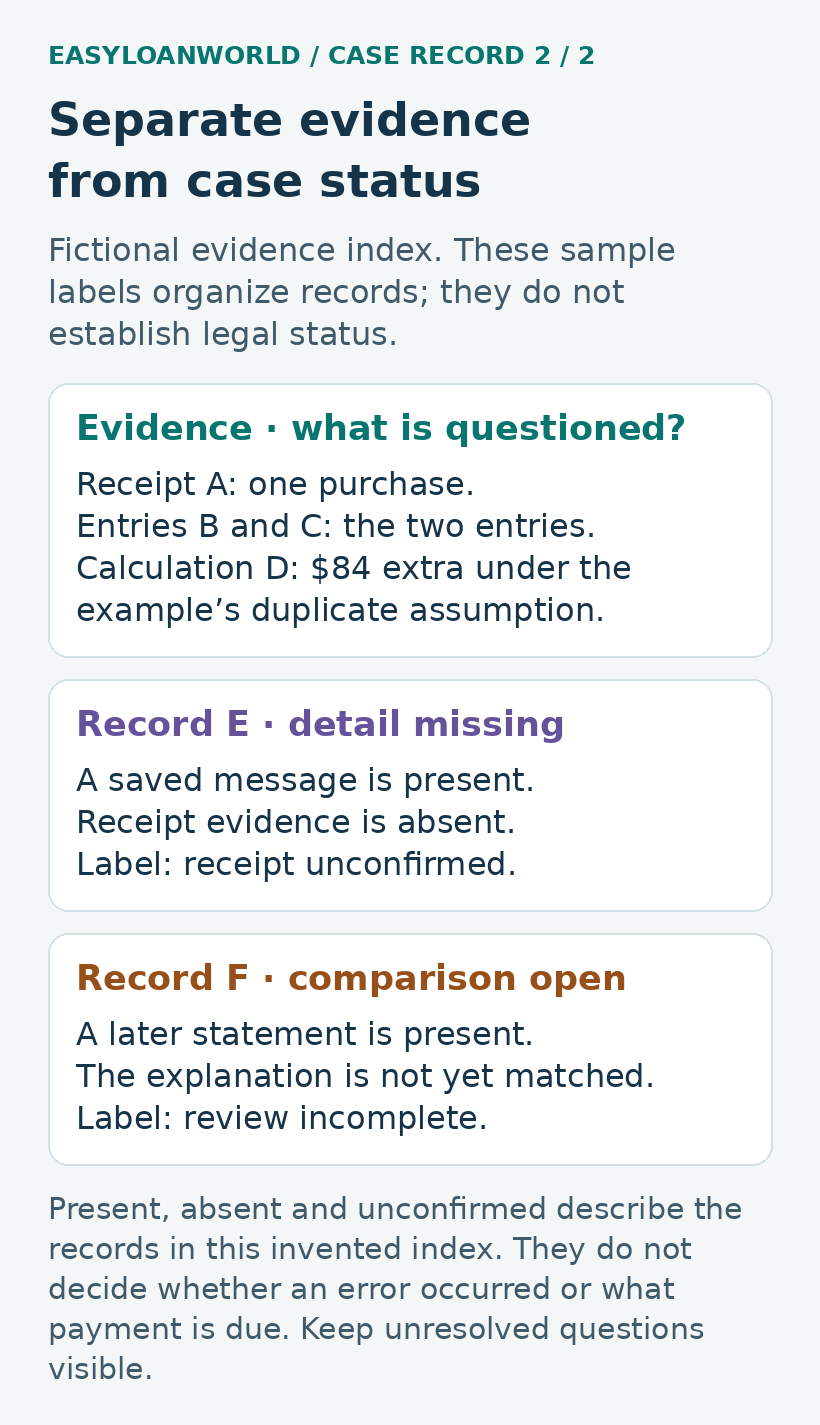
Create a private issue card with the statement period, entry identifier, billed amount, expected amount and reason for questioning it. Attach a document identifier to each factual assertion. “Receipt A shows one purchase; statement entries B and C appear to describe it twice” is easier to examine than “this entire bill is wrong.”
Record uncertainty honestly. Two identical amounts could reflect two separate purchases. Look at transaction descriptions, dates and the evidence you actually have before calling them duplicates. A missing receipt is a gap to investigate, not permission to invent the purchase history.
Keep a short list of unanswered factual questions beside the card. For example: do these entries correspond to the same order, or is one a different purchase? Avoid filling the explanation with unrelated frustrations; they can obscure the particular entry you want examined.
Credit card billing errors: preserve notice receipt
Keep three timing rules separate. They use different starting events under Regulation Z.
| Step | Rule | Record to identify |
|---|---|---|
| Qualifying notice reaches the issuer | Within 60 days after the issuer transmitted the first statement showing the error | The first affected statement, its transmission information and evidence of notice receipt |
| Written acknowledgment | Within 30 days after receipt of notice, unless required resolution is completed within that period | The issuer’s receipt date and acknowledgment or completed resolution |
| Resolution | Within two complete billing cycles after notice receipt, and no later than 90 days | Actual billing-cycle boundaries and the final written response |
Use the disclosed billing-inquiries address. Electronic notice qualifies through the issuer’s designated accepted procedure. Two complete billing cycles aren’t automatically 60 calendar days; don’t substitute that assumption for the actual cycle dates.
Build a delivery card from the actual instructions and records. Save the relevant statement, the billing-inquiries instructions you followed, the notice version submitted and the delivery evidence. Distinguish when you prepared the notice, when you sent it and what establishes its receipt. An outgoing message screenshot and a receipt confirmation answer different questions.
A phone call or ordinary chat isn’t automatically qualifying notice. The clock doesn’t start at discovery.
Don’t wait for a perfect folder before acting. If instructions or dates are unclear, contact the issuer promptly for clarification and preserve the answer. A record labeled “date unconfirmed” is more useful than an unsupported last-day calculation. This guide deliberately doesn’t calculate an individual deadline.
Before submitting, check four items:
- The issuer can identify you and the account.
- The notice explains why you believe an error occurred and gives its type, date and amount to the extent possible.
- You’re using the billing-inquiries destination rather than the payment address, or the issuer’s accepted electronic notice procedure.
- You have kept the exact notice and supporting copies so you can match them to delivery evidence.
Keep those account details private. For your own index, a short document label can point to the full record without repeating sensitive information in every note. Check that each attachment is legible and corresponds to the item described; an unrelated page can make an otherwise clear explanation harder to follow.
A fictional duplicate-entry example
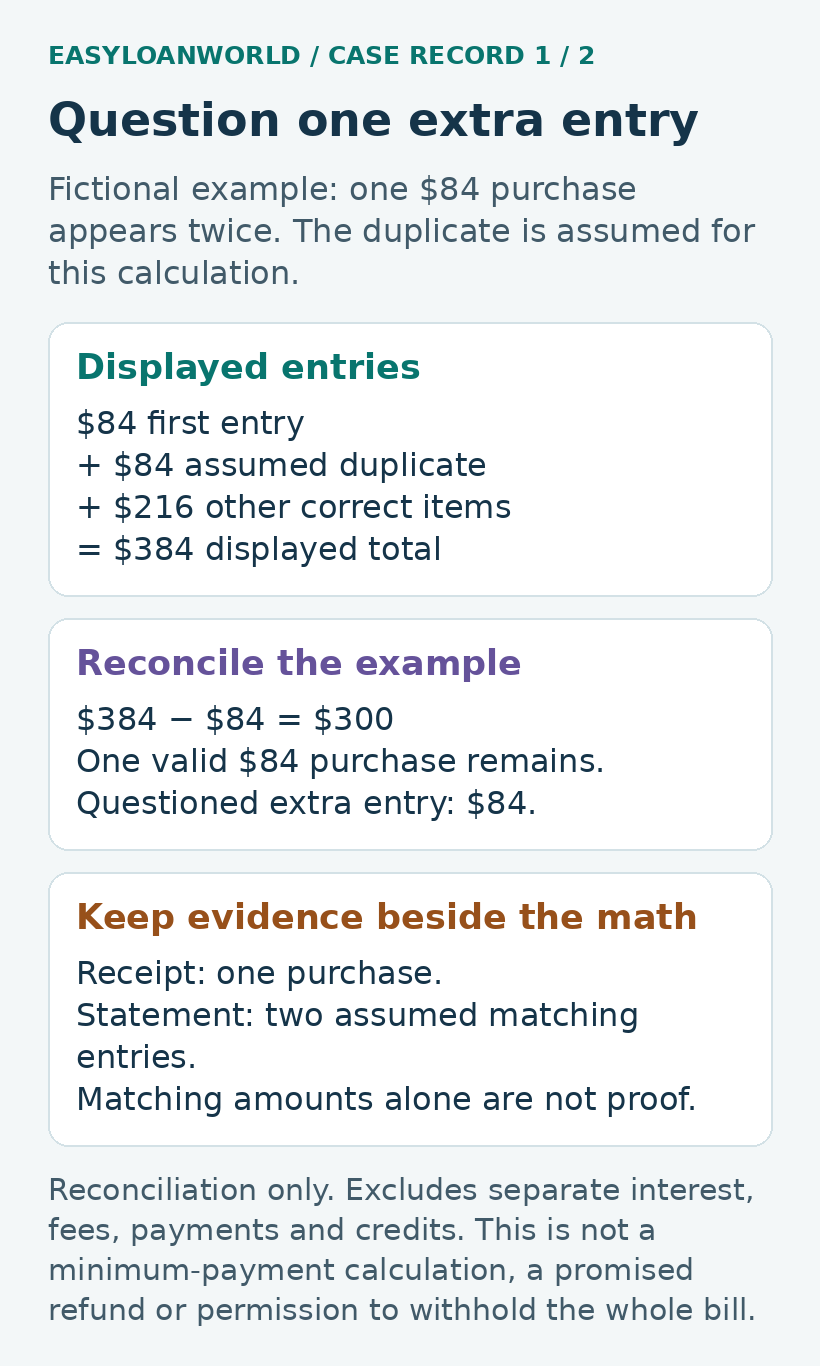
Suppose a receipt documents one $84 purchase. An invented statement contains two $84 entries that, for this example, are assumed to be duplicates of that single purchase. The apparent disputed amount is $84: one extra entry. It isn’t $168, because the example still includes one valid purchase.
Assume other correct statement items total $216. The displayed items sum to $384: $84 + $84 + $216. Removing the assumed duplicate produces $300: $84 + $216. These figures exclude separate interest, fees, payments and credits.
Label the arithmetic “reconciliation only.” It isn’t a minimum-payment calculation, a promised refund or permission to withhold the whole bill. The example’s conclusion depends on its duplicate-entry assumption; matching amounts alone wouldn’t prove that assumption in a real account.
In your issue card, separate the original evidence from the arithmetic. One line can identify the receipt and entries; another can show how you calculated the amount questioned. That lets a reviewer examine the facts without mistaking a subtraction for proof that an error occurred.
Keep payment handling separate from the evidence file
During a qualifying billing-error investigation, the disputed amount and related charges may be withheld, but undisputed amounts remain payable. Ask the issuer to clarify payment handling if uncertain. Interest isn’t universally suspended.
A temporary credit isn’t necessarily the final outcome.
Keep your payment questions beside, but separate from, the description of the error. Record the issuer’s explanation of what remains due and compare it with the statement. Don’t treat the fictional $300 figure above as an instruction for your account, or use an unexplained adjustment to decide that every remaining obligation has disappeared.
Credit card billing errors: follow a temporary adjustment separately
Extend the fictional duplicate-entry case with a posting-only exercise. Start with its $384 of displayed items, including the assumed extra $84 entry. Suppose the issuer posts an $84 temporary credit. If there are no other entries, the arithmetic subtotal becomes $300. Label the adjustment temporary, with its own reference and date.
That subtotal agrees with the original duplicate-removal arithmetic, but agreement doesn’t establish a final decision. The credit’s temporary status still matters. Keep the initial questioned entry and evidence visible while tracking the adjustment rather than marking the issue closed merely because the displayed numbers now match.
As one alternative, suppose a later final explanation confirms the correction and says the existing credit is the adjustment. With no new transaction, the subtotal stays $300. Don’t subtract another $84 just because a final letter arrived; the letter and the posting may describe the same correction.
As another alternative, suppose the temporary credit is reversed before a final correction is posted. The isolated subtotal returns from $300 to $384, then returns to $300 if a separate $84 final credit is later applied. Preserve each entry in sequence. Adding only the favorable credits while omitting the reversal would misstate this invented record.
These scenarios supply bookkeeping events, not a prediction of how an issuer will process a dispute. They exclude interest, fees, payments and all other activity. They aren’t balances to copy into a minimum-payment field or instructions to stop paying.
Credit card billing errors: match the written answer to the entries
Create one row per adjustment showing its reference, amount, status, posting date and the message that explains it. Use another row for a reversal. Two messages referring to one adjustment should point to that same row, not create a second credit in your reconciliation.
Identify the precise mismatch if the written answer and statement disagree. For example, the letter may describe an $84 correction while the next statement still shows a temporary $84 adjustment without explaining its final status. Ask the issuer to connect the records and clarify remaining payment handling rather than assuming the unexplained status is harmless.
A complete working record distinguishes the factual issue, the notice history, the written determination and the account postings. Its purpose is to make the next question specific. It can’t establish that a notice qualified, that every legal duty was satisfied or that a particular amount may safely be withheld.
Track the answer through the next statement
Make a status card containing the acknowledgment, any document requests, adjustments and final response. Identify which documents are missing rather than repeatedly sending the whole folder without explanation. When you receive a new message, record what it changes and what it leaves unanswered.
The issuer must provide a written correction explanation or, if it finds an amount owed, explain that determination and payment requirements.
Match the written result to the relevant statement entry. Keep an adjustment reference separate from the date of the final explanation so you can see whether both exist. If the response addresses a different amount or transaction, identify that mismatch specifically when following up.
Close your working record only when you can state what was decided, what the account now shows and which questions remain. A well-organized file can’t guarantee a favorable decision. It can make the evidence, delivery history and unresolved issues much clearer.
If the questioned entry is interest after a payoff, first check the residual-interest reconciliation guide to identify what the charge represents.
Featured photo: Blank paper and a calculator illustrate checking billing amounts. Photo: Mediamodifier / Unsplash. Used under the Unsplash license.