Credit Card Grace Periods: How to Keep Interest Off New Purchases
See how statement dates, payment amounts and account eligibility affect purchase interest, with a simple timeline and questions to ask your issuer.
A credit card grace period can let you avoid interest on qualifying purchases when you meet the card’s conditions, usually including paying the statement balance in full by its due date. Paying on time is only part of the test: the amount paid and your account’s existing eligibility also matter.
This guide covers U.S. consumer credit cards. Use it to check your statement and prepare questions for your issuer; your own agreement determines the applicable terms.
What the grace period means
The grace period is the time between the billing cycle’s end and the payment due date. Cards are not required to offer one, and it generally concerns purchases rather than cash advances. It is not extra time after the due date. See the CFPB’s grace-period explanation.
Three dates help you read the bill:
- Purchase date: when a transaction occurs.
- Statement closing date: when the billing cycle ends and the statement balance is established.
- Payment due date: the deadline shown for that statement’s payment.
The current balance can include activity after the closing date. That is why the number in your app may be larger than the statement balance before the payment is due. Capital One explains these two balance labels.
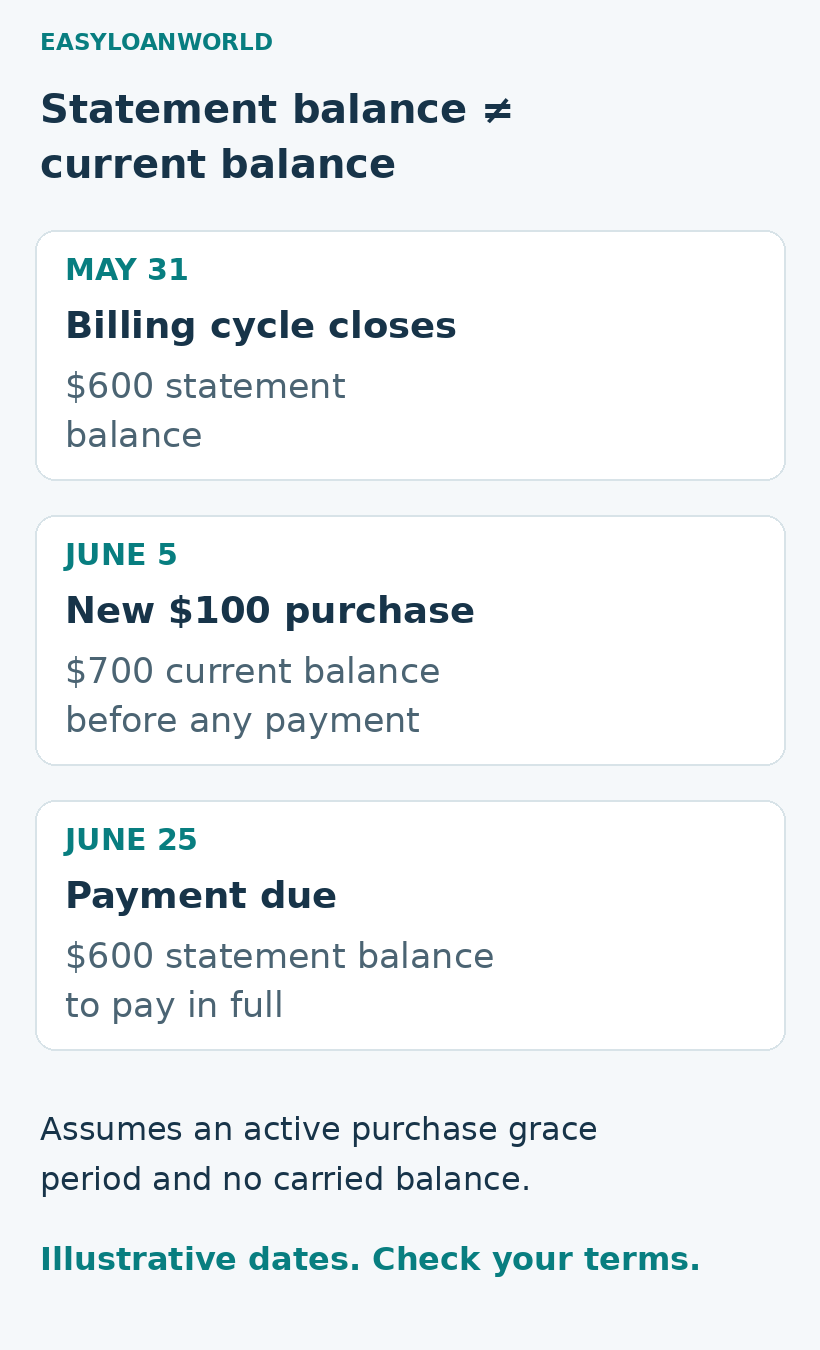
A $600 statement and a $700 current balance
Here is an illustrative account with ordinary purchases only, an active purchase grace period, no carried balance, no special promotional plan, and all required prior payments satisfied. Assume no other activity beyond the transactions described.
- May 31: the statement closes.
The statement balance is $600. Its payment due date is June 25. - June 5: a new $100 purchase posts.
The current balance becomes $700 before any payments. The May 31 statement balance remains $600. - June 25: the statement payment is due.
Under the assumed terms, paying the $600 statement balance in full by this deadline keeps that statement’s qualifying purchases interest-free.
The later $100 purchase belongs to the next billing cycle. Its payment deadline will appear on the next statement; this example does not assume what that date will be.
Now change just the payment. If the required minimum were $30 and that entire payment reduced the $600 statement balance, $570 would remain unpaid. That can affect grace-period eligibility. We have not calculated an interest charge: the amount would depend on the actual terms, transaction dates and payment timing.
All dates and amounts are hypothetical. Check your own statement rather than using these dates as a payment schedule.
On-time payment and full payment answer different questions
For the account above, ask both “Did the required payment arrive by June 25?” and “Was the full $600 statement amount paid?” A $30 payment could answer the first question without answering the second.
When reviewing autopay, write down its exact setting. “Minimum payment,” “statement balance” and “fixed amount” are different instructions. Then check the upcoming withdrawal amount, the bank balance available to fund it, and the completed payment. If you also pay manually, ask whether that changes the automatic debit.
Check these situations before making new purchases
You are already carrying a balance
With a carried balance, you may have lost purchase grace-period eligibility. New purchases can then begin accruing interest from their transaction dates. Do not treat the next due date as a guaranteed interest-free window.
You took a cash advance
Cash advances generally do not receive the usual purchase grace period. Read that transaction category’s interest terms separately.
You accepted a low-rate balance transfer
A 0% transfer rate does not automatically extend to new purchases. Carrying the transferred balance can affect the purchase grace period even while that transfer itself has a promotional rate. Before combining a transfer with spending, ask what purchase APR applies and what payment is required to retain purchase-interest relief. The CFPB explains this balance-transfer risk.
A grace period, a promotional APR and a deferred-interest offer are separate arrangements. If your statement contains a special plan, ask the issuer to explain its payment requirements rather than treating all three as equivalent.
Why interest can appear after you pay the old statement
When a balance is already accruing interest, paying the amount on an earlier statement may not cover interest that accumulated after the statement closed and before the issuer received payment. This is often called residual or trailing interest.
Ask whether additional interest remains, how the payoff amount is calculated for your intended payment date, and whether the next statement may include another charge. A visible zero balance immediately after payment is not a substitute for that check. The CFPB notes that interest generally continues until payment is received when a balance is being carried.
How to check restoration requirements
Do not assume a single payoff instantly restores the grace period. Account conditions can involve full payment for one or more billing cycles. The account-opening disclosure rules require disclosure of grace-period conditions.
Open the agreement and look for a heading such as “How to Avoid Paying Interest” or “Paying Interest.” If the answer is unclear, use this short call checklist:
- “Do I currently qualify for a purchase grace period?”
- “What amount must you receive, and by what date and cutoff time?”
- “What exactly must I do to restore eligibility if I have lost it?”
- “Does that require full payment for more than one billing cycle?”
- “Could residual interest still appear after this payment?”
- “Where are these terms in my agreement?”
Keep a record of the explanation and compare it with the next statement. If an interest charge seems inconsistent, ask the issuer to identify the balance category, dates and calculation used.
Common questions
Does every purchase get 21 interest-free days?
No. The requirement to deliver bills at least 21 days before payment is due is not a promise of 21 interest-free days after each purchase. Eligibility and transaction type still matter.
Does losing the grace period mean every past purchase gets interest from its purchase date?
No. Federal rules limit certain finance charges after loss of a grace period, including charges on eligible amounts paid within that period. Avoid assuming a blanket retroactive charge; ask for the specific calculation. See Regulation Z’s finance-charge limits.
Should I use the statement balance or current balance?
For the uncomplicated, eligible account in the example, the $600 statement amount is the relevant payment, although the current balance is $700. An account with an old interest-bearing balance or a special plan needs its own payoff and eligibility check.
Next step: Find the interest section of your agreement and compare its conditions with your latest statement and payment setting. If any condition is unclear, get the issuer’s account-specific answer before relying on a grace period for new spending.
General educational information for U.S. readers. Sources checked October 19, 2026.
Featured photo: Photo by Renáta-Adrienn on Unsplash. Used under the Unsplash license.

Credit-Builder Loan vs. Secured Card: A Cash-Access Checklist
Work through three fictional situations and four private questions before deciding whether a new account fits your needs.
Hotel Card Hold: Compare Two Checkout Payment Paths
Compare two fictional hotel checkout choices while keeping the original card’s capacity and the actual payment in separate records.
Overdraft Fee? Look Beyond the Online Bill Label
Compare three fictional document packets behind the same $60 ONLINE BILL entry, then identify what the records still leave unexplained.