Credit Card Hardship Programs: Review the Full Offer
Review a hardship offer from its confirmed start through the end of relief. Compare the payment schedule with cash you can actually fund.
Estimated reading time: 7 minutes
You need a smaller card payment this month, and the issuer offers a temporary arrangement. Before accepting it, check what becomes due when the relief ends. Credit card hardship programs can change payment terms, but a lower first bill doesn’t establish that the full schedule fits your budget.
Ask for help promptly. The CFPB’s guidance for unaffordable card bills recommends explaining why payment is difficult, what you can afford, when normal payments might resume and the temporary change you’re requesting.
This guide covers U.S. consumer cards. Availability and terms depend on the issuer and your account; use the written offer to check the actual requirements.
Bring an affordable amount to the conversation
Have the latest statement beside you and record the minimum due and its deadline, keeping any overdue amount on a separate line until the issuer explains how the arrangement handles it. Calculate what remains available for this card after essential expenses and other commitments.
Use income you can reasonably rely on. If overtime or a return to work remains uncertain, keep that possibility separate from the amount you can fund now rather than building the proposed payment around it.
For example, a hypothetical caller with $140 available could say: “My income has fallen, and I can currently budget $140 a month for this card. What assistance can you evaluate? Please explain the payment schedule after any temporary relief, too.” Change the explanation to fit your circumstances; the $140 isn’t an issuer offer or a recommended payment.
You can ask before missing a bill. As one issuer example, Wells Fargo’s payment-help center says customers can seek help before falling behind and lists possible temporary changes to interest, fees or minimum payments. Those possibilities don’t establish what another issuer will approve.
Review credit card hardship programs as a dated schedule
Start with the full payment schedule. Ask for the first required amount and due date, the number of cycles it applies to, and what makes the arrangement effective. Clarify whether enrollment requires a payment before the new terms begin.
Keep an overdue amount separate until the issuer explains how the plan treats it. A representative might quote an ongoing payment without that figure answering every question about money already due. Ask for the total required at each stage.
- Current bill
- Record what is due while the request is under review.
- Confirmed start
- Save the effective date and any enrollment payment.
- During relief
- Keep each required payment beside its due date.
- After relief
- Record the next payment and any catch-up amount.
Interest and the end of relief
Ask which annual percentage rate applies during the arrangement and whether interest continues accruing. Identify the exact fees that change, if any. A reduced payment alone doesn’t tell you how fast the balance will fall.
Then ask what happens after the final reduced payment: the next amount due, how the issuer calculates it and the date the rate changes. Find out whether a catch-up payment is required. Request those details even if you expect your income to improve before then.
If recovery might take longer, ask when another review can occur and what happens if you miss an agreed payment. An extension needs its own confirmation; don’t build an unapproved second period into your budget.
Account access, reporting and automatic payments
Ask whether you can still use the card and whether the issuer will restrict or close it. Check what would happen to recurring charges before relying on that card for another bill.
For credit reporting, ask about the account’s current status and how the issuer will report payments during the arrangement. TransUnion’s hardship guidance says lenders decide how to report accommodations and that a program doesn’t guarantee late payments will go unreported. Get an account-specific answer if you’re already behind. Don’t assume enrollment erases earlier missed payments or predicts a score change.
Finally, inspect autopay. Ask who must update it and how to verify the first withdrawal amount. Compare that instruction with any manual payment you plan to make, so the budget covers the confirmed debit rather than an assumed cancellation.
Test the payment after the smaller bills stop
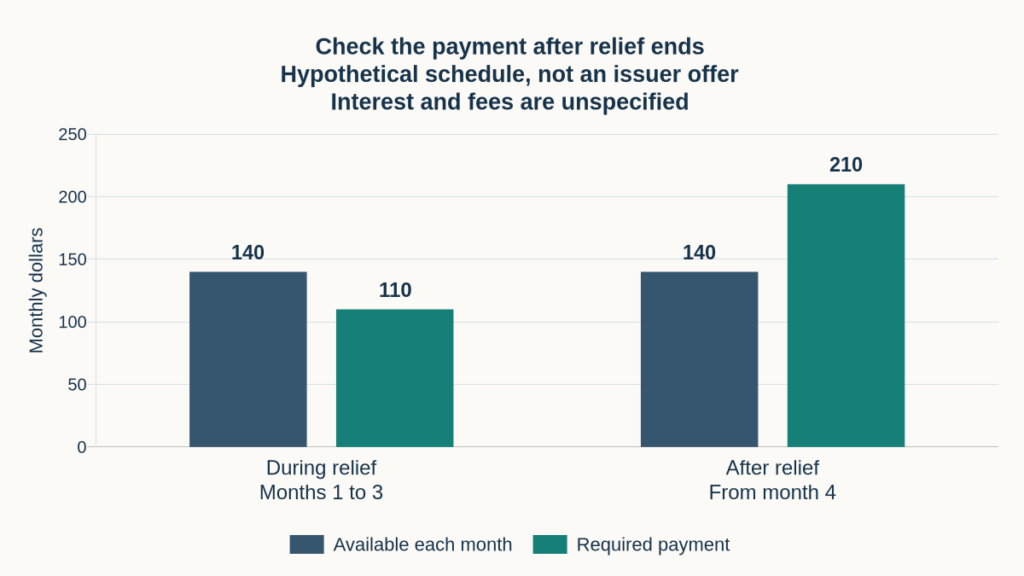
Here’s a fictional cash-budget example, not an available hardship program. A household has $140 a month for one card. The proposed schedule calls for $110 monthly for three months, then $210 monthly from month four.
During relief, $140 less $110 leaves $30 each month. Afterward, $140 less $210 creates a recurring $70 shortfall if the budget stays unchanged.
The first three payments total $330. That is scheduled cash paid. We haven’t supplied an interest rate or fees, so we can’t infer a $330 principal reduction.
Saving the initial headroom helps for a limited time
Assume the household actually saves all $30 in each of the first three months and keeps the resulting $90 exclusively for later card payments. The following table tracks that reserve:
| Post-relief payment | Monthly gap before using reserve | Reserve used | Reserve left | Still unfunded |
|---|---|---|---|---|
| Month 4 | $70 | $70 | $20 | $0 |
| Month 5 | $70 | $20 | $0 | $50 |
| Month 6 | $70 | $0 | $0 | $70 |
The reserve covers the first gap, but it can’t fund the recurring shortfall indefinitely. By the second post-relief bill, $50 lacks an identified source. Across months four through six, $120 remains unfunded after using the $90.
The six scheduled payments total $960: three at $110 and three at $210. The six monthly budget allocations total $840. Their $120 difference reconciles with the table.
This result assumes the headroom was saved. If another essential expense uses it, the reserve available for the card is smaller. Don’t count the same dollars as funding for two commitments.
In a separate variation, suppose a confirmed budget improvement raises the available monthly amount to $190 when the $210 payment begins. The ongoing gap becomes $20; a smaller shortfall still needs a source. Keep uncertain income changes out of the confirmed-budget case.
Confirm what changes while the request is pending
Call using the number on the card or statement. The FTC’s debt guide says you can discuss your card debt directly without paying another company to negotiate, and recommends keeping records and obtaining a written version of the agreement.
Record the conversation date and representative, along with the reference number if one is available, so you can connect a later written offer with the explanation you received. Save the effective date with that offer.
Ask what remains due while the issuer reviews your request. Requesting assistance doesn’t establish an approved change to the payment instruction, so don’t assume waiting gives permission to skip the current bill.
After confirmation, check the first statement against the arrangement by comparing the payment amount and due date, then reviewing the interest and fees for differences from the written terms. Check the scheduled debit as well. Contact the issuer promptly about a mismatch and retain its answer with the agreement.
If the later payment still has no funding
Explain the gap using the actual schedule. In the fictional example, that means saying the budget supports $140 while the post-relief payment requires $210. Ask whether the issuer can evaluate another arrangement and what remains due if you don’t accept the offer.
When several debts compete for the same money, a credit counselor can help review the household budget and possible debt-management options. The CFPB’s credit-counseling guide recommends checking qualifications and getting a written quote for setup or monthly fees. A counselor should assess your situation before pushing a particular plan.
Our debt-management-plan guide explains the separate commitments to compare with direct issuer assistance. Confirm creditor acceptance before sending payments under a proposed debt management plan.
For a reader whose offer fits only during temporary relief, take the first unfunded payment back to the issuer before agreeing. Write its amount and date beside the funding gap. In the example, saving the full $90 still leaves part of month five’s bill without a source.
Sources
Checked November 3, 2026. The example tests cash availability only; it doesn’t estimate interest, principal reduction or available relief.