Debt Management Plans: Costs, Trade-Offs and Questions to Ask
Evaluate a debt management proposal by its fees, creditor acceptance, payment schedule, and fit with your full household budget.

A debt management plan coordinates payments to participating creditors through a credit counseling organization. It can be worth exploring when unsecured debt payments are difficult to manage, but the decision should rest on a written proposal: which creditors accept it, what you will pay, how much the agency charges, and whether the schedule fits your budget.
A plan does not erase your debt or create a new loan. The Consumer Financial Protection Bureau distinguishes debt management from settlement and consolidation. With debt management, you pay the counseling organization, which sends payments to creditors. A consolidation loan instead involves new borrowing; settlement seeks an agreement to resolve debt for less than is owed.
Start with the budget, not the enrollment form
Before comparing proposals, write down your dependable monthly income, essential bills, and required payments. Include debts that may stay outside the plan. The question is not simply whether one new payment looks smaller than several old ones. It is whether the entire month still works after every obligation is counted.
Use these screening questions with a counselor:
- How much cash is reliably available after essential expenses?
- Which debts would be included, and which would I still pay directly?
- Does the proposal fit that available cash after agency fees?
- What changes would make the budget fail, such as reduced hours or an irregular annual bill?
- Can I maintain the proposed schedule without relying on new borrowing?
These questions are a preparation tool, not eligibility rules. If the numbers still show a deficit, ask for a wider discussion of your options rather than forcing the budget to fit the plan.
Understand the commitment and restrictions
The Federal Trade Commission explains that debt management plans focus on unsecured debts, rather than debts secured by a house or car. Creditors may agree to lower interest rates or waive certain fees, but you need confirmation of the actual terms. A plan can take 48 months or longer and requires regular, timely payments. It may also restrict applying for or using additional credit.
Ask about each account separately. Which creditor has accepted which rate, payment, and effective date? Will a card be closed or otherwise restricted? What happens if a creditor declines the proposal? An agency’s general description is not the same as confirmation for your accounts.
Separate the three parts of your monthly cost
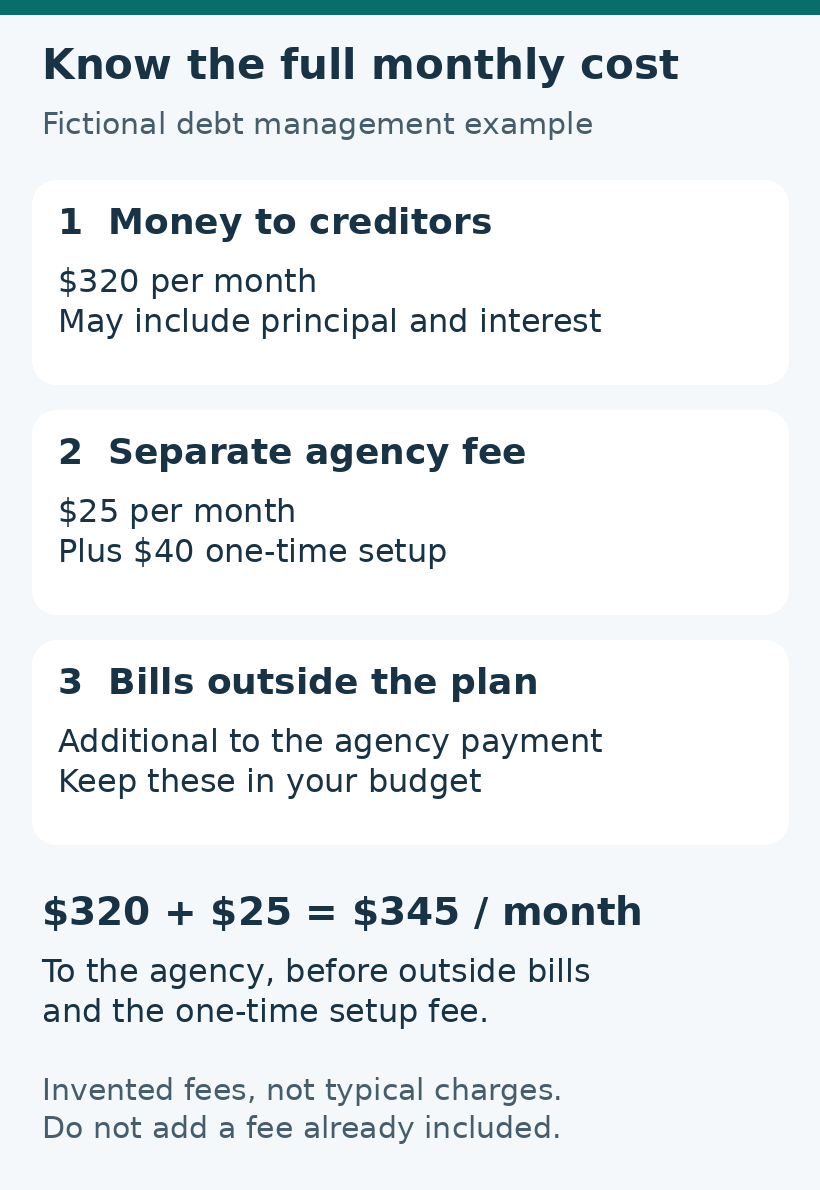
Request a written breakdown that distinguishes:
- Money sent to participating creditors. Get the amount scheduled for each creditor, not just a combined total.
- Agency fees. Identify any initial charge, recurring charge, and other potential charges described in the agreement.
- Bills outside the plan. Keep these in your household budget even though the agency is not paying them.
Check whether the quoted monthly payment already includes the agency fee. Adding an included fee again would overstate the payment; overlooking a fee charged on top would understate it. Ask about fee reductions, waivers, cancellation, and any refund terms.
A fictional cost example
These are invented figures for arithmetic practice, not typical fees, a provider quote, or a savings estimate. Suppose a proposal specifies $320 a month for creditors, a separate $25 monthly agency fee, a $40 setup fee, and 48 monthly payments.
- Ongoing payment to the agency: $320 + $25 = $345 a month.
- Agency fees over the full term: $40 + ($25 × 48) = $1,240.
- Scheduled creditor payments: $320 × 48 = $15,360.
- Total scheduled outflow to the agency: $15,360 + $1,240 = $16,600.
The creditor payments may include both principal and interest. They are not a principal-reduction estimate. Bills outside the arrangement are additional, and a changed fee, duration, or payment changes the totals. Ask when the setup fee is collected so you can calculate the first month’s cash requirement separately.
To assess any claimed savings, you would need a comparable alternative with its own interest, fees, timing, and payment assumptions. A lower monthly bill alone cannot establish a lower total cost.
Check the agency and the written proposal
Nonprofit status does not by itself prove an organization is legitimate or its services free, the FTC cautions. Compare agencies, check relevant state licensing requirements and complaints with consumer-protection authorities, and ask about counselor qualifications. Do not treat inclusion on a pre-bankruptcy counseling list as an endorsement of a particular plan.
The CFPB’s guide to selecting credit counseling recommends written fee quotes and reviewing the agreement. It also advises confirming directly with creditors that they accepted the proposal before sending payments to the organization.
Before signing, make sure you can answer these questions from the documents:
- Which creditors and accounts are included?
- What payment and rate does each creditor accept?
- What are all initial and ongoing agency charges?
- When does the agency collect my money, and when does each creditor receive it?
- What do I pay directly during the transition?
- What is the expected completion date, and what could change it?
- What account-use restrictions apply?
- What happens after a missed payment or if I leave the plan?
- How are cancellation, refunds, and an unaccepted creditor handled?
Verify the first month, then keep checking
Do not assume a transfer to the counseling organization means every creditor has received its payment or that an overdue account is now current. Keep the confirmed first-payment schedule beside your creditor statements.
For each participating account, record the payment the agency says it sent, the date the creditor posted it, the balance, and whether the statement reflects the promised terms. Raise missing payments or discrepancies promptly with the agency and creditor. Keep copies of the explanation and any corrected schedule.
Repeat that check monthly. Also review the household budget when income or essential expenses change, rather than waiting until a scheduled payment fails.
When another approach deserves a closer look
If one card is the main problem, ask its issuer directly about affordable terms. If all required payments already fit your budget, a self-managed repayment approach may be enough. If repayment remains impossible even under proposed changes, seek qualified, independent guidance about the broader options, including legal advice when appropriate.
Be clear about the service being offered. Debt settlement programs that encourage stopping creditor payments can expose you to added charges, credit damage, and collection activity; they are not interchangeable with debt management. Neither a provider’s reassurance nor enrollment alone should be treated as a guarantee against lawsuits or a promise of a particular credit score.
Before you pay: Get the written quote, confirm creditor acceptance, agree on the transition schedule, and plan to reconcile statements every month. The useful test is a verified, sustainable schedule, not the appeal of “one monthly payment.”
General education for U.S. readers, not individualized financial or legal advice. Your account agreements and confirmed plan terms control. Sources checked October 19, 2026.
Featured photo: Photo by PNW Production on Pexels. Used under the photo license. Illustrative stock photograph of tools for reviewing a repayment budget.

Credit-Builder Loan vs. Secured Card: A Cash-Access Checklist
Work through three fictional situations and four private questions before deciding whether a new account fits your needs.

Hotel Card Hold: Compare Two Checkout Payment Paths
Compare two fictional hotel checkout choices while keeping the original card’s capacity and the actual payment in separate records.
Overdraft Fee? Look Beyond the Online Bill Label
Compare three fictional document packets behind the same $60 ONLINE BILL entry, then identify what the records still leave unexplained.