Credit Freeze vs Fraud Alert: Setup and Access Checks
Compare free freezes and alerts, complete the right bureau requests and track temporary access windows separately from identity-theft recovery.
Estimated reading time: 7 minutes
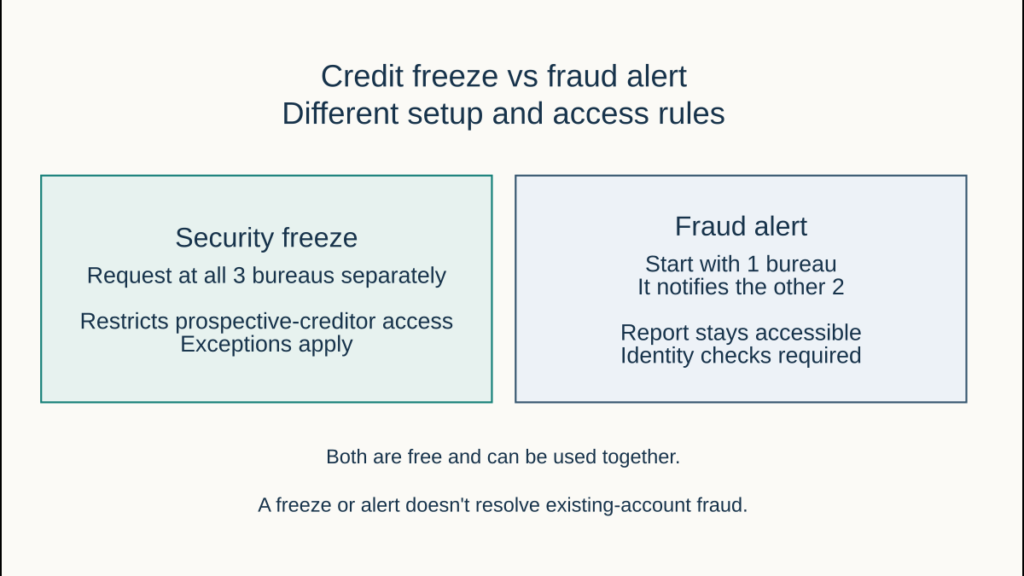
A credit freeze restricts prospective creditors’ access to your report, while a fraud alert leaves it available and requires identity checks before new credit is granted. In a credit freeze vs fraud alert decision, both options are free and can work together.
Request a freeze separately at all three nationwide bureaus, but start an alert with one bureau, which must notify the other two under the FTC’s freeze-and-alert guidance.
A completed request at one bureau doesn’t establish that you froze your reports at the others.
Credit freeze vs fraud alert: compare the access rule
A freeze can suit someone who wants to restrict new-credit access, even before identity theft occurs. You don’t need proof that somebody stole your identity to request one.
An initial alert is for someone who believes they are, or may become, a victim of identity theft. It leaves the report available to prospective creditors, who must take steps to verify the applicant’s identity before approving the request, although the verification method can differ from one application to another.
| Protection | Effect on prospective-creditor access | Where to start | Duration |
|---|---|---|---|
| Security freeze | Restricts access, subject to exceptions | Each of the three bureaus separately | Until you lift it |
| Initial fraud alert | Access remains, with identity-verification requirements | One bureau, which notifies the others | One year; renewable |
| Extended fraud alert | Access remains, with additional identity checks | One bureau, with the required identity-theft report | Seven years |
All three are free. The extended option is for identity-theft victims and requires an FTC identity theft report or a police report. A breach notification alone isn’t the same document. Check the current bureau instructions for submitting the required material.
TransUnion’s comparison describes how alerts and freezes operate together. If you use both, keep the alert’s expiration separate from any temporary freeze lift. Changing the freeze doesn’t give you evidence of a renewed alert.
Servicemembers also have an active-duty alert option. The CFPB describes that alert as lasting 12 months, with another available if deployment continues. Use the applicable military instructions rather than assuming an extended identity-theft alert is the same service.
Complete the bureau setup you actually chose
Use official bureau resources and select the security-freeze or fraud-alert service deliberately:
- Equifax credit report services, linked by the CFPB.
- Experian’s free security-freeze page.
- TransUnion’s credit-help center, with freeze and alert resources.
For a freeze, make a separate entry for each bureau and record the completed request with its date and reference, along with where you saved the confirmation so you can retrieve it later. Leave an unfinished bureau entry open until you resolve it.
For an alert, record the bureau that took the request and its confirmation. Keep your contact details current so identity verification can reach you, and calendar the actual expiration so you can decide whether to renew before relying on an old notice.
Check the product name before finishing
A security freeze and a credit lock are separate services. The CFPB’s freeze guidance explains that locks may come with paid products, while security freezes are free. You don’t need a monitoring subscription to obtain the free freeze.
Read the completed confirmation for the exact protection selected. If it names monitoring or a lock product, ask the bureau through its official support route whether you also completed the free security freeze you intended to place.
Keep credentials in a secure place. A planning checklist can use a short reference to the saved record without copying passwords or full identifiers into every note.
Plan a temporary lift around the lender’s actual need
Before applying for credit, ask which bureau or bureaus the lender needs and when it expects to check them, then use that answer to choose the relevant lift window. A freeze at a bureau the lender needs can interfere with your own application, too.
As a provider example, Experian’s freeze service lets users schedule a thaw with start and end dates and check freeze status through a free account. Follow the process at the bureau you need; don’t assume its confirmation covers another bureau.
- Freeze in place
- Keep the status for the particular bureau and date checked.
- Lift confirmed
- Save the actual bureau, start date and end date.
- Freeze restored
- Check its status when the intended window has ended.
Suppose a lender identifies Experian for an expected check. An Experian-only lift addresses that stated access need. If the lender later identifies Equifax as well, obtain the appropriate confirmation from Equifax separately. This example doesn’t predict which bureau any real lender will use.
When a check moves outside the original window, revisit the dates with the lender and bureau, then keep any revised confirmation with its actual start and end dates. The application’s pending status doesn’t extend the earlier lift.
If you withdraw the application, review any window still open. A withdrawal notice from the lender doesn’t document the bureau’s current freeze status.
Allow for receipt and processing
The CFPB lists these timing requirements for nationwide bureaus:
- Place a freeze within one business day of receiving a telephone or secure electronic request.
- Place it within three business days after receiving a mailed request.
- Remove or temporarily lift it within one hour of receiving a telephone or secure electronic request.
- Handle a mailed removal or temporary-lift request within three business days after receipt.
Leave practical time for identity verification and the lender’s own process. A completed thaw establishes access for the confirmed period; it doesn’t establish credit approval.
Keep existing-account fraud on its own track
A freeze targets access needed for new credit. It doesn’t prevent takeover or misuse of accounts you already have, and it doesn’t correct a fraudulent account already on a report.
If you find an unfamiliar charge on an existing card, contact the issuer’s security or fraud department and keep that transaction case reference separate from the bureau request history you use to manage report access.
For identity theft, follow the CFPB’s recovery guidance and report it at IdentityTheft.gov. The CFPB says that service supplies an Identity Theft Report and a recovery plan.
Use our free-credit-report routes to inspect unfamiliar accounts or inquiries. For a report error, the dispute guide explains how to keep evidence and track the response. Reporting identity theft and disputing an unrelated error require different facts and documentation.
A frozen file still has exceptions
You can review your own reports while a freeze is in place, and the freeze itself doesn’t change your credit scores. Existing creditors and some other entities can still access a frozen file.
The CFPB also says the federal security-freeze requirement doesn’t apply to report requests for employment, tenant-screening or insurance purposes. Avoid assuming every background check is blocked. Ask the requesting organization which report it needs before making an access change for that purpose.
For a planned credit application, finish by checking the status after the temporary window ends. Record that the relevant freeze is back in place, alongside the bureau and date checked. Keep the lender’s application outcome in a separate record so it can’t stand in for the protection-status check.
Sources
Checked November 3, 2026. This guide concerns U.S. nationwide credit-report protections; confirm the current bureau requirements for your request.


