Credit Repair Companies: 7 Warning Signs to Check
Check seven warning signs in a credit-repair offer, compare promises with documented tasks and act promptly on cancellation or suspected scams.
Estimated reading time: 8 minutes
Federal law bars a credit repair organization from charging or receiving payment for an agreed service before it has fully performed that service. That makes the payment clause one of the first things to read when comparing credit repair companies. A polished website tells you much less. Federal law on prohibited practices
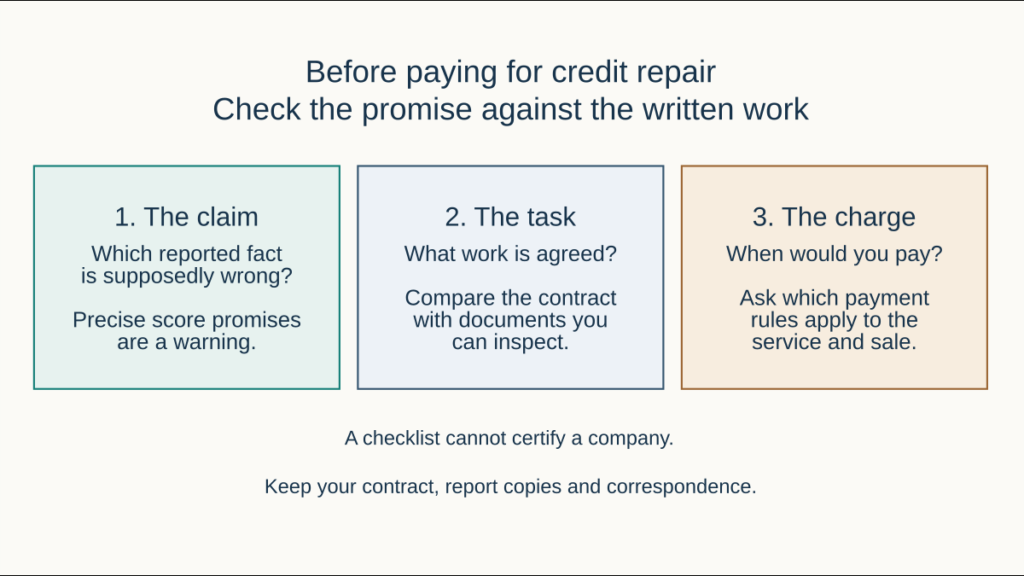
The harder question is what the company actually promises to do. Someone can help organize a dispute, yet still make misleading claims about the outcome. Before sharing documents or accepting a recurring charge, match the sales pitch to a specific task and its written terms.
Seven warning signs in a credit-repair offer
1. Payment comes before completed work
A setup fee deserves the same scrutiny as the main service charge. Ask which agreed service the fee pays for, when that service will be fully performed and what evidence will document completion. Renaming an advance payment does not settle whether it is permitted.
There are additional restrictions for credit repair sold through telemarketing covered by the Telemarketing Sales Rule. The CFPB says a seller cannot request payment until the represented service-completion period has expired and it provides a consumer report showing the promised results.
That report must have been generated more than six months after the results were claimed to have been achieved. This is a condition for covered sales, not a universal six-month clock starting at enrollment. CFPB payment guidance
Consider a hypothetical offer: $149 today for a 100-point increase within 30 days. Both the immediate charge and the precise outcome need scrutiny. Splitting that amount into monthly installments would not answer either concern.
2. The pitch promises a precise score increase
Treat a guaranteed point increase as a warning. So is a claim that accurate, current negative information can simply disappear. The CFPB identifies both as signs of possible deception. CFPB warning signs
A refund promise needs its own reading: who decides whether it applies, what records must you provide and which charges are excluded? Attractive refund wording does not establish that the underlying service is lawful or useful.
3. Accurate information supposedly has a paid removal option
An actual reporting error and an unwelcome fact are different problems. The FTC says credit repair companies cannot legally remove negative information that is accurate and current. Paying someone does not create that power. FTC credit-repair FAQs
Ask the seller to identify the exact field it believes is wrong, whether that means an account you do not recognize, an incorrect payment date or a balance that conflicts with the records. A response about removing everything avoids the factual question you need answered.
4. You are told to dispute facts you know are correct
Do not sign a statement just because the company describes it as standard paperwork. Read every assertion made in your name. Federal law prohibits specified false or misleading statements to reporting agencies and creditors, including advising consumers to make them. Federal law on prohibited practices
If a draft says an account is not yours when you recognize it, stop. Ask for a correction before anything goes out. You should be able to connect each disputed statement to a real uncertainty or supporting record.
5. A different identity is part of the plan
A seller may market a credit privacy number, or CPN, as a substitute for your Social Security number. Another version uses an employer identification number, or EIN, to hide an existing credit history. Florida’s consumer agency warns about these schemes. FDACS credit-repair scam guidance
Do not follow instructions to misstate identifying information on a credit application or falsely report identity theft. The FTC specifically warns about advice to lie or create a new credit identity. FTC credit-repair FAQs
An EIN has legitimate uses. Its existence does not make it a replacement identity for personal borrowing.
6. The contract leaves the service or cancellation terms unclear
The federal contract requirements give you something concrete to inspect. The written, dated contract must describe the services in detail, the payment terms and total payments, completion timing, any performance guarantees, and the organization’s name and principal business address. It must also include a prominent cancellation statement near the signature space. Federal contract requirements
Read those terms against what the salesperson said, especially if the contract only promises document preparation while the pitch assures you that particular accounts will disappear. Save the advertisement too.
You generally have a federal right to cancel without penalty or obligation before midnight of the third business day after signing. The cancellation provisions require notice forms and copies of the documents you sign. Follow the written-notice instructions promptly; do not assume that stopping a payment or making a phone call completes cancellation. Federal cancellation provisions
If the deadline is unclear, seek clarification immediately. Waiting for a promised callback can consume the time you have to act.
7. The company discourages direct contact with a credit bureau
The CFPB flags this tactic. You have the right to dispute reporting mistakes yourself without paying a repair company. CFPB consumer guidance
Keep your own report copies and correspondence. A paid helper should not become your only source of information about your own dispute.
Turn an impressive claim into a checkable task
Before considering a contract, choose one issue on the report and describe it in ordinary language. Avoid starting with a target score. The question is whether a particular reported fact matches the records.
The example below is hypothetical. It illustrates how to define a concern, not evidence that a bureau or creditor made an error.
- Reported field
- A card balance appears higher than the balance shown on the statement you saved.
- Evidence to compare
- The report’s balance-update date, the statement period and any payment record relevant to those dates.
- Task to describe
- Determine whether the figures refer to the same date; identify any specific reporting error before preparing a dispute.
The reporting date matters here because a statement dated later than the report’s balance update may describe a different moment, even when both documents are accurate. Gather the relevant dates before deciding what the mismatch means. An apparent difference deserves investigation; it does not automatically prove an error.
Then compare the proposed service with a deliverable you can inspect:
| Proposed service | Evidence to request | Question still unresolved |
|---|---|---|
| Review a reported balance | The field, reporting date and records compared | Does the difference reflect an error or different dates? |
| Prepare a dispute | A copy identifying the disputed fact and supporting documents | Is every assertion accurate before submission? |
| Track a response | The response and the updated report, if available | Was the factual concern actually resolved? |
This comparison helps you evaluate the work description. It does not certify the provider or authorize a fee at a particular time. Ask about payment compliance separately.
For a place to keep the issue, evidence and response together, use our credit-report dispute tracker. The FTC also explains that you can perform the lawful credit-repair steps yourself for little or no cost. FTC self-help guidance
If you already signed or paid
If you want to cancel, start with the date on your contract and read the cancellation notice now so you can send the required written notice within the applicable window. Save a dated copy and evidence of mailing or delivery. A cancellation request and an attempted payment reversal are separate actions; keep records of both.
Next, save the sales claims, signed terms, receipts and messages in one folder. Include the seller’s business name and the payment description shown on your statement. Record what happened while the details are fresh, using dates and the seller’s actual words where available.
For a suspected scam, contact the payment provider promptly to ask whether a remedy is available and what deadline applies. Recovery is not guaranteed. The FTC directs consumers to report credit-repair scams through ReportFraud.ftc.gov and to their state attorney general or consumer protection office. FTC reporting guidance
If your main difficulty is affording payments, describe that separately from a report error. A corrected field will not, by itself, settle the household budget. You can review credit-card hardship options before accepting a repair pitch aimed at a different problem.
For anyone who signed recently, the first useful check is the cancellation notice: find the deadline and delivery address before spending more time debating the sales promise.


